❌

Reading view

AI agents carried out every step of this ransomware attack – then left the victim an 80-page security audit

A human ransomware crook used frontier AI models to breach an enterprise network in less than 10 hours, an intrusion Unit 42 says would normally take human operators around two weeks. The human attacker then told negotiators that they used frontier models and agentic attack frameworks with AI agents carrying out each step in the intrusion, including leaving an 80-page security audit for the victim company. “What made the attack stand out was AI-assisted operational efficiency, without the need for a novel zero-day or super elite tradecraft,” Unit 42 incident responders said in a Wednesday report. “The attacker left tactical execution to AI agents that monitored, evaluated, acted and re-planned in real time, increasing speed throughout the attack chain.” The security shop did not immediately answer The Register’s questions about the intrusion, including which models and frameworks the attacker used. Breaking down the attack In a first step, the human attacker employed AI agents to perform reconnaissance, then gained access by breaching a public API endpoint to tunnel into the enterprise network. Upon breaking in, the attacker deployed an automated recon agent to map internal microservices. Additional subagents scraped code repositories to steal hard-coded tokens and service passwords. Using these tokens, the AI intruders accessed the org's secret-management system and stole the master administrative credentials to gain root system access. “Specialist pivot agents” then validated access to the company’s cloud, identity, CI/CD, container, and SaaS environments. The attacker also hijacked CI/CD workflows to steal cloud access keys and turn the victim’s cloud AI services into post-compromise infrastructure. This allowed the attacker to consume the victim’s compute resources while hiding orchestration traffic among legitimate activity. After achieving the human operator’s goals, an agent left the victim an 80-page report on its security failings, detailing “dozens of exploited findings,” the incident responders wrote. Not surprisingly, Palo Alto Networks says the only way defenders can protect their environments against machine-speed attacks is to use AI agents themselves. “Deploy automated playbooks that simultaneously revoke credentials, terminate OAuth sessions, freeze CI/CD pipelines and isolate cloud accounts across all operational planes,” the authors advise. The incident response team also suggests companies treat AI as core infrastructure. This requires taking inventory of every model endpoint, API key, Model Context Protocol (MCP) gateway, and AI tool integration, and applying rate limits and least-privilege policies – or risk an unexpected and very large token bill. ®

  •  

SonicWall's SMA1000 boxes under active attack again

SonicWall says attackers are actively exploiting two chained zero-days to take over Secure Mobile Access (SMA) Series 1000 boxes. Aimed at midsize and large enterprises, SMA1000 gateways secure remote access and VPN connections. Compromising one can therefore provide attackers with a valuable route into corporate networks. So, get to applying those hotfixes, says SonicWall. There are no workarounds. The first zero-day, CVE-2026-83548, is a pre-authentication server-side request forgery (SSRF) vulnerability with a maximum CVSS v3 score of 10.0. SonicWall attributed it to an unintended alternative access path. "A remote unauthenticated attacker could potentially exploit this vulnerability to gain unauthorized access to sensitive functionality and perform unauthorized operations," the vendor said. The second, CVE-2026-83549, is a post-authentication OS command injection vulnerability in the SMA1000 Appliance Management Console (AMC), rated 7.8 on CVSS v3. Under certain conditions, an attacker authenticated as an administrator could execute arbitrary commands on the appliance. The flaws affect the SMA 6210, 7210, and 8200v appliances, for which SonicWall has released hotfixes. SonicWall advised customers to contact its technical support team for help identifying indicators of compromise. If an appliance appears to have been compromised, SonicWall recommends reimaging or redeploying it, changing all passwords, and resetting TOTP tokens. NHS England, which published its own advisory, warned about the growing risk of attacks against internet-facing gateways. "Firewalls and other edge devices are internet-facing by design and are highly attractive targets to attackers, and there is an increasing number of edge device vulnerabilities disclosed each year that are rapidly exploited by attackers," it stated. "The NHS England National CSOC assesses future exploitation of these vulnerabilities as almost certain." The disclosures continue a difficult run for SonicWall and its SMA1000 product line stretching back through 2025. In July, the vendor disclosed an eerily similar pair of vulnerabilities. That pair also comprised a pre-authentication SSRF vulnerability, this time in the SMA1000 Appliance WorkPlace interface, and a post-authentication OS command injection flaw in the AMC. The SSRF received a maximum CVSS v3 score of 10.0, while the command injection bug was rated in the sevens. CISA later added CVE-2026-15409 to its Known Exploited Vulnerabilities catalog and marked it as known to have been used in ransomware campaigns. Throughout 2025, SonicWall patched a succession of SMA1000 vulnerabilities, including OS command injection and privilege escalation flaws, while investigating zero-days linked to ransomware attacks. ®

  •  

Is That TikTok Ad Legit? How to Spot Fake Ads on Social Media During Major Sales Events

Labor Day weekend means sales. And if you spend any time on Facebook, Instagram or TikTok, some of the biggest discounts may find you before you even start shopping.

That convenience comes with a catch: Not every deal in your feed is really from the brand it appears to be.

Scammers can create polished social media ads that impersonate familiar retailers, advertise steep discounts and send shoppers to convincing lookalike websites. According to the Federal Trade Commission, nearly 30% of people who reported losing money to a scam in 2025 said that it started on social media. And the reported losses hit a whopping $2.1 billion last year.

So before a Labor Day “80% off” deal stops your scroll, give it a second look.

How Fake Social Media Shopping Ads Work

A fake shopping ad often starts with something completely ordinary: a product you actually want.

Maybe it’s sneakers from a familiar brand. Patio furniture you’ve been researching. A handbag, grill or appliance marked down for Labor Day.

The ad may use the real company’s logo, product photography and branding. Click it, and the website can look remarkably similar to the retailer’s actual site.

That’s the trick.

This is a form of brand impersonation: A scammer copies the appearance of a company people already know and trust. Instead of convincing you to trust an unfamiliar store, the scammer borrows the reputation of a familiar one.

Sometimes these ads lead to completely fake storefronts. Other times shoppers receive counterfeit products, something dramatically different from what they ordered or nothing at all.

The FTC recently warned consumers specifically about social media ads advertising brand-name products at unusually low prices. And the problem isn’t limited to one platform. A convincing ad can reach you wherever you scroll.

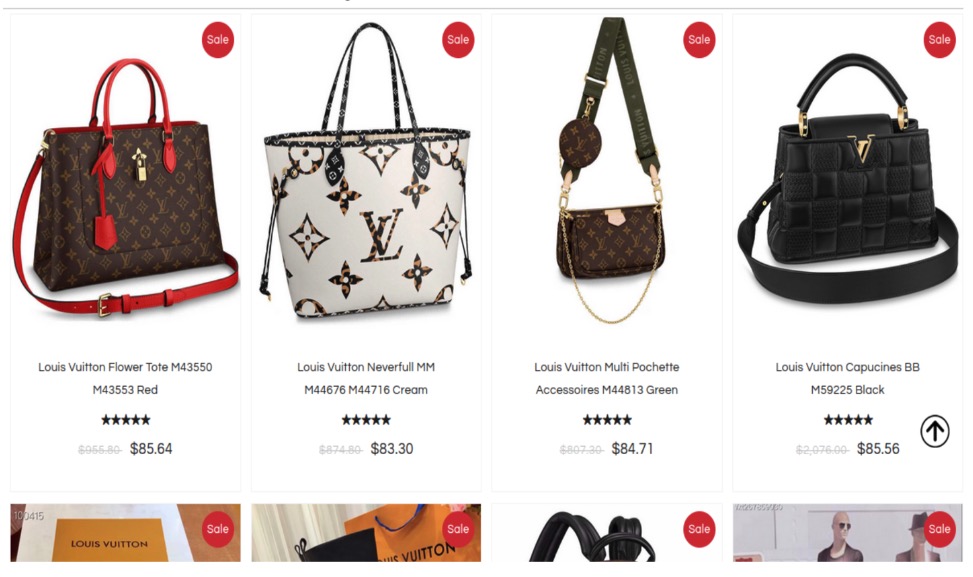
A scam shopping site that looks close to the real thing.
Here’s an example of a scam Louis Vuitton website previously detected by McAfee. Users get an ad on social media, and land on a realistic-looking shopping site. But it’s not the real vendor.

She Thought She Bought $800 Patio Chairs for $135

One shopper who shared her story with McAfee learned just how convincing these scams can be.

A few years ago, Jen was scrolling through Facebook when she spotted an ad for the exact Wayfair patio chairs she and her husband had been considering. Normally around $800, the chairs were advertised at 80% off — just $135 with free shipping.

She clicked.

The experience looked enough like Wayfair that she continued with the purchase, even though a few things started to feel strange. A new tab opened when she tried to buy the chairs. The checkout mentioned PayPal even though she was using her credit card. Then she learned the order would be shipping from China and could take six to 12 weeks.

When she checked her credit card, the charge wasn’t from Wayfair. It appeared in Chinese characters.

Weeks later, a package finally arrived.

It wasn’t a set of patio chairs. Inside the small package was a ceiling-fan chain with a cheap ring.

Her credit card company eventually reversed the charges. But the experience illustrates something important about fake shopping ads: You don’t necessarily land on an obviously fake website filled with misspellings and broken images. A scammer’s goal is to make the experience feel normal long enough for you to complete the purchase.

7 Signs a Social Media Ad or Shopping Site Could Be Fake

Before buying something you find through Facebook, Instagram, TikTok or another social platform, look for these warning signs:

1. The discount is dramatically better than everywhere else.
A legitimate sale can be generous. But if one ad offers a popular $800 product for $135 while reputable retailers are nowhere close, investigate before buying.

2. The website address doesn’t match the retailer.
A fake site can copy a logo much more easily than it can copy a company’s official domain. Look carefully for extra words, misspellings or unusual endings in the web address.

3. Clicking takes you somewhere unexpected.
Watch for redirects, new tabs or checkout pages on a different domain. A change doesn’t automatically mean fraud, but it’s a reason to verify where you are before entering payment information.

4. The checkout process feels off.
Pay attention when the payment method, merchant name or checkout experience doesn’t match what the site told you to expect.

5. There’s pressure to buy immediately.
Countdown timers and “only two left” warnings can push you to act before checking the seller. Urgency is useful to scammers because it shortens the time you spend thinking.

6. You can’t independently verify the sale.
Open a new browser window or the retailer’s official app and search for the product yourself. If the incredible sale exists only through the social ad, that’s a warning sign.

7. The merchant on your credit card doesn’t match the company you thought you paid.
Check the transaction after buying. An unfamiliar merchant name or unexpected international charge deserves immediate attention.

The Safest Way to Shop a Deal You See on Social Media

Here’s a simple safety checklist for Labor Day weekend:

✓ Leave the social app and find the retailer yourself. Don’t let the ad choose your destination.

✓ Compare the price elsewhere. A discount that’s wildly out of line with other retailers deserves extra scrutiny.

✓ Check the URL and merchant name. Make sure you’re dealing with the company you think you’re dealing with.

✓ Use a credit card when possible. And save screenshots, receipts and order confirmations in case you need to dispute the purchase.

What If You Already Bought Something From a Fake Ad?

Act quickly, but don’t panic.

Save screenshots of the ad, website, receipt and any emails or messages from the seller. Check your credit card or bank statement to see how the transaction appears.

If you believe the purchase was fraudulent, contact your card issuer or financial institution and explain what happened. Ask about disputing the transaction and whether your card information should be replaced.

If you created an account on the fake website and reused a password you use elsewhere, change that password anywhere you’ve used it. Unique passwords matter because a scammer who captures one password may try the same email-and-password combination on other accounts.

You can also report fraudulent ads to the social platform and report the scam to the FTC.

How McAfee Helps You Shop More Safely

Spotting every fake yourself is getting harder. Scammers can copy legitimate branding, product photos and storefront designs closely enough that a quick visual check isn’t always enough.

McAfee Scam Detector can help identify suspicious links, messages and websites and alert you when something may be a scam. Plus it has social media tools to help detect scams originating from your favorite platforms. That can provide another check when an attractive offer lands in a social message or sends you toward a questionable site.

Web Protection can also help warn you about risky websites as you browse, adding protection at the moment a convincing ad tries to move you away from the social platform and onto a malicious destination.

The goal isn’t to stop shopping the sales you see online. It’s to make sure the store getting your money is the store you intended to pay.

The post Is That TikTok Ad Legit? How to Spot Fake Ads on Social Media During Major Sales Events appeared first on McAfee Blog.

  •  

Legacy Lenovo login opens 5,000 Dropbox accounts to attackers

Dropbox has warned around 5,000 users that attackers compromised their accounts by abusing a legacy Lenovo login integration. In an email sent to affected customers, the cloud storage biz said attackers exploited an integration that allowed users to access Dropbox using Lenovo IDs. Dropbox blamed "an issue with Lenovo's email verification process," which allowed attackers to register Lenovo IDs using Dropbox users' email addresses and then access the corresponding storage accounts. It did not explain why the integration was allowed to grant access without requiring the user to enter a Dropbox password. The compromise lasted from August 4 to 21. Dropbox told Bloomberg that attackers accessed files belonging to fewer than a third of the affected users. Jameson Lopp, co-founder of Bitcoin security company Casa, said attackers attempted to access just one of his files, "IMPORTANT.rtf," which had been encrypted locally before it was uploaded to Dropbox. Sometimes, it pays to be a nerd. Dropbox confirmed the scale of the attack to Reuters and said none of the affected accounts had two-factor authentication (2FA) enabled. After discovering the breach, Dropbox said it "promptly expired all sessions logged in through Lenovo IDs" and "severed any link" between the affected accounts and Lenovo. In its email, the company advised affected users to change their Dropbox and personal email passwords and enable 2FA. Lenovo told Reuters that its customers were unaffected and that its investigation was continuing. The Register asked Dropbox and Lenovo for more information. ®

  •  

UK cyber bill targets AI users, not the vendors building it

The UK government has rejected proposals from members of the the House of Lords to bring AI vendors within the scope of the Cyber Security and Resilience (Network and Information Systems) Bill. Cybersecurity minister Baroness Lloyd of Effra argued that regulating AI vendors and frontier model developers through the bill would not prevent hostile actors from misusing their products. Addressing the Grand Committee on Tuesday, she said: "Bringing providers of AI services, those companies which are at the cutting edge of frontier AI development and their products, into the scope… would not address the harms that can be posed by some AI products and services, or specifically, it would not prevent their misuse by hostile actors." The minister said the UK was instead taking "firm action" to secure AI through other channels. These include supporting the AI Security Institute (AISI), which works with vendors to test the security of models before their release. Lloyd also pointed to the voluntary AI Cyber Security Code of Practice, which informed the first global AI cybersecurity standard, ETSI EN 304 223. "This demonstrates our global leadership and commitment to shaping international technical standards which go wider than some of the issues raised in this bill," she claimed. Members of the House of Lords - the upper house in UK parliament - offered numerous arguments for bringing AI within the bill's scope. They cited reports of rogue agentic behavior involving Anthropic and OpenAI, as well as Bill Gates' concerns that commercial incentives are pushing AI development forward without adequate safeguards. Lawmakers also questioned whether companies unable to prevent their agents from misbehaving should be trusted to follow voluntary ethical guidelines that they can rewrite at will. "Have we not learned from countless experiences before in online safety, privacy, and in AI itself that allowing tech companies to set and mark their own homework endangers the public and our national security?" asked Baroness Kidron, a Crossbench peer and campaigner for online safety and digital rights. Similarly, Lord Tarassenko, a Crossbench peer and veteran AI researcher, pointed to the recent open letter penned by OpenAI warning that there will soon come a time when AI-orchestrated cyberattacks will become too prevalent to handle. Although the letter was criticized for employing alarmist language while carrying the signatures of companies that profit from AI, peers argued that its warning strengthened the case for regulatory intervention. Kidron and Lloyd also clashed after the minister used a hypothetical healthcare organization to illustrate how the bill would require regulated bodies to secure systems containing AI. Kidron asked: "If I might ask the noble Lady, the Minister, if I've understood what she said, the NHS must protect itself, but the AI that is attacking it has no requirement under the Bill, no duties, no obligations under the Bill to check itself before it's used in these ways." Lloyd said the bill was designed to be technology-agnostic and to impose stricter cybersecurity requirements on key organizations, rather than regulate individual technology providers. She nevertheless said the government was willing to continue discussing AI after Kidron predicted that the issue would return during later stages of the bill's passage. The minister rejected several other amendments, including one that would require certain AI vendors to demonstrate that their products could not cross specified red lines, such as evading human oversight or assisting with the development of chemical weapons. She also dismissed a proposal that would give the Secretary of State last-resort powers to order the shutdown of a datacenter or widely deployed AI system during a security or operational emergency. Lloyd said the bill would instead allow the government to direct regulated entities, including datacenter operators but not AI vendors, to take or cease specified actions when their systems presented a qualifying risk. A power station could, for example, be instructed to stop using a particular AI model. "We believe this is a more proportionate and effective response, as datacenters operate in highly complex ecosystems and AI systems are often distributed across different datacenters and jurisdictions," said Baroness Lloyd. "It's much less desirable to direct multiple datacenters to shut down, and the impact this could have on services that rely on them, than to direct them to cease using an AI model." Despite rejecting the amendments, Lloyd said the government remained willing to discuss AI regulation because of the technology's economic significance. The Grand Committee is scheduled to resume discussions of the CSR Bill when it reconvenes on Thursday. The bill's background The CSR Bill was first proposed in the 2024 King's Speech and introduced in Parliament in November 2025. It attracted attention over the £100,000 daily fines initially proposed for in-scope organizations that failed to protect against specific threats. The legislation builds on the existing categories of operators of essential services and relevant digital service providers while extending the regime to organizations including managed service providers, datacenter operators, and designated critical suppliers. Managed service providers were previously due to be brought within scope through the abandoned 2022 update to the NIS regulations. The broad intention of the bill is to update the NIS 2018 regulations and future-proof the UK's critical infrastructure from cyber threats. However, this week's Grand Committee scrutiny is not the first time the bill has been criticized. In January, shadow deputy PM Sir Oliver Dowden called on the government to rethink its exclusion of local and central government from the CSR bill. The UK's Government Cyber Action Plan, launched hours before the former digital secretary's remarks, promised to hold government to the same standards proposed in the CSR Bill. Like the AI Cyber Security Code of Practice, the action plan lacks any legal obligations. ®

  •  

Another Artifactory CVE under attack by AI agents or humans

Security researchers reported that someone is exploiting CVE-2026-82329, a critical JFrog Artifactory authentication-bypass bug, just days after the vendor patched the 9.8-rated flaw. And we don't know if that someone is human. Artifactory is a widely used tool for managing software artifacts, packages, binaries, and AI models. It’s also popular with AI agents that go rogue and need to communicate with each other while remaining undetected by their human babysitters. In July, OpenAI and JFrog revealed that OpenAI’s models broke out of their cages to hack Hugging Face by exploiting Artifactory zero-days, and at Black Hat, the model provider said agents used Artifactory to build message boards and help each other access the open internet. JFrog disclosed CVE-2026-82329 on Friday, and by Tuesday, attackers had already begun exploiting internet-exposed systems, according to exposure-management biz watchTowr’s threat-intel team, which reported “attackers minting themselves admin tokens.” In addition to creating new administrative credentials, watchTowr’s honeypot network caught miscreants “enumerating users, groups, credential sets and federated access topologies,” Yordan Ganchev, principal threat intelligence specialist at watchTowr, told The Register. “Right now, we’re observing exploitation from a small number of IP addresses from varying geographies exploiting multiple of our honeypots,” Ganchev said. “Broad-scale scanning and mass exploitation has not been observed, but that is unlikely to stay the case for long.” Ganchev urged organizations running vulnerable versions to “urgently patch” internet-exposed systems, and treat them as being potentially compromised - so inspect audit logs, rotate credentials, and investigate connected systems for any unusual changes or backdoor implants. “When attackers gain admin level access to a central software supply chain system, they can do what every engineering team does best - build, ship and distribute software fast,” he said. “From there, they could tamper with build pipelines, move laterally into production systems and potentially push malicious changes downstream to customers.” JFrog did not immediately respond to The Register’s inquiries. We will update this story when we receive any response. ®

  •  

Attacker stole a METR API key, used $600K worth of credits, and no one noticed for weeks

AI model testing organization METR has disclosed two attacks that happened earlier this year, including one in which an attacker stole an API key and spent three weeks consuming public-model credits worth about $600,000. METR (short for Model Evaluation and Threat Research) found no evidence that the attackers accessed sensitive information in either incident, and the org said it investigated both with security experts. METR researchers worked with OpenAI to investigate how its agents hacked Hugging Face, and on Monday, it disclosed two of its own security snafus. “In March 2026, attackers stole an API key for inference on public models and consumed a substantial amount of credits,” the nonprofit disclosed in a Monday report. “In May 2026, we observed attackers systematically probing our publicly accessible infrastructure, including an unsuccessful attempt to access internal data via an inadvertently exposed endpoint.” From fail-open bug to model-credit theft The March incident involved a METR researcher who didn’t have access to sensitive information - including model data and credentials, as well as information about model architectures, training, and release dates. The researcher used agents running on a personal EC2 instance that was “intentionally” left publicly accessible behind Google authentication. The instance contained an API key for METR’s public models account. According to METR’s account, a “vibe-coded app” included a fail-open bug that disabled authentication, and this exposed the system to the public internet for several days. “We suspect that the attacker found the instance by looking through recently-registered websites (e.g. in certificate transparency lists) to find vibe-coded sites with high-signal keywords relating to LLMs or agents, for purposes of harvesting potentially exposed model provider API keys,” the AI research org wrote. Once the attacker found the app, they prompted an agent to reveal its model provider API key, then added an SSH key to maintain persistent access, and over the next three weeks used the stolen credentials to consume API credits on public models worth about $600,000. Luckily for METR, the unnamed model developer had given the credits to the nonprofit for free. How do you not notice the 'large illicit usage?' METR does answer the question on everyone’s mind in the report: Why its researchers didn’t notice the “large illicit usage?” There are several reasons for this. First, the model testing operation regularly runs evaluations that use a lot of tokens, and this means the organization is “very acclimated to getting lots of weird rate limit and API errors.” So the high usage didn’t look that out of the ordinary. Plus, since the tokens were free, METR didn’t accrue a large bill, and at the time there was no way to put a spending limit on keys like the one that was stolen. In response to the March incident, METR says it improved its security infrastructure, protocols, and review process, and will continue to invest in security. To this end, it also hired a security lead, and plans to add more security staff. Crims used agents to try to access frontier models The second incident happened in early May, when “METR became the target of a sustained external attack campaign.” After being “tipped off” that attackers who appeared financially motivated may have been trying to gain illicit access to frontier models, METR watched the intruders probe its publicly accessible infrastructure. They also used agents to find ways to gain initial access, including automated vulnerability discovery, credential stuffing against authentication providers, attempting OAuth token grants, scanning newly deployed services, and phishing attempts. At the same time, METR unintentionally “exposed a read-only SQL query mechanism via our public transcript viewer.” While queries were scoped to public data by default, a bug allowed access to unpublished evaluation data, and “some sensitive model data was accidentally included in this database.” However, there’s no evidence that the attacker found the exploit or accessed any non-public data, according to the model testing body. An independent bug hunter discovered the vulnerability and reported it to METR, which paid the researcher a bounty, and took the API offline. In response, METR says it now uses an isolated production environment for public-facing applications that is separate from its internal infrastructure.®

  •  

Firefox helps iPhone users bypass ads on web sites while making money showing its own ads

After several weeks of anticipation, Mozilla has started rolling out ad blocking to the iOS version of its popular browser, but you can still expect to see ads on Mozilla's own pages, including the new tab page. The org officially rolled out the new native ad blocking feature for iOS Firefox on Tuesday, moving it out of the experimental phase, while explaining that it had to rethink its desire to give users control over their web experience on iOS due to differences in architecture between it and other OSes. “Firefox already supports a strong ecosystem of ad-blocking and privacy extensions,” Mozilla explained. iOS works differently, though, as Apple forces all web browsers on iOS to use its own WebKit to render sites instead of their own preferred back end. “Bringing ad blocking to Firefox on iOS,” therefore, “meant building it directly into the browser,” Mozilla explained. Implementing ad blocking in the iOS version of Firefox meant incorporating Apple’s own WebKit Content Blockers. According to Apple’s introduction on the topic, it specifically doesn’t want app extensions to be used to block web content because of how they operate. “App extensions … are essentially little sandboxed applications that are launched on demand to extend some specific piece of functionality,” Apple notes. “JavaScript-based content blocking extensions … have significant performance drawbacks.” Apple complains that traditional ad blockers use too much energy, increase page load time, and eat up memory, all of which it wants to protect iOS users from. Apple describes WebKit Content Blocking as “describing content blocking rules in a structured format ahead-of-time, declaratively.” Apple Web Content Blockers instead live in bytecode format that executes for each resource request, modifying requests or injecting CSS changes as needed while pages are loaded. For Mozilla, that basically means dropping the EasyList filter, originally designed for the classic Adblock blocker, into a JSON file and passing it to WebKit. Easy peasy. Ad blocking in Firefox for iOS is off by default. Turning it on, if it’s available for you – it’s rolling out gradually – is as easy as opening the in-app settings menu, tapping on Browsing, and toggling the Ad Blocker field on. Mozilla told The Register in an email that it doesn't have a timeline for general release to all Firefox users on iOS, which it said will largely depend on how well the initial rollout goes. You also have to turn Remote Improvements on, as the feature allows Mozilla to push fixes and feature changes to Firefox between full releases. Toggling that on has traditionally meant you also had to allow Mozilla to collect browser telemetry, but that was changed in February when Firefox 148 was released and the two features have officially been decoupled. Once on, iOS Firefox Adblocking will take care of ad-related trackers, ads from third-party advertising networks, third-party ads served by websites, and popups/overlays. What it won’t do, however, is take care of ads on search result pages or sponsored content on Firefox’s home or new tab page – after all, you wouldn’t want Mozilla to lose those precious ad bucks, would you? Firefox iOS ad blocking also won’t eliminate ads served directly by websites, and the company warns that it still might not work in all places, which is pretty common for ad blockers. For Firefox users who want browser consistency across platforms, it’s likely a welcomed announcement, though it begs the question whether Mozilla is considering integrating its own ad blocking technology in the desktop or Android versions of its browser. Fortunately for those making ad-blocking extensions, and those who love them, Mozilla says it has no plans to expand built-in adblocking outside iOS. "We value that ecosystem and will continue to support it," Mozilla told us. ®

  •  

33-hour BGP hijack of Softaculous traffic prompts security scramble

Softaculous and Virtualizor customers are being urged to reset credentials and inspect their servers after a 33-hour BGP hijacking incident diverted traffic and delivered malware to a handful of installations. Softaculous makes software for the web hosting industry, while its Virtualizor control panel is used by providers and administrators to deploy and manage virtual private servers. Beginning at around 20:57 UTC on August 28, an unrelated network began announcing a block of Hetzner IP addresses used by Softaculous, diverting some traffic intended for the vendor's systems to an attacker-controlled server. German hosting provider Hetzner is one of Softaculous's upstream infrastructure providers. The affected addresses served "a number of Softaculous systems," including Virtualizor's software update endpoint and Softaculous's client and billing site. The attacker pulled off the BGP hijack by announcing a more specific IP address range than Hetzner normally advertised. Under standard BGP route selection, the more specific route took precedence wherever it was accepted. According to Softaculous, the attacker was also able to secure a valid TLS certificate from Let's Encrypt because the certificate authority's automated domain-ownership validation was routed through the hijack too. This allowed affected connections to reach the attacker's server without triggering the certificate warnings that might otherwise have alerted users. According to the vendor's timeline, the unauthorized route was initially "accepted by essentially every internet vantage point that receives it," although it flapped repeatedly rather than remaining continuously available. Softaculous said it reported the issues to Hetzner at around 08:50 UTC on August 29. The hosting provider began directly announcing the same, more-specific address range, cutting the observed diversion to almost zero for roughly 11 hours. The unauthorized announcement returned at around 20:00 UTC and was again widely accepted, beginning a second wave that lasted roughly ten hours. The route was withdrawn between 05:50 and 06:10 UTC on August 30, after which normal routing was restored globally. While either wave was active, Softaculous estimates that a given server had roughly a 72 percent chance of being on a network that routed the affected address range through the attacker. The figure is based on the proportion of RIPE routing collector peers carrying the hijacked route, not the volume of traffic intercepted, the vendor said. Anyone who logged into the Softaculous client area during the incident window is advised to reset that password immediately, as well as anywhere else it was reused. Customers who entered card details during the same window should also review their statements. Softaculous said it does not process cards on its own servers and instead uses payment gateways, but an affected session may have been diverted before reaching them. More seriously, the vendor confirmed that a malicious Virtualizor update package was delivered to a handful of installations whose update checks passed through the attacker's server. "Our product update clients did not yet cryptographically verify update packages, so a modified package would not have been rejected on that basis." Because those downloads never reached its own logs, Softaculous said it "cannot produce a definitive list" of affected installations. It is therefore telling every Virtualizor operator to treat their server as in scope for checks – not necessarily as compromised. Softaculous did not describe the malware's capabilities, but identified a systemd unit at /etc/systemd/system/java-jre-update.service as an indicator of compromise. Operators that find it are advised not to delete it immediately, but to contact the vendor so evidence can be preserved. The vendor has not identified malicious packages targeting Backuply, Softaculous, SitePad, Webuzo, or its other products, although its investigation continues. Virtualizor operators should rotate and restrict their API credentials, check for unknown SSH keys and accounts, inspect scheduled tasks and outbound connections, and regenerate client-area API keys. Softaculous is also invalidating client-area sessions created during the incident window. Softaculous did not disclose how many customers downloaded the malicious update or may have handed credentials to the attacker. It said only that the confirmed infections amounted to "a handful of servers rather than the general Virtualizor user base." ®

  •  

Attack hides malware in PNGs and drops custom reverse tunnel on victims' machines

An unknown miscreant is using "TerminalFix" to trick unsuspecting users into running PowerShell commands that infect their computers with a reverse tunnel granting attackers access to their networks. Some of the malware is even hidden inside PNG graphics the PC downloads. TerminalFix is the latest variant of the wildly popular ClickFix initial access method for attackers. This type of social engineering technique tricks users into running malicious commands by promoting them with a phony fix or CAPTCHA verification. While traditional ClickFix attacks point victims to the Windows Run dialog, TerminalFix directs users to Windows Terminal or PowerShell, which increases the likelihood that they will unknowingly run multi-line scripts on their own computers, Redmond says. Plus, instead of delivering just one infostealer, this campaign kicks off a multi-stage attack chain that combines DLL sideloading, steganographic payload extraction, and Active Directory reconnaissance. It ultimately deploys a custom reverse tunnel on the infected machine that gives the attacker persistent, network-level proxy access through the compromised device. Microsoft declined to answer The Register’s questions, including how many organizations were targeted and victimized in this TerminalFix campaign, and which attacker or criminal crew is responsible for these attacks. The attack chain begins when the victim interacts with a phony overlay that spoofs the Cloudflare CAPTCHA “verify you are human” checkbox and includes a Cloudflare logo, causing a fake verification command to be copied to the clipboard before the victim pastes it into Windows Terminal or PowerShell. This command runs a hidden PowerShell script that prints a fake “Starting Cloudflare verification…” message and downloads a ZIP archive from an attacker-controlled server. It extracts the archive under C:\ProgramData and launches a batch file (1.bat) that silently executes LockScreenContentServer.exe. LockScreenContentServer.exe is a legitimate, signed Windows executable - and it acts as the DLL sideloading host for a second file: dui70.dll. This purports to be a “Windows DirectUI Engine,” but is actually the malicious payload, which executes a second-stage PowerShell script once it’s sideloaded. The second PowerShell script downloads additional payloads hidden inside PNG images - this is called steganography, and it makes file- and content-type inspection more difficult, and thus easier to hide malicious payloads. In an attempt to further obfuscate the payload and avoid being detected, the attacker split the payload into multiple PNGs. The PowerShell script downloads the three images, extracts an executable from the first image and two halves of the DLL from the second and third images, and then reassembles the components on disk. “After extraction, the source images are deleted to reduce forensic artifacts,” Microsoft researchers Sagar Patil, Suriyaraj Natarajan, and Parasharan Raghavan wrote. The malware establishes redundant persistence through both HKCU\…\Run registry keys and scheduled tasks that re-execute LockScreenContentServer.exe every 60 minutes to ensure it survives reboots. It then does reconnaissance on the compromised machine, scooping up system information across multiple language configurations including English, Spanish, and German. It also performs domain trust discovery, domain admin enumeration, and Active Directory user and computer searches, while pinging targeted, named servers. “The observed names correspond to common infrastructure roles, including domain controllers, databases, backup, gateways, and mail systems,” according to the threat hunters. “This probing could help an attacker identify accessible target systems for follow-on activity.” Next, the malware drops a persistent PowerShell file-watch loop that monitors a text file for new commands, executes them via Invoke-Expression, and writes results to an output file. This allows the attacker to execute additional PowerShell commands by writing them to the text file. And finally, the attacker deploys a custom, Python-based reverse-tunnel implant. The tunnel launches with no visible window via pythonw.exe, and it sets up a reverse WebSocket tunnel to gitnow[.]dev:443. This implant, combined with earlier reconnaissance data, gives the attacker SOCKS-style TCP proxy access through the victim’s network. Microsoft recommends organizations take several steps to avoid becoming a victim of this campaign. These include restricting PowerShell and Run dialog execution, and either blocking or auditing the Windows Run dialog (Win+R) if it’s not needed for daily work. Also, train employees on how to look for ClickFix tactics, like fake CAPTCHA verification pages that tell them to paste commands into Terminal or the Run dialog. ®

  •  

Anthropic cracks down on hijacked user accounts mining AI tokens

Rather than paying for their own Claude usage, crims are using malware to steal access to other people's accounts. Aware of this issue, Anthropic has signed at least one affected user out and removed the saved payment method to stop stolen sessions being abused. According to an email shared by Reddit user WorriedAssociate7029, who sent a copy to The Register, Anthropic has been keeping an eye on a threat actor using infostealer malware to hijack Claude login details, session cookies, and other info needed to subvert multifactor authentication on user accounts. Once obtained, the miscreant is using the stolen information to use premium Claude services without having to pay the bill themselves. Fortunately for WorriedAssociate7029, Anthropic logged the user out of their account and deleted their stored payment method because it had detected evidence of attempted fraud. “A few days ago, my social media accounts were hacked,” WorriedAssociate said, adding that they'd managed to track the malware down with the help of Claude Opus 5 Max and, they believe, cleaned the system. “But last night I received this email from Anthropic warning me of an attempt to steal tokens via the API.” They explained that the attempt failed, apparently thanks to Anthropic spotting it, but they realized that meant that the cybercriminal behind the incident seemed to have hijacked Google account credentials, cookies, and session IDs as well, since that’s how they were signed into Claude. After changing their password again and removing all active sessions, it appears they are now safe. Who’s eating your cookies? Anthropic made clear in the email that the credential theft wave it’s identified has nothing to do with Claude itself, nor is it some sort of fancy, new-fangled, agentic AI malware that’s being used to create a base of accounts for bad actors to abuse. This is just good old-fashioned infostealer malware being turned to a new purpose, the email explains. “We have no reason to believe that this malware is related to Claude, installed through Claude, or related to anything you did with Claude,” the email forwarded to us by WorriedAssociate and posted to Reddit stated. “Your Claude session was likely one of the many things it collected. It appears that a bad actor has now started picking the Claude sessions out of what it collected and using them.” In this case, it’s well-known infostealing malware too: Vidar, LummaC2, StealC, RedLine, Acreed, and Atomic Stealer have all been fingered by Anthropic as being used to steal Claude credentials, sessions, and cookies. As for WorriedAssociate, they copped to making a noob mistake that led to their infection. “I got fooled like a rookie by downloading a cracked game,” they admitted in a comment on their post. “Never again.” As in their post, WorriedAssociate told us in a chat that they gave credit to Anthropic for cluing them in to the fact that they hadn’t fully secured their accounts, and said they appreciated what the company did to help lock their Claude account down. “There have been several cases on Reddit in the past of accounts being hacked to steal tokens, and Anthropic’s customer service seems pretty dreadful when it comes to refunds and account recovery,” they told us. “This email appears to be new, and measures have finally been put in place to protect AI users.” “Tokens are valuable and can be resold,” WorriedAssociate added. So let this be a lesson: Providers might not catch every case of account theft, and AI accounts are the new hotness. Don’t let your tokens be burned by someone else - they’re expensive and the last thing you want them to be used for is someone else's work. ®

  •  

Turns out Brits would quite like their private messages to stay private

Brits have delivered a fairly unambiguous verdict on giving the government access to their encrypted messages: no, thanks. New polling commissioned by the Center for Democracy & Technology (CDT) found that 93 percent of British adults believe they have a right to private conversations online, while 89 percent think nobody should be able to access their personal messages without a court order. Perhaps more awkwardly for Westminster, two-thirds said they would not trust either the current government or any future one with the power to access encrypted messages. That distrust crosses political lines. Among people who voted in the 2024 general election, 58 percent of Labour voters said they wouldn't trust any government with the power, alongside 59 percent of Conservatives, 56 percent of Liberal Democrats, 69 percent of Greens and 75 percent of Reform voters. Public First did the asking, polling 2,000 British adults for CDT in April and weighting the results to reflect the wider population. The margin of error is 2.2 percentage points. The findings land as the UK government's appetite for slurping encrypted data continues to collide with the tech industry's insistence that encryption works best when nobody has a spare key lying around. That fight became particularly public when Apple withdrew Advanced Data Protection from UK users after receiving a secret Technical Capability Notice (TCN) under the Investigatory Powers Act. Apple challenged the order, and while the US government later said Britain had withdrawn its demand for access to Americans' encrypted data, reports have since suggested another TCN was issued focusing on British users. Despite the international row, 55 percent of those polled hadn't heard about the Apple notice at all. Once presented with the idea, enthusiasm remained thin. Just 12 percent backed the government being able to secretly order companies to provide access to users' information while preventing those companies from revealing the order. A third said the government shouldn't have that power at all, while another 41 percent wanted greater transparency or parliamentary oversight. Nor were respondents particularly sold on sacrificing security for law enforcement. 53 percent said the security risks of accessing encrypted messages outweighed the benefits, compared with 28 percent who thought the benefits came out on top. The reasons will sound familiar to anyone who has followed the encryption debate for more than five minutes. 84 percent worried that mechanisms allowing access to encrypted messages could introduce vulnerabilities for hackers and criminals, while 82 percent were concerned the powers could be abused. Knowing someone might be watching could also change how people behave. 65 percent said they'd become more cautious about what they liked, shared or commented on, while 41 percent said they'd self-censor criticism of public institutions or government officials. CDT is not a disinterested observer: the digital rights group campaigns for strong encryption and commissioned the research as part of that work. The polling itself, however, was carried out independently. Commenting on the research, Jim Killock, executive director of Open Rights Group, said: “The British public instinctively know that being able to communicate privately is crucial to our individuality and to the survival of a free and open society. “The government persists with the myth that it can weaken encryption to target the bad guys only. Attacks on the security of our phones, security tools and messaging apps harm us all and make our democracy weaker.” None of this is likely to end Westminster's long-running pursuit of encrypted communications. But if ministers were hoping the public was enthusiastically behind them, the numbers suggest otherwise. ®

  •  

Airport Wi-Fi Data Breach Exposes Millions of Travelers: This Week in Scams

Free airport Wi-Fi can be useful when you’re waiting for a flight. But this week’s biggest security story is a reminder that there are two different ways your information can be exposed when you connect.

One risk happens while your information is traveling across a public network. Another happens after a company collects and stores information about you.

A cyberattack affecting three major UK airports illustrates the difference, and why travelers need protection for both.

What happened in the Manchester Airports Group cyberattack?

Manchester Airports Group, or MAG, confirmed that an unauthorized third party obtained customer information connected with Manchester Airport, London Stansted Airport, and East Midlands Airport.

According to reports, the affected information came from car park, airport lounge, Fast Track bookings, and airport Wi-Fi registrations. MAG says the stolen data includes email addresses, phone numbers, vehicle registration numbers, and postcodes. The company says the affected system did not contain customers’ payment or banking details.

The Telegraph reported that approximately 8.7 million passengers were affected and that more than 90% of the stolen records were email addresses, largely because travelers provide an email address when registering for free airport Wi-Fi. The attackers reportedly demanded a ransom, which MAG declined to pay.

MAG says airport operations and passenger safety were not affected and that it has contained access to the compromised systems.

For travelers, however, the breach creates another concern: what criminals might do with the stolen information next.

Why stolen airport data can lead to convincing scams

An email address alone might not seem particularly sensitive. But combined with a phone number, postcode, vehicle registration, or knowledge that someone has interacted with a particular airport, it becomes more useful to a scammer.

That information can help criminals make phishing emails and texts feel believable.

A message might claim there is a problem with your airport parking reservation, ask you to confirm a Fast Track booking, or say you need to pay an outstanding airport charge. Someone who recently used the airport may be much more inclined to click.

That is one reason breach victims should be especially cautious about unexpected messages that appear connected to the organization involved.

Does a VPN protect you from an airport Wi-Fi data breach?

Not from this kind of breach.

A VPN, or virtual private network, encrypts the internet traffic traveling between your device and the VPN service. Think of it as putting your online activity inside a protected tunnel while it crosses a public network.

That matters at airports, hotels, cafés, and other places where many people share the same Wi-Fi. McAfee Secure VPN can encrypt your connection and can be configured to turn on automatically when you join an unsecured network.

But that is different from what happened here.

If you voluntarily give an airport your email address to register for Wi-Fi, that email address may then be stored in the airport operator’s systems. A VPN cannot prevent a later breach of that company’s database.

In short: A VPN helps protect information in transit. It does not control what happens to information you give directly to a company.

Both risks matter.

Before, During, and After a Data Breach

Before a breach: Share only the information a service genuinely requires. Use strong, unique passwords for online accounts, and use a VPN when connecting to public Wi-Fi.

During a breach: Look for information directly from the affected company rather than relying on messages arriving by email or text. Criminals often take advantage of security incidents by sending fake “account protection” or “verify your information” messages.

After a breach: Watch for unusual emails, calls, texts, and account activity. Be particularly suspicious when someone creates urgency or asks for passwords, verification codes, payment information, or money.

MAG specifically warns that it will not unexpectedly contact customers asking for payment card information, banking details, or passwords.

At a Glance

➡ The breach affected customer information from bookings and airport Wi-Fi registrations.

➡ 8.7 million passengers were affected

➡ MAG says banking and payment details were not stored in the affected system.

➡ Stolen contact information can still make phishing and impersonation scams more convincing.

➡ A VPN protects your connection on public Wi-Fi, but it cannot prevent a company from later suffering a database breach.

➡ Be particularly cautious about unexpected airport-related emails and texts following the incident.

How McAfee Helps

Secure VPN helps address the other major risk associated with airport Wi-Fi: someone attempting to monitor your traffic while you use an unsecured network. McAfee Secure VPN encrypts your connection and can automatically activate on unsecured Wi-Fi, helping keep browsing activity and information transmitted from your device private.

Identity Monitoring keeps watch for your personal information associated with breaches, giving you an opportunity to act when exposed information is detected.

And because stolen email addresses and phone numbers can fuel follow-up phishing attempts, Scam Detector can identify suspicious texts, emails, and other QR codes before you act on them.
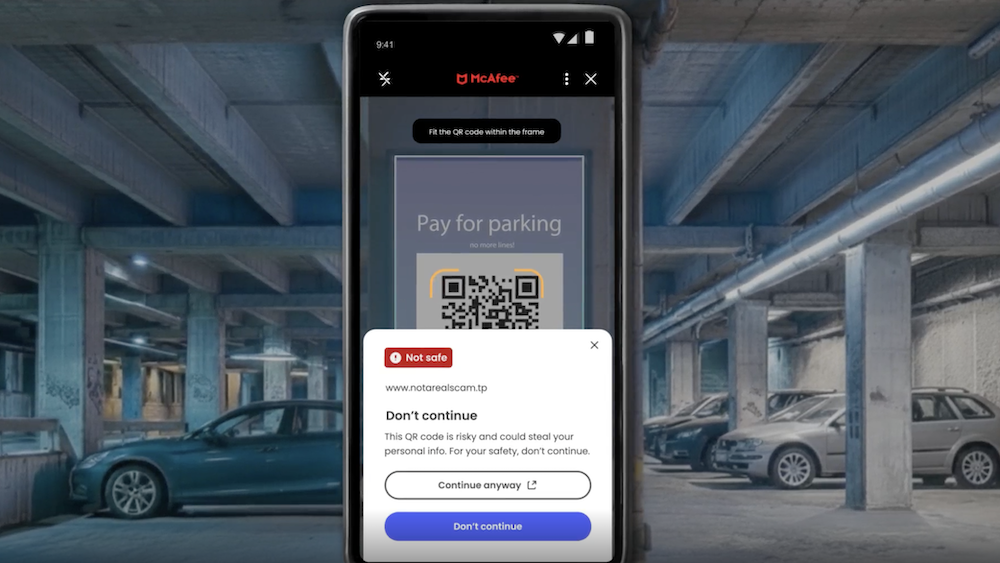
QR Scan Example

The broader lesson is layered protection: protect your connection while you’re online, then keep watching for misuse of information that companies already hold.

Other Scam and Security News This Week

Hackers claim breach of major data center provider. The ShinyHunters group claims it stole extensive corporate and employee information from U.S. data center company CyrusOne and demanded $13 million.

CyrusOne had not publicly confirmed the hackers’ claims when TechRadar reported the story, so the alleged scale of the breach remains unverified.
Source: TechRadar

Man accused of posing as a 49ers player in $1.3 million romance scam. Federal prosecutors allege that two men defrauded at least 26 women after one portrayed himself online as a wealthy San Francisco 49ers player and the other posed as his financial adviser.

Investigators say fake banking apps and fabricated investment balances helped make the scheme appear legitimate; both defendants are presumed innocent unless proven guilty.
Source: U.S. Department of Justice

Fake sports streams target fans looking for the game. The Better Business Bureau warns that scammers post supposed free streaming links on social media, sometimes tagging real schools or teams, then direct fans to sites designed to collect payment or personal information instead of showing a game.

Go to the team, school, league, or known streaming provider directly rather than trusting a link in a social post — and remember that HTTPS alone does not prove a website is legitimate.
Source: Better Business Bureau

This Week’s Safety Tips

“Once you give your information to a company, you can’t completely control what happens to it,” says McAfee’s Tyler McGee. “But you can limit what you share and take steps to protect yourself if your information is exposed.”

“Only provide what’s needed, use unique passwords and turn on multi-factor authentication where you can. Tools like McAfee’s identity monitoring can also alert you if your information shows up in a known breach. And be extra cautious after a breach,” he says. “Scammers can use exposed information to make messages about a booking, refund or account look much more convincing. If you get one, go directly to the company’s website or app rather than clicking the link.”

✓ Use a VPN on public Wi-Fi. Encrypt your connection before checking email, shopping, banking, or signing into important accounts.

✓ Treat breach-related messages cautiously. Navigate to the company’s official website yourself rather than clicking a link in an unexpected email or text.

✓ Use unique passwords. A password stolen from one service should never unlock another account.

✓ Verify before sending money. Whether someone claims to be an athlete, investment adviser, streaming provider, or familiar company, independently confirm who you are dealing with.

And we’ll be back next week with more cybersecurity news and scam alerts.

The post Airport Wi-Fi Data Breach Exposes Millions of Travelers: This Week in Scams appeared first on McAfee Blog.

  •  

US government snitch-finder pleads guilty to leaking state secrets to foreign spies

The former Defense Intelligence Agency (DIA) IT specialist previously accused of trying to pass secret and top-secret information to foreign spies has pleaded guilty following a successful FBI sting. Nathan Vilas Laatsch, then 28, and now 29, was arrested in May 2025 after an undercover FBI agent caught him for the second time transmitting intelligence packages in a public park that he believed would be collected by a foreign government’s spy. The man, who had been employed at the DIA as a civilian employee since 2019, held top-secret clearance, and in March 2025 offered to transmit classified information to an overseas administration. The identity of this country has never been revealed, but court documents [PDF] describe it as “a friendly foreign government.” Laatsch was assigned to the DIA’s Insider Threat Division in “spring 2025,” a unit dedicated to identifying government workers who were likely to leak, or already were leaking, classified information to foreign powers. According to the Justice Department, the FBI “became aware” of Laatsch’s offer in March. The man’s initial email, sent from a newly created account, had the subject line: “Outreach from USA Defense Intelligence Agency (DIA) Officer.” The email introduced Laatsch, his role at the DIA, and the service he was willing to provide. According to the complaint, Laatsch served in a technical role in support of the DIA's internal Office of Security (SEC). Among other things, his duties included "enabling user activity monitoring on individuals with access to DIA systems, including individuals who are under investigation" and "assisting external partners, such as law enforcement, on the use of insider threat tools." “I am willing to share classified information that I have access to, which are completed intelligence products, some unprocessed intelligence, and other assorted classified documentation,” the email stated. The email included a picture of his government ID used to enter and exit his Washington, D.C. workplace, with name and image redacted, and a username associated with an encrypted messaging platform the recipient could use to continue the conversation. Soon after Laatsch’s email was intercepted, the FBI instigated an undercover operation to trick the IT bod into thinking that he was talking to a genuine spy. The feds’ efforts were not immediately successful. Agents replied on March 23, saying: “Good afternoon, I received your message and share your concerns. We are glad you reached out. I look forward to your response and learning more about your work.” Laatsch did not respond until April 14, after the FBI sent a follow-up via the original email address on April 4. Following additional conversations, in which Laatsch described what information he was offering to the "foreign spy," on April 28, 2025, Laatsch entered his office and within 20 minutes began accessing classified information. Prosecutors said he spent much of the entire workday writing on a physical notepad while intermittently looking at his computer monitor, hiding the notebook when coworkers walked by. “The defendant wrote multiple pages of notes, which he then removed from the notepad at his desk and folded into squares,” court documents state. “At the end of his workday, the defendant bent under his desk, placed the folded papers into his socks, and departed the office.” Laatsch repeated the same behavior on April 29, and again on April 30, only this time placing the paper squares in the bottom of his lunchbox. The next day, the IT specialist followed FBI instructions on where to dead-drop the thumb drive - onto which he had transposed state secrets - in an Arlington, Virginia park. Although he believed he was leaving the device for a foreign spy to collect, the FBI instead gathered Laatsch’s deposit and found nine typed documents, eight of which contained information classified as top-secret and contained sensitive compartmented information. Court documents confirmed that the nature of the files Laatsch transmitted included sensitive methods of intelligence collection, intelligence related to foreign military exercises, and analysis of the impact of those military exercises. These were chosen entirely by Laatsch, who had not received a brief on what files to collect from the FBI. In exchanged messages, Laatsch stated he chose the files based on assumed interests. The device also contained a note from Laatsch personally. In it, he said he hoped the initial tranche of files would serve as proof of the type of information to which he had access. Laatsch, whom prosecutors described as an individual who had become disenchanted with the current administration, also expressed his willingness to accept citizenship in the foreign nation. Further, he said he was “not opposed to other compensation,” but was not in need of financial or other kinds of material rewards. In the interim, Laatsch messaged the "spy" with additional details about how internal investigations are carried out at the DIA, the common “stupid mistakes” made by those under investigation, and that they “should not be too difficult” for him to avoid. The undercover FBI agent arranged a second intel drop for the following month, to which Laatsch agreed. According to the plea agreement, between May 15 and May 27, Laatsch would enter his workplace, log into his classified system, and spend most of the day transcribing classified information by hand into a notebook. He repeatedly folded up the pages and placed them in his socks before leaving at the end of the workday. The FBI arranged the second intel drop for May 29, 2025. It instructed Laatsch to instead head to a specific picnic table in the same Arlington park and electronically transfer the files from his personal computer while situated at the picnic table. Laatsch agreed, executed the transfer to the FBI-controlled address while sitting in the park, and was arrested on the spot. The man waived his right to an attorney and admitted to the offenses when questioned by FBI agents. “By his own admission, Laatsch betrayed his oath by offering classified information to a foreign government, the very thing he was supposed to prevent as an employee of DIA’s Insider Threat Division,” said Roman Rozhavsky, assistant director at the FBI’s Counterintelligence and Espionage Division. “Those entrusted with our nation’s most sensitive information must not exploit their access for personal gain - in this case offering to sell American secrets to buy foreign citizenship. The FBI and our partners will continue to hold accountable all those who betray the trust of the American people.” Laatsch’s plea agreement [PDF] recommends a sentence between 11 and 18 years, including time served, although the court is able to issue a maximum sentence that includes a life term and a $250,000 fine. ®

  •  
❌