 Login
Login
The Journey towards Logically Air-Gapped Deployment
Achieve digital autonomy in critical infra with a 'logically air-gapped' model using eBPF, Cilium, and Cisco for secure, compliant cloud-native operations.



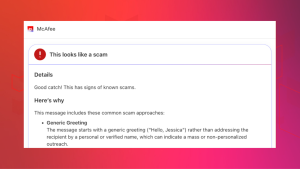
Scam messages are getting smarter and faster.
According to McAfee’s 2026 State of the Scamiverse report, Americans now spend 114 hours a year trying to figure out what’s real and what’s fake online. That’s nearly three full workweeks lost to second-guessing messages, alerts, and links.
And when scams do succeed, they move quickly. The typical scam unfolds in about 38 minutes, leaving little room for hesitation.
That creates a gap: People want to check before they act, but the tools haven’t always met them in that moment.
Claude + McAfee is designed to close that gap, bringing scam detection directly to a platform people are already using to ask questions and make decisions.
And it’s available to anyone. You don’t have to be a McAfee subscriber.
This isn’t just detection. It’s guidance in the exact moment you’re deciding what to do.
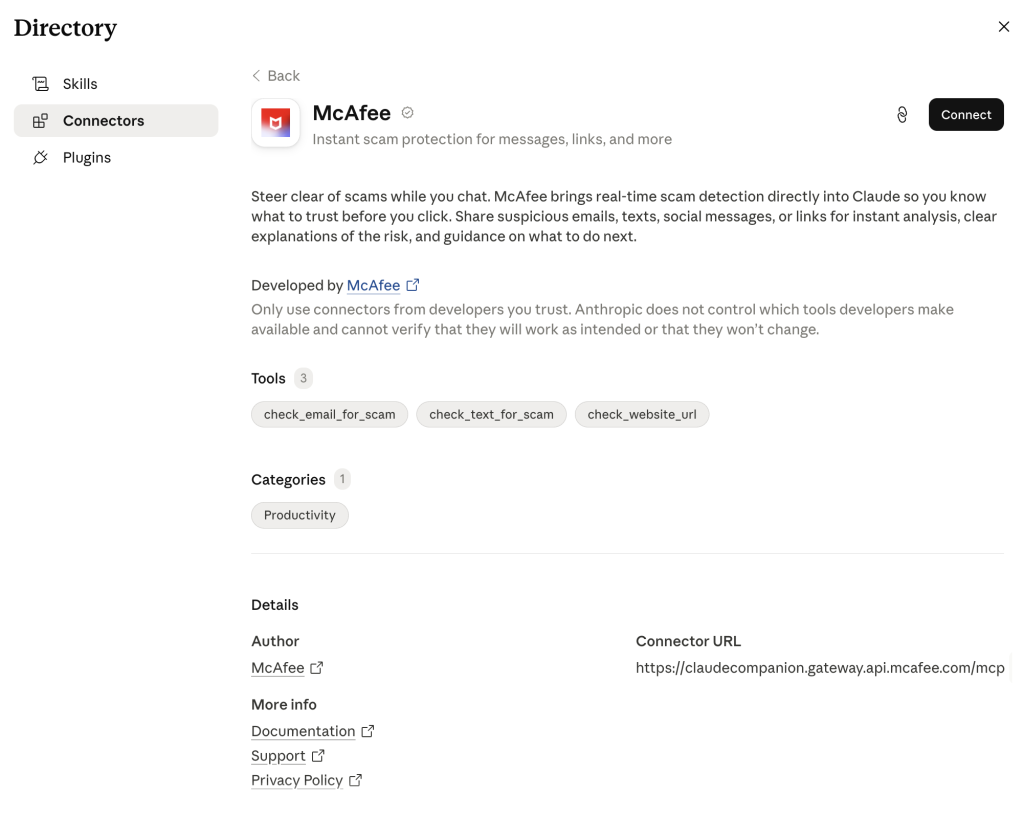
Instead of guessing, you can paste a message or drop in a screenshot and get a clear explanation of what’s risky, and what to do next, powered by McAfee’s threat intelligence.
With this integration, checking something suspicious becomes as simple as asking a question.
Paste a message. Drop in a link. Upload a screenshot. And just make sure to @McAfee when you’re asking a question.
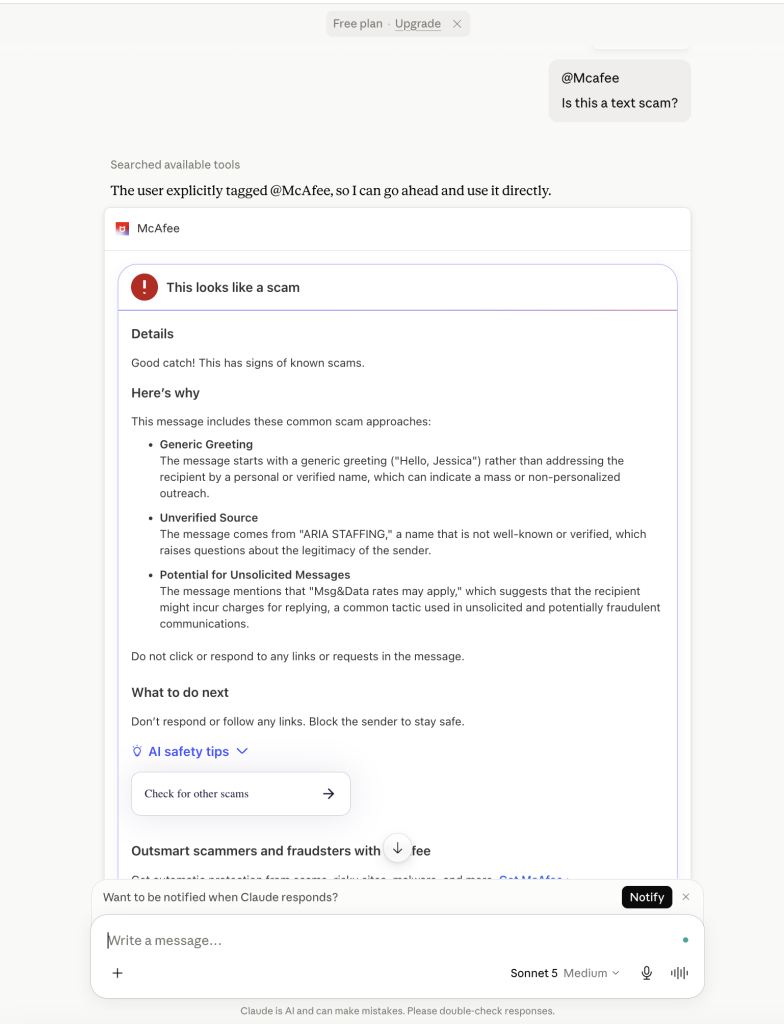
McAfee analyzes it and explains what’s going on clearly and in context.
For example, I got this suspicious “job offer” message over the weekend:
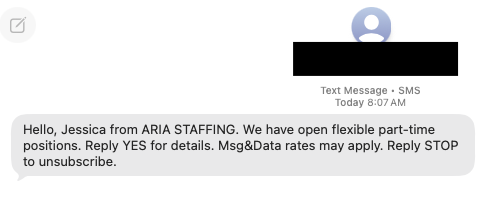
So I uploaded it in Claude and asked @McAfee, which caught it right away. You can even see I’m using the free plan.
| Feature | What it does | How it protects you |
| Link safety check | Paste a suspicious URL and get a reputational analysis based on McAfee threat intelligence | Scam links are often designed to look legitimate. A quick check helps avoid phishing and malware |
| Message analysis | Submit texts, emails, or social messages for evaluation | Many scams now rely on urgency and tone. Analysis helps surface subtle red flags |
| Screenshot uploads | Upload screenshots of messages or emails for review | Scams don’t always come as clean text. This makes it easier to check what you’re seeing |
| Clear explanations | Get a breakdown of why something is flagged as risky or safe | Not just a warning—an explanation that helps you recognize patterns next time |
| Guided next steps | Receive recommendations on what to do next | Helps prevent escalation, especially in moments of uncertainty |
It’s a quick, accessible way to get answers in the moment. But it’s just one part of a broader system designed to protect you more comprehensively.
Add the Connector to your Claude account here.
And make sure to go into “manage connections” to give McAfee permissions to review the texts, emails, and URLs you upload to Claude.
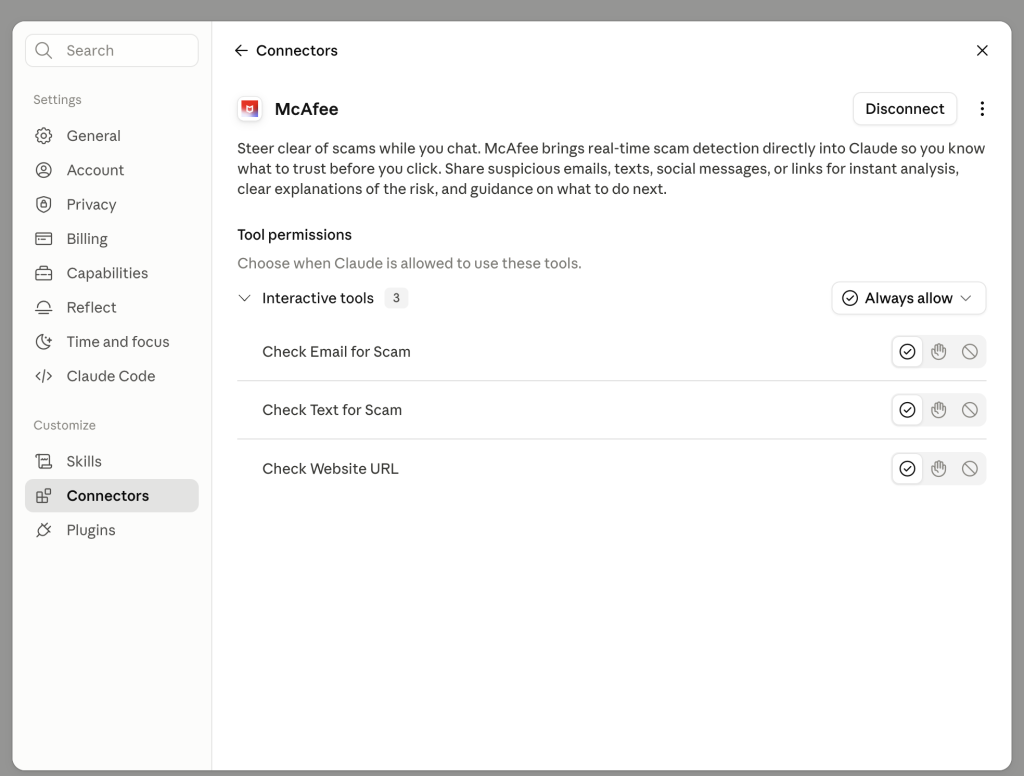
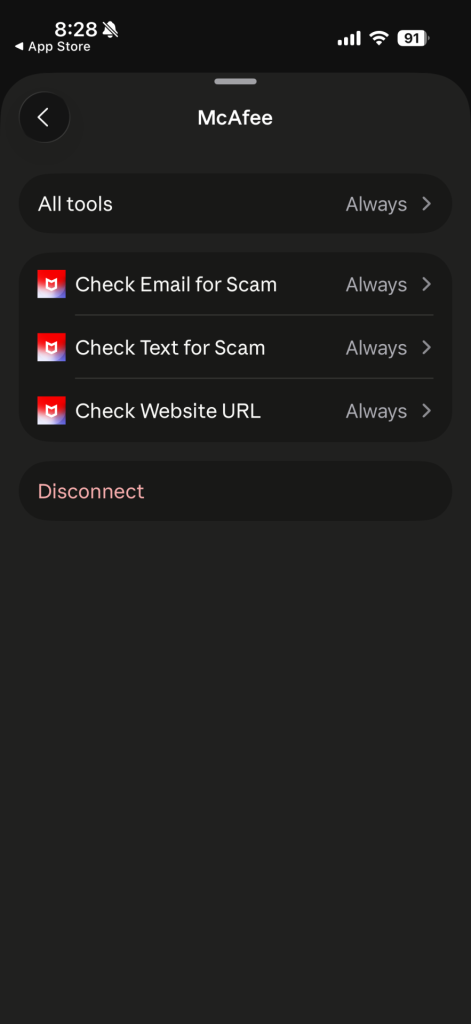
Need help getting the extension installed? Check out our step-by-step guide.
Behind the scenes, Claude + McAfee is powered by the same intelligence that fuels McAfee’s broader scam protection ecosystem.
When you submit something for review:
The goal isn’t just to flag risk. It’s to help you understand it.
Scams aren’t slowing down. If anything, they’re becoming more convincing, more personalized, and harder to detect.
That’s where Claude + McAfee comes in. But this is only one part of a much bigger system designed to protect you before, during, and after a scam attempt.
With McAfee+ Advanced, multiple layers work together so you’re not left figuring it out after the damage is done:
McAfee+ Advanced makes sure you’re protected across everything else.
The post How to Use Claude with McAfee to Check “Is This a Scam?” appeared first on McAfee Blog.


Scammers don’t always need sophisticated malware to steal your money. Increasingly, they’re relying on something much simpler: your trust.
This week, fraudsters were reported using FaceTime to watch victims log into their online banking accounts in real time, while Arizona authorities warned about fake QR codes exploiting the disappearance of 84-year-old Nancy Guthrie.
Here’s what happened, and how to protect yourself.
A growing scam is turning one of Apple’s most familiar apps into a tool for financial fraud.
According to CBS News, scammers first contact victims by text or phone while pretending to represent their bank or credit card company. They claim there’s suspicious activity on the account and that additional verification is needed.
Instead of keeping the conversation on a regular phone call, they switch to FaceTime.
Victims are then convinced to share their screens while logging into online banking. As they do, scammers can watch account numbers, passwords, and even one-time security codes appear in real time.
How the scam works
Remember: Your bank should never ask you to share your screen or reveal one-time authentication codes. If you receive an unexpected call, hang up and contact your bank using the number on the back of your card or through its official app.
Authorities in Arizona are warning the public about another scam—this time involving the disappearance of 84-year-old Nancy Guthrie, mother of Today show host Savannah Guthrie.
According to the Pima County Sheriff’s Department, scammers have been circulating social media posts containing QR codes requesting donations connected to the investigation.
The department says it will never ask the public for money related to this case or any investigation and urged people not to scan QR codes requesting payment.
The warning comes as investigators continue to search for Nancy Guthrie, whose disappearance remains under investigation.
Scammers know that people want to help during emergencies. Unfortunately, they also know that urgency and emotion can cause people to act before verifying where their money is going.
Even scam reporters can be targeted. A CBS News correspondent shared how he nearly withdrew money from his own bank after falling for a sophisticated imposter scam before realizing something didn’t add up. (Yahoo Finance)
India investigates reported nuclear plant-related data breach. Reuters reported that ransomware group World Leaks published files allegedly connected to contractors working on India’s Kudankulam Nuclear Power Plant. Officials say no nuclear security systems were exposed. (Reuters/Al Jazeera)
Cyberattack disrupts KFC Japan supply chain. A cyberattack on food logistics provider Nichirei Co. disrupted frozen food deliveries to KFC Japan, leading the company to warn of possible menu restrictions, shorter hours, and temporary pauses to online ordering. Nichirei said it has found no evidence that customer or personal information was exposed. (TechRadar)
Before you trust a call, text, or QR code:
 Never share your screen with someone claiming to be your bank.
Don’t scan QR codes requesting money unless you’ve verified the source.
Contact organizations directly using their official website or phone number—not the contact information provided in a text or social media post.
Slow down when someone creates urgency. Whether it’s a missing person case or a frozen bank account, scammers rely on emotional reactions.
Scammers often begin with a text, phone call, or malicious link designed to earn your trust before stealing your information.
Before a breach: Personal Data Cleanup helps reduce your digital footprint by removing your personal information from many data broker sites, limiting what scammers can easily find about you.
During a breach: Identity Monitoring alerts you if your personal information appears on the dark web or in known data leaks, helping you respond faster if your information is exposed.
After a breach: Scam Detector helps identify suspicious texts, emails, and links that often follow major breaches, while Web Protection helps block malicious websites designed to steal additional information or credentials.
And we’ll be back next week with more news and safety tips.
The post The FaceTime Bank Scam That Can Expose Your Passwords in Real Time: This Week in Scams appeared first on McAfee Blog.



Millions of Americans hand over personal information every day. They share their data with insurance companies, banks, investment apps, and other services they trust.
And that’s exactly why cybercriminals target and impersonate those services.
This week, an insurance provider disclosed a breach reportedly affecting nearly 7 million people’s driver’s license numbers, while a California journalist shared how a convincing fake Robinhood text ultimately cost her more than $70,000.
Here’s what happened, why these scams work, and what you can do to protect yourself This Week in Scams.
One of the largest U.S. data breaches of the year has exposed sensitive information belonging to 6.9 million people.
According to reporting from TechCrunch, insurance provider AssuranceAmerica confirmed that hackers accessed customer information after compromising an employee account. The company says the stolen data includes names, contact information, driver’s license numbers, insurance policy details, vehicle information, and claims data.
While the company has not said exactly how the employee’s credentials were compromised, it noted that the attackers targeted an employee account before accessing company systems.
Unlike a password, you can’t simply change your driver’s license number.
Combined with your name, address, phone number, or other information from previous breaches, driver’s license numbers can be used by criminals to:
This is also part of a larger trend. In recent months, multiple breaches have exposed government-issued identity documents as more organizations collect IDs for identity verification and age-check requirements.
If you receive a notice that your information was involved in a breach, monitor your financial accounts closely, consider placing a fraud alert or credit freeze, and remain cautious of unexpected emails, texts, or phone calls referencing your insurance or driver’s license information.
Unfortunately, scammers will reach out saying they’re trying to “help” secure your stolen information, only to try and steal more personal data from you.
Before a breach
Personal Data Cleanup helps reduce your digital footprint by removing your personal information from many data broker sites, limiting what scammers can easily find about you.
During a breach
Identity Monitoring alerts you if your personal information appears on the dark web or in known data leaks, helping you respond faster if your information is exposed.
After a breach
Scam Detector helps identify suspicious texts, emails, and links that often follow major breaches, while Web Protection helps block malicious websites designed to steal additional information or credentials.
Even people who report on scams can become victims.
A former California television news anchor recently shared how she lost more than $70,000 after receiving what appeared to be a legitimate text message claiming there was suspicious activity on her Robinhood investment account.
The message instructed her to call a phone number for assistance. Once connected, the caller posed as Robinhood support before transferring her to a fake “fraud department.”
Believing she was protecting her investments from hackers, she was convinced to move her money into what she thought was a secure account. Instead, it went directly to scammers.
She later contacted Robinhood through the official app, but by then the money had already been transferred.
Investment scams rely on urgency, authority, and impersonation rather than obvious phishing emails.
Rather than asking targets to “invest” immediately, many scams begin by convincing people that their existing account is under attack and immediate action is needed.
At McAfee, we’ve also seen scammers impersonate Robinhood, Charles Schwab, cryptocurrency platforms, and other investment services through fraudulent text messages and malicious links promising AI-powered investing, exclusive bonuses, or unusually high returns.
Whether the message claims your account has been compromised or promises incredible profits, the goal is often the same: get you to click, call, or transfer money before you have time to verify what’s happening.
Before responding to any message about your investments:
 Never call the phone number provided in a text message or email. Instead, contact your financial institution using the number listed in its official app or website.
Slow down when someone creates urgency. Claims that your account is being hacked or frozen are designed to make you act before you think.
Be skeptical of guaranteed returns or AI-powered investment opportunities. Promises of extraordinary profits are a common hallmark of investment fraud.
Verify alerts through your account directly. If you receive a suspicious notification, log in through the official app, not a link in the message.
With McAfee+, multiple layers work together before any damage is done:
Scam Detector flags suspicious texts, emails, links, QR codes, and even deepfake videos before you engage
Secure VPN keeps your data private, especially on public Wi-Fi
Web Protection helps block risky sites, even if you do accidentally click
Password Manager doesn’t just help you make unique, strong passwords, it keeps them stored and organized for you
Device Security helps detect malicious apps or downloads
Identity Monitoring alerts you if your personal info appears online in places it shouldn’t, so you can act fast
Personal Data Cleanup helps remove your information from sites selling it.
Online Account Cleanup assists in taking down your old, forgotten accounts across the web
Social Privacy Manager helps you monitor and change privacy settings across your social platforms in just a few clicks
Together, these protections are designed to address the broader range of online risks people face every day.
The post Nearly 7 Million Driver’s Licenses Exposed in Assurance Breach: This Week in Scams appeared first on McAfee Blog.
