 Login
Login


A sprawling academic cheating network turbocharged by Google Ads that has generated nearly $25 million in revenue has curious ties to a Kremlin-connected oligarch whose Russian university builds drones for Russia’s war against Ukraine.

The Nerdify homepage.
The link between essay mills and Russian attack drones might seem improbable, but understanding it begins with a simple question: How does a human-intensive academic cheating service stay relevant in an era when students can simply ask AI to write their term papers? The answer – recasting the business as an AI company – is just the latest chapter in a story of many rebrands that link the operation to Russia’s largest private university.
Search in Google for any terms related to academic cheating services — e.g., “help with exam online” or “term paper online” — and you’re likely to encounter websites with the words “nerd” or “geek” in them, such as thenerdify[.]com and geekly-hub[.]com. With a simple request sent via text message, you can hire their tutors to help with any assignment.
These nerdy and geeky-branded websites frequently cite their “honor code,” which emphasizes they do not condone academic cheating, will not write your term papers for you, and will only offer support and advice for customers. But according to This Isn’t Fine, a Substack blog about contract cheating and essay mills, the Nerdify brand of websites will happily ignore that mantra.
“We tested the quick SMS for a price quote,” wrote This Isn’t Fine author Joseph Thibault. “The honor code references and platitudes apparently stop at the website. Within three minutes, we confirmed that a full three-page, plagiarism- and AI-free MLA formatted Argumentative essay could be ours for the low price of $141.”

A screenshot from Joseph Thibault’s Substack post shows him purchasing a 3-page paper with the Nerdify service.
Google prohibits ads that “enable dishonest behavior.” Yet, a sprawling global essay and homework cheating network run under the Nerdy brands has quietly bought its way to the top of Google searches – booking revenues of almost $25 million through a maze of companies in Cyprus, Malta and Hong Kong, while pitching “tutoring” that delivers finished work that students can turn in.
When one Nerdy-related Google Ads account got shut down, the group behind the company would form a new entity with a front-person (typically a young Ukrainian woman), start a new ads account along with a new website and domain name (usually with “nerdy” in the brand), and resume running Google ads for the same set of keywords.
UK companies belonging to the group that have been shut down by Google Ads since Jan 2025 include:
–Proglobal Solutions LTD (advertised nerdifyit[.]com);
–AW Tech Limited (advertised thenerdify[.]com);
–Geekly Solutions Ltd (advertised geekly-hub[.]com).
Currently active Google Ads accounts for the Nerdify brands include:
-OK Marketing LTD (advertising geekly-hub[.]net), formed in the name of Olha Karpenko, a young Ukrainian woman;
–Two Sigma Solutions LTD (advertising litero[.]ai), formed in the name of Olekszij (Alexey) Pokatilo.
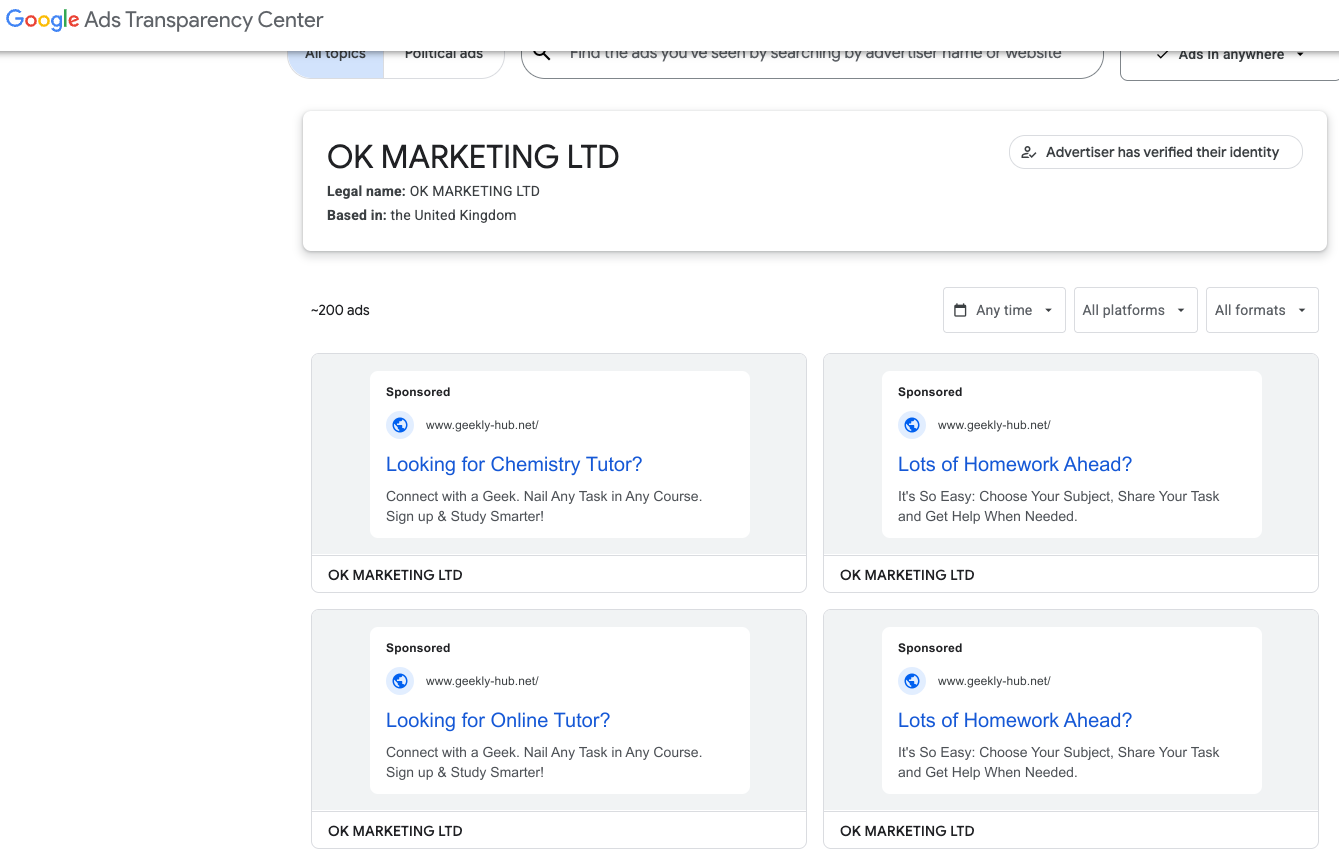
Google’s Ads Transparency page for current Nerdify advertiser OK Marketing LTD.
Mr. Pokatilo has been in the essay-writing business since at least 2009, operating a paper-mill enterprise called Livingston Research alongside Alexander Korsukov, who is listed as an owner. According to a lengthy account from a former employee, Livingston Research mainly farmed its writing tasks out to low-cost workers from Kenya, Philippines, Pakistan, Russia and Ukraine.
Pokatilo moved from Ukraine to the United Kingdom in Sept. 2015 and co-founded a company called Awesome Technologies, which pitched itself as a way for people to outsource tasks by sending a text message to the service’s assistants.
The other co-founder of Awesome Technologies is 36-year-old Filip Perkon, a Swedish man living in London who touts himself as a serial entrepreneur and investor. Years before starting Awesome together, Perkon and Pokatilo co-founded a student group called Russian Business Week while the two were classmates at the London School of Economics. According to the Bulgarian investigative journalist Christo Grozev, Perkon’s birth certificate was issued by the Soviet Embassy in Sweden.

Alexey Pokatilo (left) and Filip Perkon at a Facebook event for startups in San Francisco in mid-2015.
Around the time Perkon and Pokatilo launched Awesome Technologies, Perkon was building a social media propaganda tool called the Russian Diplomatic Online Club, which Perkon said would “turbo-charge” Russian messaging online. The club’s newsletter urged subscribers to install in their Twitter accounts a third-party app called Tweetsquad that would retweet Kremlin messaging on the social media platform.
Perkon was praised by the Russian Embassy in London for his efforts: During the contentious Brexit vote that ultimately led to the United Kingdom leaving the European Union, the Russian embassy in London used this spam tweeting tool to auto-retweet the Russian ambassador’s posts from supporters’ accounts.
Neither Mr. Perkon nor Mr. Pokatilo replied to requests for comment.
A review of corporations tied to Mr. Perkon as indexed by the business research service North Data finds he holds or held director positions in several U.K. subsidiaries of Synergy University, Russia’s largest private education provider. Synergy has more than 35,000 students, and sells T-shirts with patriotic slogans such as “Crimea is Ours,” and “The Russian Empire — Reloaded.”
The president of Synergy University is Vadim Lobov, a Kremlin insider whose headquarters on the outskirts of Moscow reportedly features a wall-sized portrait of Russian President Vladimir Putin in the pop-art style of Andy Warhol. For a number of years, Lobov and Perkon co-produced a cross-cultural event in the U.K. called Russian Film Week.

Synergy President Vadim Lobov and Filip Perkon, speaking at a press conference for Russian Film Week, a cross-cultural event in the U.K. co-produced by both men.
Mr. Lobov was one of 11 individuals reportedly hand-picked by the convicted Russian spy Marina Butina to attend the 2017 National Prayer Breakfast held in Washington D.C. just two weeks after President Trump’s first inauguration.
While Synergy University promotes itself as Russia’s largest private educational institution, hundreds of international students tell a different story. Online reviews from students paint a picture of unkept promises: Prospective students from Nigeria, Kenya, Ghana, and other nations paying thousands in advance fees for promised study visas to Russia, only to have their applications denied with no refunds offered.
“My experience with Synergy University has been nothing short of heartbreaking,” reads one such account. “When I first discovered the school, their representative was extremely responsive and eager to assist. He communicated frequently and made me believe I was in safe hands. However, after paying my hard-earned tuition fees, my visa was denied. It’s been over 9 months since that denial, and despite their promises, I have received no refund whatsoever. My messages are now ignored, and the same representative who once replied instantly no longer responds at all. Synergy University, how can an institution in Europe feel comfortable exploiting the hopes of Africans who trust you with their life savings? This is not just unethical — it’s predatory.”
This pattern repeats across reviews by multilingual students from Pakistan, Nepal, India, and various African nations — all describing the same scheme: Attractive online marketing, promises of easy visa approval, upfront payment requirements, and then silence after visa denials.
Reddit discussions in r/Moscow and r/AskARussian are filled with warnings. “It’s a scam, a diploma mill,” writes one user. “They literally sell exams. There was an investigation on Rossiya-1 television showing students paying to pass tests.”
The Nerdify website’s “About Us” page says the company was co-founded by Pokatilo and an American named Brian Mellor. The latter identity seems to have been fabricated, or at least there is no evidence that a person with this name ever worked at Nerdify.
Rather, it appears that the SMS assistance company co-founded by Messrs. Pokatilo and Perkon (Awesome Technologies) fizzled out shortly after its creation, and that Nerdify soon adopted the process of accepting assignment requests via text message and routing them to freelance writers.
A closer look at an early “About Us” page for Nerdify in The Wayback Machine suggests that Mr. Perkon was the real co-founder of the company: The photo at the top of the page shows four people wearing Nerdify T-shirts seated around a table on a rooftop deck in San Francisco, and the man facing the camera is Perkon.
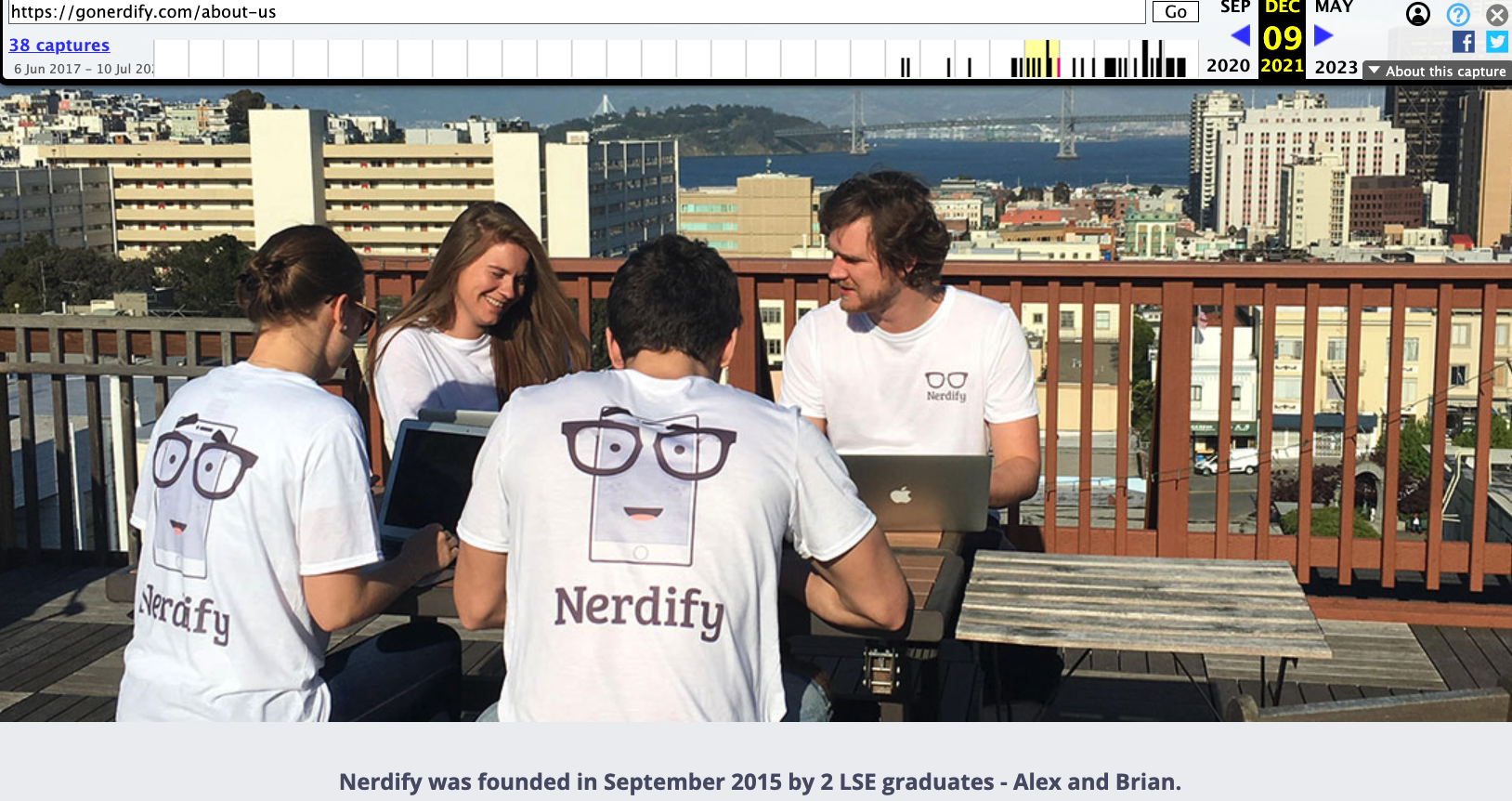
Filip Perkon, top right, is pictured wearing a Nerdify T-shirt in an archived copy of the company’s About Us page. Image: archive.org.
Where are they now? Pokatilo is currently running a startup called Litero.Ai, which appears to be an AI-based essay writing service. In July 2025, Mr. Pokatilo received pre-seed funding of $800,000 for Litero from an investment program backed by the venture capital firms AltaIR Capital, Yellow Rocks, Smart Partnership Capital, and I2BF Global Ventures.
Meanwhile, Filip Perkon is busy setting up toy rubber duck stores in Miami and in at least three locations in the United Kingdom. These “Duck World” shops market themselves as “the world’s largest duck store.”
This past week, Mr. Lobov was in India with Putin’s entourage on a charm tour with India’s Prime Minister Narendra Modi. Although Synergy is billed as an educational institution, a review of the company’s sprawling corporate footprint (via DNS) shows it also is assisting the Russian government in its war against Ukraine.

Synergy University President Vadim Lobov (right) pictured this week in India next to Natalia Popova, a Russian TV presenter known for her close ties to Putin’s family, particularly Putin’s daughter, who works with Popova at the education and culture-focused Innopraktika Foundation.
The website bpla.synergy[.]bot, for instance, says the company is involved in developing combat drones to aid Russian forces and to evade international sanctions on the supply and re-export of high-tech products.
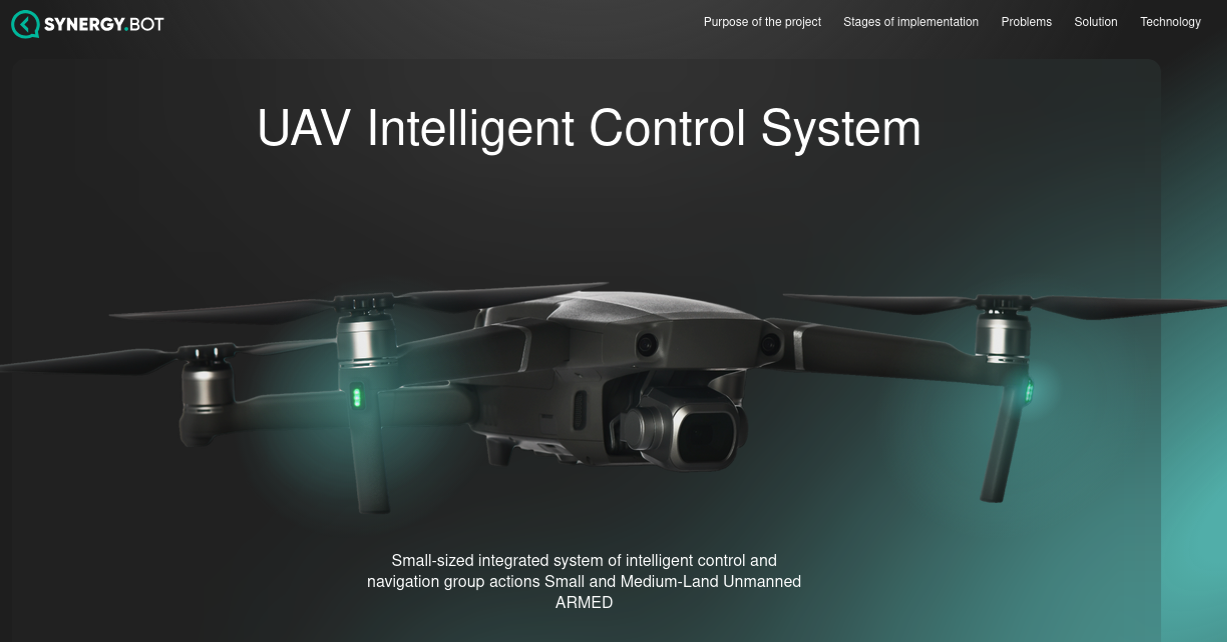
A screenshot from the website of synergy,bot shows the company is actively engaged in building armed drones for the war in Ukraine.
KrebsOnSecurity would like to thank the anonymous researcher NatInfoSec for their assistance in this investigation.
Update, Dec. 8, 10:06 a.m. ET: Mr. Pokatilo responded to requests for comment after the publication of this story. Pokatilo said he has no relation to Synergy nor to Mr. Lobov, and that his work with Mr. Perkon ended with the dissolution of Awesome Technologies.
“I have had no involvement in any of his projects and business activities mentioned in the article and he has no involvement in Litero.ai,” Pokatilo said of Perkon.
Mr. Pokatilo said his new company Litero “does not provide contract cheating services and is built specifically to improve transparency and academic integrity in the age of universal use of AI by students.”
“I am Ukrainian,” he said in an email. “My close friends, colleagues, and some family members continue to live in Ukraine under the ongoing invasion. Any suggestion that I or my company may be connected in any way to Russia’s war efforts is deeply offensive on a personal level and harmful to the reputation of Litero.ai, a company where many team members are Ukrainian.”
Update, Dec. 11, 12:07 p.m. ET: Mr. Perkon responded to requests for comment after the publication of this story. Perkon said the photo of him in a Nerdify T-shirt (see screenshot above) was taken after a startup event in San Francisco, where he volunteered to act as a photo model to help friends with their project.
“I have no business or other relations to Nerdify or any other ventures in that space,” Mr. Perkon said in an email response. “As for Vadim Lobov, I worked for Venture Capital arm at Synergy until 2013 as well as his business school project in the UK, that didn’t get off the ground, so the company related to this was made dormant. Then Synergy kindly provided sponsorship for my Russian Film Week event that I created and ran until 2022 in the U.K., an event that became the biggest independent Russian film festival outside of Russia. Since the start of the Ukraine war in 2022 I closed the festival down.”
“I have had no business with Vadim Lobov since 2021 (the last film festival) and I don’t keep track of his endeavours,” Perkon continued. “As for Alexey Pokatilo, we are university friends. Our business relationship has ended after the concierge service Awesome Technologies didn’t work out, many years ago.”
An intermittent outage at Cloudflare on Tuesday briefly knocked many of the Internet’s top destinations offline. Some affected Cloudflare customers were able to pivot away from the platform temporarily so that visitors could still access their websites. But security experts say doing so may have also triggered an impromptu network penetration test for organizations that have come to rely on Cloudflare to block many types of abusive and malicious traffic.
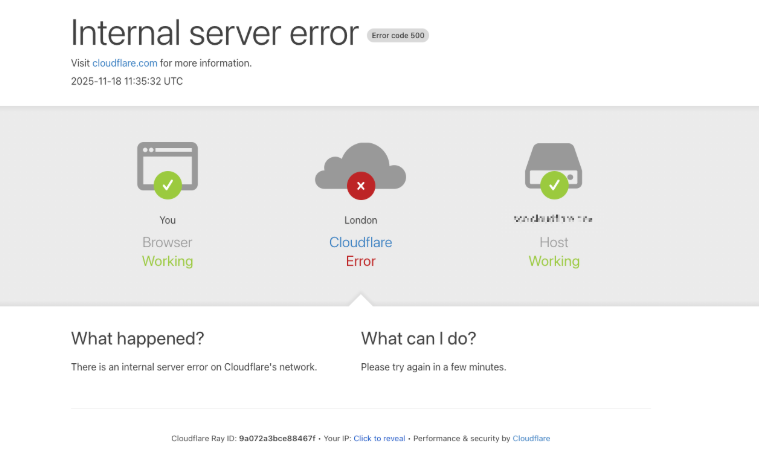
At around 6:30 EST/11:30 UTC on Nov. 18, Cloudflare’s status page acknowledged the company was experiencing “an internal service degradation.” After several hours of Cloudflare services coming back up and failing again, many websites behind Cloudflare found they could not migrate away from using the company’s services because the Cloudflare portal was unreachable and/or because they also were getting their domain name system (DNS) services from Cloudflare.
However, some customers did manage to pivot their domains away from Cloudflare during the outage. And many of those organizations probably need to take a closer look at their web application firewall (WAF) logs during that time, said Aaron Turner, a faculty member at IANS Research.
Turner said Cloudflare’s WAF does a good job filtering out malicious traffic that matches any one of the top ten types of application-layer attacks, including credential stuffing, cross-site scripting, SQL injection, bot attacks and API abuse. But he said this outage might be a good opportunity for Cloudflare customers to better understand how their own app and website defenses may be failing without Cloudflare’s help.
“Your developers could have been lazy in the past for SQL injection because Cloudflare stopped that stuff at the edge,” Turner said. “Maybe you didn’t have the best security QA [quality assurance] for certain things because Cloudflare was the control layer to compensate for that.”
Turner said one company he’s working with saw a huge increase in log volume and they are still trying to figure out what was “legit malicious” versus just noise.
“It looks like there was about an eight hour window when several high-profile sites decided to bypass Cloudflare for the sake of availability,” Turner said. “Many companies have essentially relied on Cloudflare for the OWASP Top Ten [web application vulnerabilities] and a whole range of bot blocking. How much badness could have happened in that window? Any organization that made that decision needs to look closely at any exposed infrastructure to see if they have someone persisting after they’ve switched back to Cloudflare protections.”
Turner said some cybercrime groups likely noticed when an online merchant they normally stalk stopped using Cloudflare’s services during the outage.
“Let’s say you were an attacker, trying to grind your way into a target, but you felt that Cloudflare was in the way in the past,” he said. “Then you see through DNS changes that the target has eliminated Cloudflare from their web stack due to the outage. You’re now going to launch a whole bunch of new attacks because the protective layer is no longer in place.”
Nicole Scott, senior product marketing manager at the McLean, Va. based Replica Cyber, called yesterday’s outage “a free tabletop exercise, whether you meant to run one or not.”
“That few-hour window was a live stress test of how your organization routes around its own control plane and shadow IT blossoms under the sunlamp of time pressure,” Scott said in a post on LinkedIn. “Yes, look at the traffic that hit you while protections were weakened. But also look hard at the behavior inside your org.”
Scott said organizations seeking security insights from the Cloudflare outage should ask themselves:
1. What was turned off or bypassed (WAF, bot protections, geo blocks), and for how long?
2. What emergency DNS or routing changes were made, and who approved them?
3. Did people shift work to personal devices, home Wi-Fi, or unsanctioned Software-as-a-Service providers to get around the outage?
4. Did anyone stand up new services, tunnels, or vendor accounts “just for now”?
5. Is there a plan to unwind those changes, or are they now permanent workarounds?
6. For the next incident, what’s the intentional fallback plan, instead of decentralized improvisation?
In a postmortem published Tuesday evening, Cloudflare said the disruption was not caused, directly or indirectly, by a cyberattack or malicious activity of any kind.
“Instead, it was triggered by a change to one of our database systems’ permissions which caused the database to output multiple entries into a ‘feature file’ used by our Bot Management system,” Cloudflare CEO Matthew Prince wrote. “That feature file, in turn, doubled in size. The larger-than-expected feature file was then propagated to all the machines that make up our network.”
Cloudflare estimates that roughly 20 percent of websites use its services, and with much of the modern web relying heavily on a handful of other cloud providers including AWS and Azure, even a brief outage at one of these platforms can create a single point of failure for many organizations.
Martin Greenfield, CEO at the IT consultancy Quod Orbis, said Tuesday’s outage was another reminder that many organizations may be putting too many of their eggs in one basket.
“There are several practical and overdue fixes,” Greenfield advised. “Split your estate. Spread WAF and DDoS protection across multiple zones. Use multi-vendor DNS. Segment applications so a single provider outage doesn’t cascade. And continuously monitor controls to detect single-vendor dependency.”
The U.S. government is reportedly preparing to ban the sale of wireless routers and other networking gear from TP-Link Systems, a tech company that currently enjoys an estimated 50% market share among home users and small businesses. Experts say while the proposed ban may have more to do with TP-Link’s ties to China than any specific technical threats, much of the rest of the industry serving this market also sources hardware from China and ships products that are insecure fresh out of the box.

A TP-Link WiFi 6 AX1800 Smart WiFi Router (Archer AX20).
The Washington Post recently reported that more than a half-dozen federal departments and agencies were backing a proposed ban on future sales of TP-Link devices in the United States. The story said U.S. Department of Commerce officials concluded TP-Link Systems products pose a risk because the U.S.-based company’s products handle sensitive American data and because the officials believe it remains subject to jurisdiction or influence by the Chinese government.
TP-Link Systems denies that, saying that it fully split from the Chinese TP-Link Technologies over the past three years, and that its critics have vastly overstated the company’s market share (TP-Link puts it at around 30 percent). TP-Link says it has headquarters in California, with a branch in Singapore, and that it manufactures in Vietnam. The company says it researches, designs, develops and manufactures everything except its chipsets in-house.
TP-Link Systems told The Post it has sole ownership of some engineering, design and manufacturing capabilities in China that were once part of China-based TP-Link Technologies, and that it operates them without Chinese government supervision.
“TP-Link vigorously disputes any allegation that its products present national security risks to the United States,” Ricca Silverio, a spokeswoman for TP-Link Systems, said in a statement. “TP-Link is a U.S. company committed to supplying high-quality and secure products to the U.S. market and beyond.”
Cost is a big reason TP-Link devices are so prevalent in the consumer and small business market: As this February 2025 story from Wired observed regarding the proposed ban, TP-Link has long had a reputation for flooding the market with devices that are considerably cheaper than comparable models from other vendors. That price point (and consistently excellent performance ratings) has made TP-Link a favorite among Internet service providers (ISPs) that provide routers to their customers.
In August 2024, the chairman and the ranking member of the House Select Committee on the Strategic Competition Between the United States and the Chinese Communist Party called for an investigation into TP-Link devices, which they said were found on U.S. military bases and for sale at exchanges that sell them to members of the military and their families.
“TP-Link’s unusual degree of vulnerabilities and required compliance with PRC law are in and of themselves disconcerting,” the House lawmakers warned in a letter (PDF) to the director of the Commerce Department. “When combined with the PRC government’s common use of SOHO [small office/home office] routers like TP-Link to perpetrate extensive cyberattacks in the United States, it becomes significantly alarming.”
The letter cited a May 2023 blog post by Check Point Research about a Chinese state-sponsored hacking group dubbed “Camaro Dragon” that used a malicious firmware implant for some TP-Link routers to carry out a sequence of targeted cyberattacks against European foreign affairs entities. Check Point said while it only found the malicious firmware on TP-Link devices, “the firmware-agnostic nature of the implanted components indicates that a wide range of devices and vendors may be at risk.”
In a report published in October 2024, Microsoft said it was tracking a network of compromised TP-Link small office and home office routers that has been abused by multiple distinct Chinese state-sponsored hacking groups since 2021. Microsoft found the hacker groups were leveraging the compromised TP-Link systems to conduct “password spraying” attacks against Microsoft accounts. Password spraying involves rapidly attempting to access a large number of accounts (usernames/email addresses) with a relatively small number of commonly used passwords.
TP-Link rightly points out that most of its competitors likewise source components from China. The company also correctly notes that advanced persistent threat (APT) groups from China and other nations have leveraged vulnerabilities in products from their competitors, such as Cisco and Netgear.
But that may be cold comfort for TP-Link customers who are now wondering if it’s smart to continue using these products, or whether it makes sense to buy more costly networking gear that might only be marginally less vulnerable to compromise.
Almost without exception, the hardware and software that ships with most consumer-grade routers includes a number of default settings that need to be changed before the devices can be safely connected to the Internet. For example, bring a new router online without changing the default username and password and chances are it will only take a few minutes before it is probed and possibly compromised by some type of Internet-of-Things botnet. Also, it is incredibly common for the firmware in a brand new router to be dangerously out of date by the time it is purchased and unboxed.
Until quite recently, the idea that router manufacturers should make it easier for their customers to use these products safely was something of an anathema to this industry. Consumers were largely left to figure that out on their own, with predictably disastrous results.
But over the past few years, many manufacturers of popular consumer routers have begun forcing users to perform basic hygiene — such as changing the default password and updating the internal firmware — before the devices can be used as a router. For example, most brands of “mesh” wireless routers — like Amazon’s Eero, Netgear’s Orbi series, or Asus’s ZenWifi — require online registration that automates these critical steps going forward (or at least through their stated support lifecycle).
For better or worse, less expensive, traditional consumer routers like those from Belkin and Linksys also now automate this setup by heavily steering customers toward installing a mobile app to complete the installation (this often comes as a shock to people more accustomed to manually configuring a router). Still, these products tend to put the onus on users to check for and install available updates periodically. Also, they’re often powered by underwhelming or else bloated firmware, and a dearth of configurable options.
Of course, not everyone wants to fiddle with mobile apps or is comfortable with registering their router so that it can be managed or monitored remotely in the cloud. For those hands-on folks — and for power users seeking more advanced router features like VPNs, ad blockers and network monitoring — the best advice is to check if your router’s stock firmware can be replaced with open-source alternatives, such as OpenWrt or DD-WRT.
These open-source firmware options are compatible with a wide range of devices, and they generally offer more features and configurability. Open-source firmware can even help extend the life of routers years after the vendor stops supporting the underlying hardware, but it still requires users to manually check for and install any available updates.
Happily, TP-Link users spooked by the proposed ban may have an alternative to outright junking these devices, as many TP-Link routers also support open-source firmware options like OpenWRT. While this approach may not eliminate any potential hardware-specific security flaws, it could serve as an effective hedge against more common vendor-specific vulnerabilities, such as undocumented user accounts, hard-coded credentials, and weaknesses that allow attackers to bypass authentication.
Regardless of the brand, if your router is more than four or five years old it may be worth upgrading for performance reasons alone — particularly if your home or office is primarily accessing the Internet through WiFi.
NB: The Post’s story notes that a substantial portion of TP-Link routers and those of its competitors are purchased or leased through ISPs. In these cases, the devices are typically managed and updated remotely by your ISP, and equipped with custom profiles responsible for authenticating your device to the ISP’s network. If this describes your setup, please do not attempt to modify or replace these devices without first consulting with your Internet provider.
QuickResponseC2 is a stealthy Command and Control (C2) framework that enables indirect and covert communication between the attacker and victim machines via an intermediate HTTP/S server. All network activity is limited to uploading and downloading images, making it an fully undetectable by IPS/IDS Systems and an ideal tool for security research and penetration testing.
Command Execution via QR Codes:
Users can send custom commands to the victim machine, encoded as QR codes.
Victims scan the QR code, which triggers the execution of the command on their system.
The command can be anything from simple queries to complex operations based on the test scenario.
Result Retrieval:
Results of the executed command are returned from the victim system and encoded into a QR code.
The server decodes the result and provides feedback to the attacker for further analysis or follow-up actions.
Built-in HTTP Server:
The tool includes a lightweight HTTP server that facilitates the victim machine's retrieval of command QR codes.
Results are sent back to the server as QR code images, and they are automatically saved with unique filenames for easy management.
The attacker's machine handles multiple requests, with HTTP logs organized and saved separately.
Stealthy Communication:
QuickResponseC2 operates under the radar, with minimal traces, providing a covert way to interact with the victim machine without alerting security defenses.
Ideal for security assessments or testing command-and-control methodologies without being detected.
File Handling:
The tool automatically saves all QR codes (command and result) to the server_files directory, using sequential filenames like command0.png, command1.png, etc.
Decoding and processing of result files are handled seamlessly.
User-Friendly Interface:
The tool is operated via a simple command-line interface, allowing users to set up a C2 server, send commands, and receive results with ease.
No additional complex configurations or dependencies are needed.
pip3 install -r requirements.txt
python3 main.py
1 - Run the C2 Server
2 - Build the Victim Implant
https://github.com/user-attachments/assets/382e9350-d650-44e5-b8ef-b43ec90b315d
8080).commandX.png on the HTTP server.commandX.png), it downloads and decodes the image to retrieve the command.resultX.png.resultX.png).Feel free to fork and contribute! Pull requests are welcome.

OSINT Tool for research social media accounts by username
```Install Requests pip install requests
#### Install BeautifulSoup
```Install BeautifulSoup
pip install beautifulsoup4
Execute Snoop python3 snoop.py

Tool for obfuscating PowerShell scripts written in Go. The main objective of this program is to obfuscate PowerShell code to make its analysis and detection more difficult. The script offers 5 levels of obfuscation, from basic obfuscation to script fragmentation. This allows users to tailor the obfuscation level to their specific needs.
./psobf -h

    ██████╗ ███████╗ ██████╗ ██████╗ ███████╗
    ██╔══██╗██╔════╝██╔═══██╗██╔══██╗██╔════╝
    ██████╔╝███████╗██║   ██║██████╔╝█████╗
    ██╔═══╝ ╚════██║██║   ██║██╔══██╗██╔══╝
    ██║     ███████║╚██████╔╝██████╔╝██║
    ╚═╝     ╚══════╝ ╚═════╝ ╚═════╝ ╚═╝
    @TaurusOmar
    v.1.0

Usage: ./obfuscator -i <inputFile> -o <outputFile> -level <1|2|3|4|5>
Options:
  -i string
        Name of the PowerShell script file.
  -level int
        Obfuscation level (1 to 5). (default 1)
  -o string
        Name of the output file for the obfuscated script. (default "obfuscated.ps1")

Obfuscation levels:
  1: Basic obfuscation by splitting the script into individual characters.
  2: Base64 encoding of the script.
  3: Alternative Base64 encoding with a different PowerShell decoding method.
  4: Compression and Base64 encoding of the script will be decoded and decompressed at runtime.
  5: Fragmentation of the script into multiple parts and reconstruction at runtime.
go install github.com/TaurusOmar/psobf@latest
The obfuscation levels are divided into 5 options. First, you need to have a PowerShell file that you want to obfuscate. Let's assume you have a file named script.ps1 with the following content:
Write-Host "Hello, World!"
Run the script with level 1 obfuscation.
./obfuscator -i script.ps1 -o obfuscated_level1.ps1 -level 1
This will generate a file named obfuscated_level1.ps1 with the obfuscated content. The result will be a version of your script where each character is separated by commas and combined at runtime.
Result (level 1)
$obfuscated = $([char[]]("`W`,`r`,`i`,`t`,`e`,`-`,`H`,`o`,`s`,`t`,` `,`"`,`H`,`e`,`l`,`l`,`o`,`,` `,`W`,`o`,`r`,`l`,`d`,`!`,`"`") -join ''); Invoke-Expression $obfuscated
Run the script with level 2 obfuscation:
./obfuscator -i script.ps1 -o obfuscated_level2.ps1 -level 2
This will generate a file named obfuscated_level2.ps1 with the content encoded in base64. When executing this script, it will be decoded and run at runtime.
Result (level 2)
$obfuscated = [System.Text.Encoding]::UTF8.GetString([System.Convert]::FromBase64String('V3JpdGUtSG9zdCAiSGVsbG8sIFdvcmxkISI=')); Invoke-Expression $obfuscated
Execute the script with level 3 obfuscation:
./obfuscator -i script.ps1 -o obfuscated_level3.ps1 -level 3
This level uses a slightly different form of base64 encoding and decoding in PowerShell, adding an additional layer of obfuscation.
Result (level 3)
$e = [System.Convert]::FromBase64String('V3JpdGUtSG9zdCAiSGVsbG8sIFdvcmxkISI='); $obfuscated = [System.Text.Encoding]::UTF8.GetString($e); Invoke-Expression $obfuscated
Execute the script with level 4 obfuscation:
./obfuscator -i script.ps1 -o obfuscated_level4.ps1 -level 4
This level compresses the script before encoding it in base64, making analysis more complicated. The result will be decoded and decompressed at runtime.
Result (level 4)
$compressed = 'H4sIAAAAAAAAC+NIzcnJVyjPL8pJUQQAlRmFGwwAAAA='; $bytes = [System.Convert]::FromBase64String($compressed); $stream = New-Object IO.MemoryStream(, $bytes); $decompressed = New-Object IO.Compression.GzipStream($stream, [IO.Compression.CompressionMode]::Decompress); $reader = New-Object IO.StreamReader($decompressed); $obfuscated = $reader.ReadToEnd(); Invoke-Expression $obfuscated
Run the script with level 5 obfuscation:
./obfuscator -i script.ps1 -o obfuscated_level5.ps1 -level 5
This level fragments the script into multiple parts and reconstructs it at runtime.
Result (level 5)
$fragments = @(
'Write-',
'Output "',
'Hello,',
' Wo',
'rld!',
'"'
);
$script = $fragments -join '';
Invoke-Expression $script
This program is provided for educational and research purposes. It should not be used for malicious activities.

 FreshRSS


