FreshRSS

🔒
❌ Secure Planet Training Courses Updated For 2019 - Click Here
There are new available articles, click to refresh the page.
☐ ☆ ✇ Security – Cisco Blog

Simplifying Decryption With Cisco’s Secure Firewall 7.7

By: Gurdeep Gill — June 19th 2025 at 12:00
Simplify decryption with Cisco Secure Firewall 7.7! Intelligent bypass, enhanced wizard & more for optimized security & performance.
☐ ☆ ✇ Security – Cisco Blog

The Quantum Sky Is Falling! Understanding the Quantum Threat to Network Security

By: Rakesh Kandula — March 12th 2025 at 12:00
Demystify the potential threat that quantum computing poses to encryption and the security of the network.
☐ ☆ ✇ KitPloit - PenTest Tools!

Sttr - Cross-Platform, Cli App To Perform Various Operations On String

By: Unknown — June 8th 2024 at 12:30


sttr is command line software that allows you to quickly run various transformation operations on the string.


// With input prompt
sttr

// Direct input
sttr md5 "Hello World"

// File input
sttr md5 file.text
sttr base64-encode image.jpg

// Reading from different processor like cat, curl, printf etc..
echo "Hello World" | sttr md5
cat file.txt | sttr md5

// Writing output to a file
sttr yaml-json file.yaml > file-output.json

:movie_camera: Demo

:battery: Installation

Quick install

You can run the below curl to install it somewhere in your PATH for easy use. Ideally it will be installed at ./bin folder

curl -sfL https://raw.githubusercontent.com/abhimanyu003/sttr/main/install.sh | sh

Webi

MacOS / Linux

curl -sS https://webi.sh/sttr | sh

Windows

curl.exe https://webi.ms/sttr | powershell

See here

Homebrew

If you are on macOS and using Homebrew, you can install sttr with the following:

brew tap abhimanyu003/sttr
brew install sttr

Snap

sudo snap install sttr

Arch Linux

yay -S sttr-bin

Scoop

scoop bucket add sttr https://github.com/abhimanyu003/scoop-bucket.git
scoop install sttr

Go

go install github.com/abhimanyu003/sttr@latest

Manually

Download the pre-compiled binaries from the Release! page and copy them to the desired location.

:books: Guide

  • After installation simply run sttr command.
// For interactive menu
sttr
// Provide your input
// Press two enter to open operation menu
// Press `/` to filter various operations.
// Can also press UP-Down arrows select various operations.
  • Working with help.
sttr -h

// Example
sttr zeropad -h
sttr md5 -h
  • Working with files input.
sttr {command-name} {filename}

sttr base64-encode image.jpg
sttr md5 file.txt
sttr md-html Readme.md
  • Writing output to file.
sttr yaml-json file.yaml > file-output.json
  • Taking input from other command.
curl https: //jsonplaceholder.typicode.com/users | sttr json-yaml
  • Chaining the different processor.
sttr md5 hello | sttr base64-encode

echo "Hello World" | sttr base64-encode | sttr md5

:boom: Supported Operations

Encode/Decode

  • [x] ascii85-encode - Encode your text to ascii85
  • [x] ascii85-decode - Decode your ascii85 text
  • [x] base32-decode - Decode your base32 text
  • [x] base32-encode - Encode your text to base32
  • [x] base64-decode - Decode your base64 text
  • [x] base64-encode - Encode your text to base64
  • [x] base85-encode - Encode your text to base85
  • [x] base85-decode - Decode your base85 text
  • [x] base64url-decode - Decode your base64 url
  • [x] base64url-encode - Encode your text to url
  • [x] html-decode - Unescape your HTML
  • [x] html-encode - Escape your HTML
  • [x] rot13-encode - Encode your text to ROT13
  • [x] url-decode - Decode URL entities
  • [x] url-encode - Encode URL entities

Hash

  • [x] bcrypt - Get the Bcrypt hash of your text
  • [x] md5 - Get the MD5 checksum of your text
  • [x] sha1 - Get the SHA1 checksum of your text
  • [x] sha256 - Get the SHA256 checksum of your text
  • [x] sha512 - Get the SHA512 checksum of your text

String

  • [x] camel - Transform your text to CamelCase
  • [x] kebab - Transform your text to kebab-case
  • [x] lower - Transform your text to lower case
  • [x] reverse - Reverse Text ( txeT esreveR )
  • [x] slug - Transform your text to slug-case
  • [x] snake - Transform your text to snake_case
  • [x] title - Transform your text to Title Case
  • [x] upper - Transform your text to UPPER CASE

Lines

  • [x] count-lines - Count the number of lines in your text
  • [x] reverse-lines - Reverse lines
  • [x] shuffle-lines - Shuffle lines randomly
  • [x] sort-lines - Sort lines alphabetically
  • [x] unique-lines - Get unique lines from list

Spaces

  • [x] remove-spaces - Remove all spaces + new lines
  • [x] remove-newlines - Remove all new lines

Count

  • [x] count-chars - Find the length of your text (including spaces)
  • [x] count-lines - Count the number of lines in your text
  • [x] count-words - Count the number of words in your text

RGB/Hex

  • [x] hex-rgb - Convert a #hex-color code to RGB
  • [x] hex-encode - Encode your text Hex
  • [x] hex-decode - Convert Hexadecimal to String

JSON

  • [x] json - Format your text as JSON
  • [x] json-escape - JSON Escape
  • [x] json-unescape - JSON Unescape
  • [x] json-yaml - Convert JSON to YAML text
  • [x] json-msgpack - Convert JSON to MSGPACK
  • [x] msgpack-json - Convert MSGPACK to JSON

YAML

  • [x] yaml-json - Convert YAML to JSON text

Markdown

  • [x] markdown-html - Convert Markdown to HTML

Extract

  • [x] extract-emails - Extract emails from given text
  • [x] extract-ip - Extract IPv4 and IPv6 from your text
  • [x] extract-urls - Extract URls your text ( we don't do ping check )

Other

  • [x] escape-quotes - escape single and double quotes from your text
  • [x] completion - generate the autocompletion script for the specified shell
  • [x] interactive - Use sttr in interactive mode
  • [x] version - Print the version of sttr
  • [x] zeropad - Pad a number with zeros
  • [x] and adding more....

Featured On

These are the few locations where sttr was highlighted, many thanks to all of you. Please feel free to add any blogs/videos you may have made that discuss sttr to the list.


☐ ☆ ✇ The Hacker News

Are Your SaaS Backups as Secure as Your Production Data?

By: The Hacker News — May 23rd 2024 at 11:14
Conversations about data security tend to diverge into three main threads: How can we protect the data we store on our on-premises or cloud infrastructure? What strategies and tools or platforms can reliably backup and restore data? What would losing all this data cost us, and how quickly could we get it back? All are valid and necessary conversations for technology organizations of all shapes
☐ ☆ ✇ The Hacker News

Zoom Adopts NIST-Approved Post-Quantum End-to-End Encryption for Meetings

By: Newsroom — May 22nd 2024 at 04:46
Popular enterprise services provider Zoom has announced the rollout of post-quantum end-to-end encryption (E2EE) for Zoom Meetings, with support for Zoom Phone and Zoom Rooms coming in the future. "As adversarial threats become more sophisticated, so does the need to safeguard user data," the company said in a statement. "With the launch of post-quantum E2EE, we are doubling down on
☐ ☆ ✇ The Hacker News

Critical GitHub Enterprise Server Flaw Allows Authentication Bypass

By: Newsroom — May 21st 2024 at 16:16
GitHub has rolled out fixes to address a maximum severity flaw in the GitHub Enterprise Server (GHES) that could allow an attacker to bypass authentication protections. Tracked as CVE-2024-4985 (CVSS score: 10.0), the issue could permit unauthorized access to an instance without requiring prior authentication. "On instances that use SAML single sign-on (SSO) authentication with the
☐ ☆ ✇ The Hacker News

Windows 11 to Deprecate NTLM, Add AI-Powered App Controls and Security Defenses

By: Newsroom — May 21st 2024 at 09:02
 Microsoft on Monday confirmed its plans to deprecate NT LAN Manager (NTLM) in Windows 11 in the second half of the year, as it announced a slew of new security measures to harden the widely-used desktop operating system. "Deprecating NTLM has been a huge ask from our security community as it will strengthen user authentication, and deprecation is planned in the second half of 2024," the
☐ ☆ ✇ The Hacker News

New Wi-Fi Vulnerability Enables Network Eavesdropping via Downgrade Attacks

By: Newsroom — May 16th 2024 at 16:02
Researchers have discovered a new security vulnerability stemming from a design flaw in the IEEE 802.11 Wi-Fi standard that tricks victims into connecting to a less secure wireless network and eavesdrop on their network traffic. The SSID Confusion attack, tracked as CVE-2023-52424, impacts all operating systems and Wi-Fi clients, including home and mesh networks that are based on
☐ ☆ ✇ The Hacker News

Black Basta Ransomware Strikes 500+ Entities Across North America, Europe, and Australia

By: Newsroom — May 13th 2024 at 10:01
The Black Basta ransomware-as-a-service (RaaS) operation has targeted more than 500 private industry and critical infrastructure entities in North America, Europe, and Australia since its emergence in April 2022. In a joint advisory published by the Cybersecurity and Infrastructure Security Agency (CISA), the Federal Bureau of Investigation (FBI), the Department of Health and Human Services (HHS
☐ ☆ ✇ The Hacker News

New TunnelVision Attack Allows Hijacking of VPN Traffic via DHCP Manipulation

By: Newsroom — May 9th 2024 at 17:55
Researchers have detailed a Virtual Private Network (VPN) bypass technique dubbed TunnelVision that allows threat actors to snoop on victim's network traffic by just being on the same local network. The "decloaking" method has been assigned the CVE identifier CVE-2024-3661 (CVSS score: 7.6). It impacts all operating systems that implement a DHCP client and has
☐ ☆ ✇ The Hacker News

New Spectre-Style 'Pathfinder' Attack Targets Intel CPU, Leak Encryption Keys and Data

By: Newsroom — May 8th 2024 at 14:17
Researchers have discovered two novel attack methods targeting high-performance Intel CPUs that could be exploited to stage a key recovery attack against the Advanced Encryption Standard (AES) algorithm. The techniques have been collectively dubbed Pathfinder by a group of academics from the University of California San Diego, Purdue University, UNC Chapel
☐ ☆ ✇ The Hacker News

Hijack Loader Malware Employs Process Hollowing, UAC Bypass in Latest Version

By: Newsroom — May 8th 2024 at 10:58
A newer version of a malware loader called Hijack Loader has been observed incorporating an updated set of anti-analysis techniques to fly under the radar. "These enhancements aim to increase the malware's stealthiness, thereby remaining undetected for longer periods of time," Zscaler ThreatLabz researcher Muhammed Irfan V A said in a technical report. "Hijack
☐ ☆ ✇ The Hacker News

Russian Hacker Dmitry Khoroshev Unmasked as LockBit Ransomware Administrator

By: Newsroom — May 7th 2024 at 15:49
The U.K. National Crime Agency (NCA) has unmasked the administrator and developer of the LockBit ransomware operation, revealing it to be a 31-year-old Russian national named Dmitry Yuryevich Khoroshev. In addition, Khoroshev has been sanctioned by the U.K. Foreign, Commonwealth and Development Office (FCD), the U.S. Department of the Treasury’s Office of Foreign Assets Control (
☐ ☆ ✇ The Hacker News

It Costs How Much?!? The Financial Pitfalls of Cyberattacks on SMBs

By: The Hacker News — May 6th 2024 at 11:00
Cybercriminals are vipers. They’re like snakes in the grass, hiding behind their keyboards, waiting to strike. And if you're a small- and medium-sized business (SMB), your organization is the ideal lair for these serpents to slither into.  With cybercriminals becoming more sophisticated, SMBs like you must do more to protect themselves. But at what price? That’s the daunting question
☐ ☆ ✇ The Hacker News

Google Announces Passkeys Adopted by Over 400 Million Accounts

By: Newsroom — May 3rd 2024 at 06:40
Google on Thursday announced that passkeys are being used by over 400 million Google accounts, authenticating users more than 1 billion times over the past two years. "Passkeys are easy to use and phishing resistant, only relying on a fingerprint, face scan or a pin making them 50% faster than passwords," Heather Adkins, vice president of security engineering at Google, said.
☐ ☆ ✇ The Hacker News

Major Security Flaws Expose Keystrokes of Over 1 Billion Chinese Keyboard App Users

By: Newsroom — April 24th 2024 at 09:36
Security vulnerabilities uncovered in cloud-based pinyin keyboard apps could be exploited to reveal users' keystrokes to nefarious actors. The findings come from the Citizen Lab, which discovered weaknesses in eight of nine apps from vendors like Baidu, Honor, iFlytek, OPPO, Samsung, Tencent, Vivo, and Xiaomi. The only vendor whose keyboard app did not have any security
☐ ☆ ✇ The Hacker News

Police Chiefs Call for Solutions to Access Encrypted Data in Serious Crime Cases

By: Newsroom — April 23rd 2024 at 10:45
European Police Chiefs said that the complementary partnership between law enforcement agencies and the technology industry is at risk due to end-to-end encryption (E2EE). They called on the industry and governments to take urgent action to ensure public safety across social media platforms. "Privacy measures currently being rolled out, such as end-to-end encryption, will stop tech companies
☐ ☆ ✇ The Hacker News

Akira Ransomware Gang Extorts $42 Million; Now Targets Linux Servers

By: Newsroom — April 19th 2024 at 11:01
Threat actors behind the Akira ransomware group have extorted approximately $42 million in illicit proceeds after breaching the networks of more than 250 victims as of January 1, 2024. "Since March 2023, Akira ransomware has impacted a wide range of businesses and critical infrastructure entities in North America, Europe, and Australia," cybersecurity agencies from the Netherlands and the U.S.,
☐ ☆ ✇ The Hacker News

Critical Atlassian Flaw Exploited to Deploy Linux Variant of Cerber Ransomware

By: Newsroom — April 17th 2024 at 10:57
Threat actors are exploiting unpatched Atlassian servers to deploy a Linux variant of Cerber (aka C3RB3R) ransomware. The attacks leverage CVE-2023-22518 (CVSS score: 9.1), a critical security vulnerability impacting the Atlassian Confluence Data Center and Server that allows an unauthenticated attacker to reset Confluence and create an administrator account. Armed with this access, a
☐ ☆ ✇ The Hacker News

Widely-Used PuTTY SSH Client Found Vulnerable to Key Recovery Attack

By: Newsroom — April 16th 2024 at 11:14
The maintainers of the PuTTY Secure Shell (SSH) and Telnet client are alerting users of a critical vulnerability impacting versions from 0.68 through 0.80 that could be exploited to achieve full recovery of NIST P-521 (ecdsa-sha2-nistp521) private keys. The flaw has been assigned the CVE identifier CVE-2024-31497, with the discovery credited to researchers Fabian Bäumer and Marcus
☐ ☆ ✇ The Hacker News

Considerations for Operational Technology Cybersecurity

By: The Hacker News — April 4th 2024 at 11:27
Operational Technology (OT) refers to the hardware and software used to change, monitor, or control the enterprise's physical devices, processes, and events. Unlike traditional Information Technology (IT) systems, OT systems directly impact the physical world. This unique characteristic of OT brings additional cybersecurity considerations not typically present in conventional IT security
☐ ☆ ✇ The Hacker News

Vultur Android Banking Trojan Returns with Upgraded Remote Control Capabilities

By: Newsroom — April 1st 2024 at 06:04
The Android banking trojan known as Vultur has resurfaced with a suite of new features and improved anti-analysis and detection evasion techniques, enabling its operators to remotely interact with a mobile device and harvest sensitive data. "Vultur has also started masquerading more of its malicious activity by encrypting its C2 communication, using multiple encrypted payloads that are decrypted
☐ ☆ ✇ The Hacker News

Dormakaba Locks Used in Millions of Hotel Rooms Could Be Cracked in Seconds

By: Newsroom — March 29th 2024 at 14:54
Security vulnerabilities discovered in Dormakaba's Saflok electronic RFID locks used in hotels could be weaponized by threat actors to forge keycards and stealthily slip into locked rooms. The shortcomings have been collectively named Unsaflok by researchers Lennert Wouters, Ian Carroll, rqu, BusesCanFly, Sam Curry, sshell, and Will Caruana. They were reported to the Zurich-based
☐ ☆ ✇ The Hacker News

Linux Version of DinodasRAT Spotted in Cyber Attacks Across Several Countries

By: Newsroom — March 28th 2024 at 17:02
A Linux version of a multi-platform backdoor called DinodasRAT has been detected in the wild targeting China, Taiwan, Turkey, and Uzbekistan, new findings from Kaspersky reveal. DinodasRAT, also known as XDealer, is a C++-based malware that offers the ability to harvest a wide range of sensitive data from compromised hosts. In October 2023, Slovak cybersecurity firm ESET&nbsp
☐ ☆ ✇ The Hacker News

Darcula Phishing Network Leveraging RCS and iMessage to Evade Detection

By: Newsroom — March 28th 2024 at 14:43
A sophisticated phishing-as-a-service (PhaaS) platform called Darcula has set its sights on organizations in over 100 countries by leveraging a massive network of more than 20,000 counterfeit domains to help cyber criminals launch attacks at scale. "Using iMessage and RCS rather than SMS to send text messages has the side effect of bypassing SMS firewalls, which is being used to great
☐ ☆ ✇ The Hacker News

Behind the Scenes: The Art of Safeguarding Non-Human Identities

By: The Hacker News — March 28th 2024 at 11:00
In the whirlwind of modern software development, teams race against time, constantly pushing the boundaries of innovation and efficiency. This relentless pace is fueled by an evolving tech landscape, where SaaS domination, the proliferation of microservices, and the ubiquity of CI/CD pipelines are not just trends but the new norm. Amidst this backdrop, a critical aspect subtly weaves into the
☐ ☆ ✇ The Hacker News

SASE Solutions Fall Short Without Enterprise Browser Extensions, New Report Reveals

By: The Hacker News — March 27th 2024 at 10:56
As SaaS applications dominate the business landscape, organizations need optimized network speed and robust security measures. Many of them have been turning to SASE, a product category that offers cloud-based network protection while enhancing network infrastructure performance. However, a new report: "Better Together: SASE and Enterprise Browser Extension for the SaaS-First Enterprise" (
☐ ☆ ✇ The Hacker News

Alert: New Phishing Attack Delivers Keylogger Disguised as Bank Payment Notice

By: Newsroom — March 27th 2024 at 07:56
A new phishing campaign has been observed leveraging a novel loader malware to deliver an information stealer and keylogger called Agent Tesla. Trustwave SpiderLabs said it identified a phishing email bearing this attack chain on March 8, 2024. The message masquerades as a bank payment notification, urging the user to open an archive file attachment. The archive ("Bank Handlowy w Warszawie
☐ ☆ ✇ The Hacker News

German Police Seize 'Nemesis Market' in Major International Darknet Raid

By: Newsroom — March 24th 2024 at 05:24
German authorities have announced the takedown of an illicit underground marketplace called Nemesis Market that peddled narcotics, stolen data, and various cybercrime services. The Federal Criminal Police Office (aka Bundeskriminalamt or BKA) said it seized the digital infrastructure associated with the darknet service located in Germany and Lithuania and confiscated €94,000 ($102,107)
☐ ☆ ✇ The Hacker News

Implementing Zero Trust Controls for Compliance

By: The Hacker News — March 22nd 2024 at 11:28
The ThreatLocker® Zero Trust Endpoint Protection Platform implements a strict deny-by-default, allow-by-exception security posture to give organizations the ability to set policy-based controls within their environment and mitigate countless cyber threats, including zero-days, unseen network footholds, and malware attacks as a direct result of user error. With the capabilities of the
☐ ☆ ✇ The Hacker News

China-Linked Group Breaches Networks via Connectwise, F5 Software Flaws

By: Newsroom — March 22nd 2024 at 11:28
A China-linked threat cluster leveraged security flaws in Connectwise ScreenConnect and F5 BIG-IP software to deliver custom malware capable of delivering additional backdoors on compromised Linux hosts as part of an "aggressive" campaign. Google-owned Mandiant is tracking the activity under its uncategorized moniker UNC5174 (aka Uteus or Uetus), describing it as a "former
☐ ☆ ✇ The Hacker News

U.S. Justice Department Sues Apple Over Monopoly and Messaging Security

By: Newsroom — March 22nd 2024 at 06:14
The U.S. Department of Justice (DoJ), along with 16 other state and district attorneys general, on Thursday accused Apple of illegally maintaining a monopoly over smartphones, thereby undermining, among other things, the security and privacy of users when messaging non-iPhone users. "Apple wraps itself in a cloak of privacy, security, and consumer preferences to justify its
☐ ☆ ✇ The Hacker News

AndroxGh0st Malware Targets Laravel Apps to Steal Cloud Credentials

By: Newsroom — March 21st 2024 at 12:48
Cybersecurity researchers have shed light on a tool referred to as AndroxGh0st that's used to target Laravel applications and steal sensitive data. "It works by scanning and taking out important information from .env files, revealing login details linked to AWS and Twilio," Juniper Threat Labs researcher Kashinath T Pattan said. "Classified as an SMTP cracker, it exploits SMTP
☐ ☆ ✇ The Hacker News

TeamCity Flaw Leads to Surge in Ransomware, Cryptomining, and RAT Attacks

By: Newsroom — March 20th 2024 at 11:26
Multiple threat actors are exploiting the recently disclosed security flaws in JetBrains TeamCity software to deploy ransomware, cryptocurrency miners, Cobalt Strike beacons, and a Golang-based remote access trojan called Spark RAT. The attacks entail the exploitation of CVE-2024-27198 (CVSS score: 9.8) that enables an adversary to bypass authentication measures and gain administrative
☐ ☆ ✇ The Hacker News

Ukraine Arrests Trio for Hijacking Over 100 Million Email and Instagram Accounts

By: Newsroom — March 20th 2024 at 06:48
The Cyber Police of Ukraine has arrested three individuals on suspicion of hijacking more than 100 million emails and Instagram accounts from users across the world. The suspects, aged between 20 and 40, are said to be part of an organized criminal group living in different parts of the country. If convicted, they face up to 15 years in prison. The accounts, authorities said, were
☐ ☆ ✇ The Hacker News

New Phishing Attack Uses Clever Microsoft Office Trick to Deploy NetSupport RAT

By: Newsroom — March 19th 2024 at 05:28
A new phishing campaign is targeting U.S. organizations with the intent to deploy a remote access trojan called NetSupport RAT. Israeli cybersecurity company Perception Point is tracking the activity under the moniker Operation PhantomBlu. "The PhantomBlu operation introduces a nuanced exploitation method, diverging from NetSupport RAT’s typical delivery mechanism by leveraging OLE (Object
☐ ☆ ✇ The Hacker News

New DEEP#GOSU Malware Campaign Targets Windows Users with Advanced Tactics

By: Newsroom — March 18th 2024 at 17:56
A new elaborate attack campaign has been observed employing PowerShell and VBScript malware to infect Windows systems and harvest sensitive information. Cybersecurity company Securonix, which dubbed the campaign DEEP#GOSU, said it's likely associated with the North Korean state-sponsored group tracked as Kimsuky (aka Emerald Sleet, Springtail, or Velvet Chollima). "The malware payloads used in
☐ ☆ ✇ The Hacker News

Third-Party ChatGPT Plugins Could Lead to Account Takeovers

By: Newsroom — March 15th 2024 at 11:34
Cybersecurity researchers have found that third-party plugins available for OpenAI ChatGPT could act as a new attack surface for threat actors looking to gain unauthorized access to sensitive data. According to new research published by Salt Labs, security flaws found directly in ChatGPT and within the ecosystem could allow attackers to install malicious plugins without users' consent
☐ ☆ ✇ The Hacker News

Google Introduces Enhanced Real-Time URL Protection for Chrome Users

By: Newsroom — March 15th 2024 at 07:50
Google on Thursday announced an enhanced version of Safe Browsing to provide real-time, privacy-preserving URL protection and safeguard users from visiting potentially malicious sites. “The Standard protection mode for Chrome on desktop and iOS will check sites against Google’s server-side list of known bad sites in real-time,” Google’s Jonathan Li and Jasika Bawa said. “If we
☐ ☆ ✇ The Hacker News

Malicious Ads Targeting Chinese Users with Fake Notepad++ and VNote Installers

By: Newsroom — March 15th 2024 at 06:18
Chinese users looking for legitimate software such as Notepad++ and VNote on search engines like Baidu are being targeted with malicious ads and bogus links to distribute trojanized versions of the software and ultimately deploy Geacon, a Golang-based implementation of Cobalt Strike. “The malicious site found in the notepad++ search is distributed through an advertisement block,” Kaspersky
☐ ☆ ✇ The Hacker News

LockBit Ransomware Hacker Ordered to Pay $860,000 After Guilty Plea in Canada

By: Newsroom — March 14th 2024 at 13:47
A 34-year-old Russian-Canadian national has been sentenced to nearly four years in jail in Canada for his participation in the LockBit global ransomware operation. Mikhail Vasiliev, an Ontario resident, was originally arrested in November 2022 and charged by the U.S. Department of Justice (DoJ) with "conspiring with others to intentionally damage protected computers and to transmit
☐ ☆ ✇ The Hacker News

DarkGate Malware Exploited Recently Patched Microsoft Flaw in Zero-Day Attack

By: Newsroom — March 14th 2024 at 04:57
A DarkGate malware campaign observed in mid-January 2024 leveraged a recently patched security flaw in Microsoft Windows as a zero-day using bogus software installers. “During this campaign, users were lured using PDFs that contained Google DoubleClick Digital Marketing (DDM) open redirects that led unsuspecting victims to compromised sites hosting the Microsoft Windows SmartScreen bypass CVE-
☐ ☆ ✇ KitPloit - PenTest Tools!

Some-Tweak-To-Hide-Jwt-Payload-Values - A Handful Of Tweaks And Ideas To Safeguard The JWT Payload

By: Zion3R — March 10th 2024 at 11:30


some-tweak-to-hide-jwt-payload-values
  • a handful of tweaks and ideas to safeguard the JWT payload, making it futile to attempt decoding by constantly altering its value,
    ensuring the decoded output remains unintelligible while imposing minimal performance overhead.


What is a JWT Token?

A JSON Web Token (JWT, pronounced "jot") is a compact and URL-safe way of passing a JSON message between two parties. It's a standard, defined in RFC 7519. The token is a long string, divided into parts separated by dots. Each part is base64 URL-encoded.

What parts the token has depends on the type of the JWT: whether it's a JWS (a signed token) or a JWE (an encrypted token). If the token is signed it will have three sections: the header, the payload, and the signature. If the token is encrypted it will consist of five parts: the header, the encrypted key, the initialization vector, the ciphertext (payload), and the authentication tag. Probably the most common use case for JWTs is to utilize them as access tokens and ID tokens in OAuth and OpenID Connect flows, but they can serve different purposes as well.


Primary Objective of this Code Snippet

This code snippet offers a tweak perspective aiming to enhance the security of the payload section when decoding JWT tokens, where the stored keys are visible in plaintext. This code snippet provides a tweak perspective aiming to enhance the security of the payload section when decoding JWT tokens. Typically, the payload section appears in plaintext when decoded from the JWT token (base64). The main objective is to lightly encrypt or obfuscate the payload values, making it difficult to discern their meaning. The intention is to ensure that even if someone attempts to decode the payload values, they cannot do so easily.


userid
  • The code snippet targets the key named "userid" stored in the payload section as an example.
  • The choice of "userid" stems from its frequent use for user identification or authentication purposes after validating the token's validity (e.g., ensuring it has not expired).

The idea behind attempting to obscure the value of the key named "userid" is as follows:


Encryption:
  • The timestamp is hashed and then encrypted by performing bitwise XOR operation with the user ID.
  • XOR operation is performed using a symmetric key.
  • The resulting value is then encoded using Base64.

Decryption:
  • Encrypted data is decoded using Base64.
  • Decryption is performed by XOR operation with the symmetric key.
  • The original user ID and hashed timestamp are revealed in plaintext.
  • The user ID part is extracted by splitting at the "|" delimiter for relevant use and purposes.

Symmetric Key for XOR Encoding:
  • Various materials can be utilized for this key.
  • It could be a salt used in conventional password hashing, an arbitrary random string, a generated UUID, or any other suitable material.
  • However, this key should be securely stored in the database management system (DBMS).

and..^^

in the example, the key is shown as { 'userid': 'random_value' },
making it apparent that it represents a user ID.

However, this is merely for illustrative purposes.

In practice, a predetermined and undisclosed name is typically used.
For example, 'a': 'changing_random_value'

Notes
  • This code snippet is created for educational purposes and serves as a starting point for ideas rather than being inherently secure.
  • It provides a level of security beyond plaintext visibility but does not guarantee absolute safety.

Attempting to tamper with JWT tokens generated using this method requires access to both the JWT secret key and the XOR symmetric key used to create the UserID.


And...
  • If you find this helpful, please the "star":star2: to support further improvements.

preview
# python3 main.py

- Current Unix Timestamp: 1709160368
- Current Unix Timestamp to Human Readable: 2024-02-29 07:46:08

- userid: 23243232
- XOR Symmetric key: b'generally_user_salt_or_hash_or_random_uuid_this_value_must_be_in_dbms'
- JWT Secret key: yes_your_service_jwt_secret_key

- Encoded UserID and Timestamp: VVZcUUFTX14FOkdEUUFpEVZfTWwKEGkLUxUKawtHOkAAW1RXDGYWQAo=
- Decoded UserID and Hashed Timestamp: 23243232|e27436b7393eb6c2fb4d5e2a508a9c5c

- JWT Token: eyJhbGciOiJIUzI1NiIsInR5cCI6IkpXVCJ9.eyJ0aW1lc3RhbXAiOiIyMDI0LTAyLTI5IDA3OjQ2OjA4IiwidXNlcmlkIjoiVlZaY1VVRlRYMTRGT2tkRVVVRnBFVlpmVFd3S0VHa0xVeFVLYXd0SE9rQUFXMVJYREdZV1FBbz0ifQ.bM_6cBZHdXhMZjyefr6YO5n5X51SzXjyBUEzFiBaZ7Q
- Decoded JWT: {'timestamp': '2024-02-29 07:46:08', 'userid': 'VVZcUUFTX14FOkdEUUFpEVZfTWwKEGkLUxUKawtHOkAAW1RXDGYWQAo='}


# run again
- Decoded JWT: {'timestamp': '2024-02-29 08:16:36', 'userid': 'VVZcUUFTX14FaRNAVBRpRQcORmtWRGl eVUtRZlYXaBZZCgYOWGlDR10='}
- Decoded JWT: {'timestamp': '2024-02-29 08:16:51', 'userid': 'VVZcUUFTX14FZxMRVUdnEgJZEmxfRztRVUBabAsRZkdVVlJWWztGQVA='}
- Decoded JWT: {'timestamp': '2024-02-29 08:17:01', 'userid': 'VVZcUUFTX14FbxYQUkM8RVRZEmkLRWsNUBYNb1sQPREFDFYKDmYRQV4='}
- Decoded JWT: {'timestamp': '2024-02-29 08:17:09', 'userid': 'VVZcUUFTX14FbUNEVEVqEFlaTGoKQjxZBRULOlpGPUtSClALWD5GRAs='}


☐ ☆ ✇ The Hacker News

Meta Details WhatsApp and Messenger Interoperability to Comply with EU's DMA Regulations

By: Newsroom — March 8th 2024 at 13:14
Meta has offered details on how it intends to implement interoperability in WhatsApp and Messenger with third-party messaging services as the Digital Markets Act (DMA) went into effect in the European Union. “This allows users of third-party providers who choose to enable interoperability (interop) to send and receive messages with opted-in users of either Messenger or WhatsApp – both designated
☐ ☆ ✇ The Hacker News

Secrets Sensei: Conquering Secrets Management Challenges

By: The Hacker News — March 8th 2024 at 09:49
In the realm of cybersecurity, the stakes are sky-high, and at its core lies secrets management — the foundational pillar upon which your security infrastructure rests. We're all familiar with the routine: safeguarding those API keys, connection strings, and certificates is non-negotiable. However, let's dispense with the pleasantries; this isn't a simple 'set it and forget it' scenario. It's
☐ ☆ ✇ The Hacker News

Lazarus Exploits Typos to Sneak PyPI Malware into Dev Systems

By: Newsroom — February 29th 2024 at 08:17
The notorious North Korean state-backed hacking group Lazarus uploaded four packages to the Python Package Index (PyPI) repository with the goal of infecting developer systems with malware. The packages, now taken down, are pycryptoenv, pycryptoconf, quasarlib, and swapmempool. They have been collectively downloaded 3,269 times, with pycryptoconf accounting for the most
☐ ☆ ✇ The Hacker News

Open-Source Xeno RAT Trojan Emerges as a Potent Threat on GitHub

By: The Hacker News — February 27th 2024 at 12:56
An "intricately designed" remote access trojan (RAT) called Xeno RAT has been made available on GitHub, making it easily accessible to other actors at no extra cost. Written in C# and compatible with Windows 10 and Windows 11 operating systems, the open-source RAT comes with a "comprehensive set of features for remote system management," according to its developer, who goes by the name
☐ ☆ ✇ The Hacker News

LockBit Ransomware Group Resurfaces After Law Enforcement Takedown

By: Newsroom — February 26th 2024 at 04:57
The threat actors behind the LockBit ransomware operation have resurfaced on the dark web using new infrastructure, days after an international law enforcement exercise seized control of its servers. To that end, the notorious group has moved its data leak portal to a new .onion address on the TOR network, listing 12 new victims as of writing. The administrator behind LockBit, in a&
☐ ☆ ✇ The Hacker News

Authorities Claim LockBit Admin "LockBitSupp" Has Engaged with Law Enforcement

By: Newsroom — February 25th 2024 at 08:53
LockBitSupp, the individual(s) behind the persona representing the LockBit ransomware service on cybercrime forums such as Exploit and XSS, "has engaged with law enforcement," authorities said. The development comes following the takedown of the prolific ransomware-as-a-service (RaaS) operation as part of a coordinated international operation codenamed Cronos. Over 14,000 rogue
☐ ☆ ✇ The Hacker News

Apple Unveils PQ3 Protocol - Post-Quantum Encryption for iMessage

By: Newsroom — February 22nd 2024 at 16:25
Apple has announced a new post-quantum cryptographic protocol called PQ3 that it said will be integrated into iMessage to secure the messaging platform against future attacks arising from the threat of a practical quantum computer. "With compromise-resilient encryption and extensive defenses against even highly sophisticated quantum attacks, PQ3 is the first messaging protocol to reach
☐ ☆ ✇ The Hacker News

A New Age of Hacktivism

By: The Hacker News — February 22nd 2024 at 10:44
In the past 2 years, we have observed a significant surge in hacktivism activity due to ongoing wars and geopolitical conflicts in various regions. Since the war against Ukraine began, we have witnessed a notable mobilization of non-state and state-backed actors alike, forming new groups or joining existing hacker collectives.  We understand hacktivism as a form of computer hacking that is
☐ ☆ ✇ The Hacker News

U.S. Offers $15 Million Bounty to Hunt Down LockBit Ransomware Leaders

By: Newsroom — February 22nd 2024 at 05:26
The U.S. State Department has announced monetary rewards of up to $15 million for information that could lead to the identification of key leaders within the LockBit ransomware group and the arrest of any individual participating in the operation. "Since January 2020, LockBit actors have executed over 2,000 attacks against victims in the United States, and around the world, causing costly
☐ ☆ ✇ KitPloit - PenTest Tools!

RansomwareSim - A Simulated Ransomware

By: Zion3R — January 3rd 2024 at 11:30

Overview

RansomwareSim is a simulated ransomware application developed for educational and training purposes. It is designed to demonstrate how ransomware encrypts files on a system and communicates with a command-and-control server. This tool is strictly for educational use and should not be used for malicious purposes.

Features

  • Encrypts specified file types within a target directory.
  • Changes the desktop wallpaper (Windows only).
  • Creates&Delete a README file on the desktop with a simulated ransom note.
  • Simulates communication with a command-and-control server to send system data and receive a decryption key.
  • Decrypts files after receiving the correct key.

Usage

Important: This tool should only be used in controlled environments where all participants have given consent. Do not use this tool on any system without explicit permission. For more, read SECURE

Requirements

  • Python 3.x
  • cryptography
  • colorama

Installation

  1. Clone the repository:

    git clone https://github.com/HalilDeniz/RansomwareSim.git
  2. Navigate to the project directory:

    cd RansomwareSim
  3. Install the required dependencies:

    pip install -r requirements.txt

 My Book

Running the Control Server

  1. Open controlpanel.py.
  2. Start the server by running controlpanel.py.
  3. The server will listen for connections from RansomwareSim and the Decoder.

Running the Simulator

  1. Navigate to the directory containing RansomwareSim.
  2. Modify the main function in encoder.py to specify the target directory and other parameters.
  3. Run encoder.py to start the encryption process.
  4. Follow the instructions displayed on the console.

Running the Decoder

  1. Run decoder.py after the files have been encrypted.
  2. Follow the prompts to input the decryption key.

Disclaimer

RansomwareSim is developed for educational purposes only. The creators of RansomwareSim are not responsible for any misuse of this tool. This tool should not be used in any unauthorized or illegal manner. Always ensure ethical and legal use of this tool.

Contributing

Contributions, suggestions, and feedback are welcome. Please create an issue or pull request for any contributions.

  1. Fork the repository.
  2. Create a new branch for your feature or bug fix.
  3. Make your changes and commit them.
  4. Push your changes to your forked repository.
  5. Open a pull request in the main repository.

Contact

For any inquiries or further information, you can reach me through the following channels:


☐ ☆ ✇ KitPloit - PenTest Tools!

Padre - Blazing Fast, Advanced Padding Oracle Exploit

By: Zion3R — November 16th 2023 at 11:30


padre is an advanced exploiter for Padding Oracle attacks against CBC mode encryption

Features:

  • blazing fast, concurrent implementation
  • decryption of tokens
  • encryption of arbitrary data
  • automatic fingerprinting of padding oracles
  • automatic detection of cipher block length
  • HINTS! if failure occurs during operations, padre will hint you about what can be tweaked to succeed
  • supports tokens in GET/POST parameters, Cookies
  • flexible specification of encoding rules (base64, hex, etc.)

Demo

Installation/Update

  • Fastest way is to download pre-compiled binary for your OS from Latest release

  • Alternatively, if you have Go installed, build from source:

go install github.com/glebarez/padre@latest

Usage scenario

If you find a suspected padding oracle, where the encrypted data is stored inside a cookie named SESS, you can use the following:

padre -u 'https://target.site/profile.php' -cookie 'SESS=$' 'Gw3kg8e3ej4ai9wffn%2Fd0uRqKzyaPfM2UFq%2F8dWmoW4wnyKZhx07Bg=='

padre will automatically fingerprint HTTP responses to determine if padding oracle can be confirmed. If server is indeed vulnerable, the provided token will be decrypted into something like:

 {"user_id": 456, "is_admin": false}

It looks like you could elevate your privileges here!

You can attempt to do so by first generating your own encrypted data that the oracle will decrypt back to some sneaky plaintext:

padre -u 'https://target.site/profile.php' -cookie 'SESS=$' -enc '{"user_id": 456, "is_admin": true}'

This will spit out another encoded set of encrypted data, perhaps something like below (if base64 used):

dGhpcyBpcyBqdXN0IGFuIGV4YW1wbGU=

Now you can open your browser and set the value of the SESS cookie to the above value. Loading the original oracle page, you should now see you are elevated to admin level.

Impact of padding Oracles

  • disclosing encrypted session information
  • bypassing authentication
  • providing fake tokens that server will trust
  • generally, broad extension of attack surface

Full usage options

Usage: padre [OPTIONS] [INPUT]

INPUT:
In decrypt mode: encrypted data
In encrypt mode: the plaintext to be encrypted
If not passed, will read from STDIN

NOTE: binary data is always encoded in HTTP. Tweak encoding rules if needed (see options: -e, -r)

OPTIONS:

-u *required*
target URL, use $ character to define token placeholder (if present in URL)

-enc
Encrypt mode

-err
Regex pattern, HTTP response bodies will be matched against this to detect padding oracle. Omit to perform automatic fingerprinting

-e
Encoding to apply to binary data. Supported values:
b64 (standard base64) *default*
lhex (lowercase hex)

-r
Additional replacements to apply after encoding binary data. Use odd-length strings, consiting of pairs of characters <OLD><NEW>.
Example:
If server uses base64, but replaces '/' with '!', '+' with '-', '=' with '~', then use -r "/!+-=~"

-cookie
Cookie value to be set in HTTP requests. Use $ character to mark token placeholder.

-post
String data to perform POST requests. Use $ character to mark token placeholder.

-ct
Content-Type for POST requests. If not specified, Content-Type will be determined automatically.

-b
Block length used in cipher (use 16 for AES). Omit to perform automatic detection. Supported values:
8
16 *default*
32

-p
Number of parallel HTTP connections established to target server [1-256]
30 *default*

-proxy
HTTP proxy. e.g. use -proxy "http://localhost:8080" for Burp or ZAP

Further read

Alternative tools


☐ ☆ ✇ Verisign Blog

Minimized DNS Resolution: Into the Penumbra

By: Zaid AlBanna — March 30th 2023 at 19:37
green-and-yellow-web-circuit-board

Over the past several years, domain name queries – a critical element of internet communication – have quietly become more secure, thanks, in large part, to a little-known set of technologies that are having a global impact. Verisign CTO Dr. Burt Kaliski covered these in a recent Internet Protocol Journal article, and I’m excited to share more about the role Verisign has performed in advancing this work and making one particular technology freely available worldwide.

The Domain Name System (DNS) has long followed a traditional approach of answering queries, where resolvers send a query with the same fully qualified domain name to each name server in a chain of referrals. Then, they generally apply the final answer they receive only to the domain name that was queried for in the original request.

But recently, DNS operators have begun to deploy various “minimization techniques” – techniques aimed at reducing both the quantity and sensitivity of information exchanged between DNS ecosystem components as a means of improving DNS security. Why the shift? As we discussed in a previous blog, it’s all in the interest of bringing the process closer to the “need-to-know” security principle, which emphasizes the importance of sharing only the minimum amount of information required to complete a task or carry out a function. This effort is part of a general, larger movement to reduce the disclosure of sensitive information in our digital world.

As part of Verisign’s commitment to security, stability, and resiliency of the global DNS, the company has worked both to develop qname minimization techniques and to encourage the adoption of DNS minimization techniques in general. We believe strongly in this work since these techniques can reduce the sensitivity of DNS data exchanged between resolvers and both root and TLD servers without adding operational risk to authoritative name server operations.

To help advance this area of technology, in 2015, Verisign announced a royalty-free license to its qname minimization patents in connection with certain Internet Engineering Task Force (IETF) standardization efforts. There’s been a steady increase in support and deployment since that time; as of this writing, roughly 67% of probes were utilizing qname-minimizing resolvers, according to statistics hosted by NLnet Labs. That’s up from just 0.7% in May 2017 – a strong indicator of minimization techniques’ usefulness to the community. At Verisign, we are seeing similar trends with approximately 65% of probes utilizing qname-minimizing resolvers in queries with two labels at .com and .net authoritative name servers, as shown in Figure 1 below.
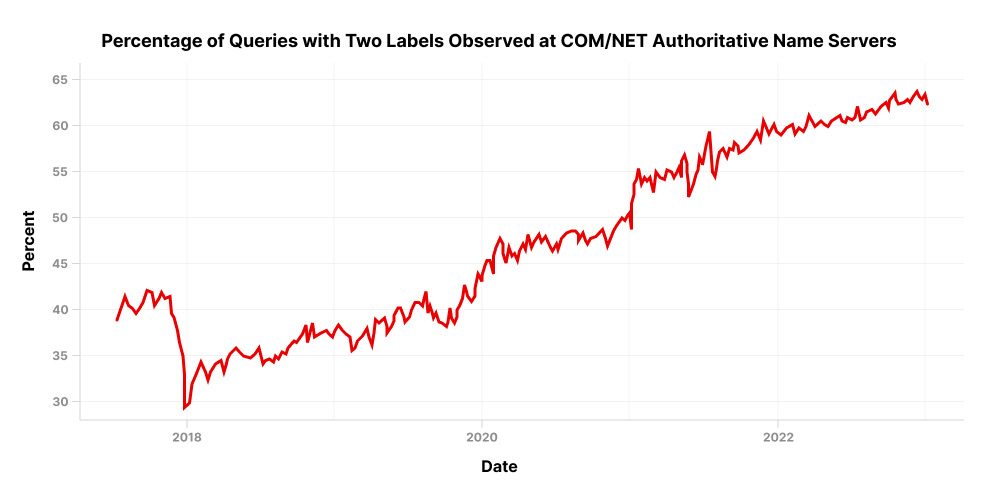
Graph showing percentage of queries with two labels observed at COM/NET authoritative name servers
Figure 1: A domain name consists of one or more labels. For instance, www.example.com consists of three labels: “www”, “example”, and “com”. This chart suggests that more and more recursive resolvers have implemented qname minimization, which results in fewer queries for domain names with three or more labels. With qname minimization, the resolver would send “example.com,” with two labels, instead of “www.example.com” with all three.

Kaliski’s article, titled “Minimized DNS Resolution: Into the Penumbra,” explores several specific minimization techniques documented by the IETF, reports on their implementation status, and discusses the effects of their adoption on DNS measurement research. An expanded version of the article can be found on the Verisign website.

This piece is just one of the latest to demonstrate Verisign’s continued investment in research and standards development in the DNS ecosystem. As a company, we’re committed to helping shape the DNS of today and tomorrow, and we recognize this is only possible through ongoing contributions by dedicated members of the internet infrastructure community – including the team here at Verisign.

Read more about Verisign’s contributions to this area:

Query Name Minimization and Authoritative DNS Server Behavior – DNS-OARC Spring ’15 Workshop (presentation)

Minimum Disclosure: What Information Does a Name Server Need to Do Its Job? (blog)

Maximizing Qname Minimization: A New Chapter in DNS Protocol Evolution (blog)

A Balanced DNS Information Protection Strategy: Minimize at Root and TLD, Encrypt When Needed Elsewhere (blog)

Information Protection for the Domain Name System: Encryption and Minimization (blog)

The post Minimized DNS Resolution: Into the Penumbra appeared first on Verisign Blog.

☐ ☆ ✇ Naked Security

Morgan Stanley fined millions for selling off devices full of customer PII

By: Paul Ducklin — September 23rd 2022 at 14:07
Critical data on old disks always seems inaccessible if you really need it. But when you DON''T want it back, guess what happens...

☐ ☆ ✇ Naked Security

S3 Ep99: TikTok “attack” – was there a data breach, or not? [Audio + Text]

By: Paul Ducklin — September 8th 2022 at 13:21
Latest episode - listen now! (Or read if you prefer - full transcript inside.)

☐ ☆ ✇ Naked Security

Peter Eckersley, co-creator of Let’s Encrypt, dies at just 43

By: Paul Ducklin — September 4th 2022 at 00:50
This site, like millions of others, has a certificate from Let's Encrypt. Farewell, Peter Eckersley, PhD, who helped make it all possible.

☐ ☆ ✇ Verisign Blog

Industry Insights: RDAP Becomes Internet Standard

By: Scott Hollenbeck — September 16th 2021 at 15:20
Technical header image of code

This article originally appeared in The Domain Name Industry Brief (Volume 18, Issue 3)

Earlier this year, the Internet Engineering Task Force’s (IETF’s) Internet Engineering Steering Group (IESG) announced that several Proposed Standards related to the Registration Data Access Protocol (RDAP), including three that I co-authored, were being promoted to the prestigious designation of Internet Standard. Initially accepted as proposed standards six years ago, RFC 7480, RFC 7481, RFC 9082 and RFC 9083 now comprise the new Standard 95. RDAP allows users to access domain registration data and could one day replace its predecessor the WHOIS protocol. RDAP is designed to address some widely recognized deficiencies in the WHOIS protocol and can help improve the registration data chain of custody.

In the discussion that follows, I’ll look back at the registry data model, given the evolution from WHOIS to the RDAP protocol, and examine how the RDAP protocol can help improve upon the more traditional, WHOIS-based registry models.

Registration Data Directory Services Evolution, Part 1: The WHOIS Protocol

In 1998, Network Solutions was responsible for providing both consumer-facing registrar and back-end registry functions for the legacy .com, .net and .org generic top-level domains (gTLDs). Network Solutions collected information from domain name registrants, used that information to process domain name registration requests, and published both collected data and data derived from processing registration requests (such as expiration dates and status values) in a public-facing directory service known as WHOIS.

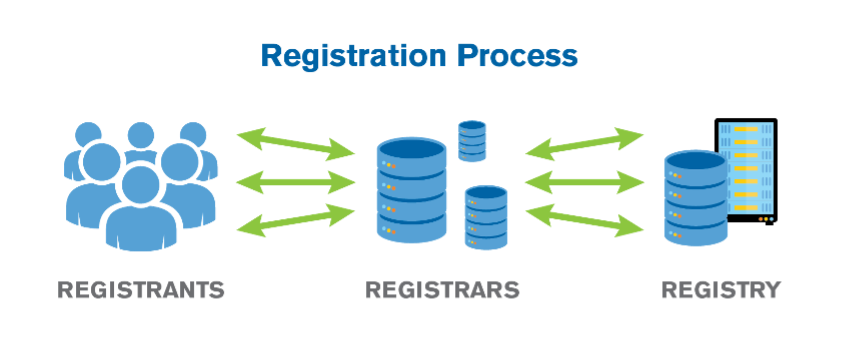
From Network Solution’s perspective as the registry, the chain of custody for domain name registration data involved only two parties: the registrant (or their agent) and Network Solutions. With the introduction of a Shared Registration System (SRS) in 1999, multiple registrars began to compete for domain name registration business by using the registry services operated by Network Solutions. The introduction of additional registrars and the separation of registry and registrar functions added parties to the chain of custody of domain name registration data. Information flowed from the registrant, to the registrar, and then to the registry, typically crossing multiple networks and jurisdictions, as depicted in Figure 1.

Flowchart of registration process. Information flowed from the registrant, to the registrar, and then to the registry.
Figure 1. Flow of information in early data registration process.

Registration Data Directory Services Evolution, Part 2: The RDAP Protocol

Over time, new gTLDs and new registries came into existence, new WHOIS services (with different output formats) were launched, and countries adopted new laws and regulations focused on protecting the personal information associated with domain name registration data. As time progressed, it became clear that WHOIS lacked several needed features, such as:

  • Standardized command structures
  • Output and error structures
  • Support for internationalization and localization
  • User identification
  • Authentication and access control

The IETF made multiple attempts to add features to WHOIS to address some of these issues, but none of them were widely adopted. A possible replacement protocol known as the Internet Registry Information Service (IRIS) was standardized in 2005, but it was not widely adopted. Something else was needed, and the IETF went back to work to produce what became known as RDAP.

RDAP was specified in a series of five IETF Proposed Standard RFC documents, including the following, all of which were published in March 2015:

  • RFC 7480, HTTP Usage in the Registration Data Access Protocol (RDAP)
  • RFC 7481, Security Services for the Registration Data Access Protocol (RDAP)
  • RFC 7482, Registration Data Access Protocol (RDAP) Query Format
  • RFC 7483, JSON Responses for the Registration Data Access Protocol (RDAP)
  • RFC 7484, Finding the Authoritative Registration Data (RDAP) Service

Only when RDAP was standardized did we start to see broad deployment of a possible WHOIS successor by domain name registries, domain name registrars and address registries.

The broad deployment of RDAP led to RFCs 7480 and 7481 becoming Internet Standard RFCs (part of Internet Standard 95) without modification in March 2021. As operators of registration data directory services implemented and deployed RDAP, they found places in the other specifications where minor corrections and clarifications were needed without changing the protocol itself. RFC 7482 was updated to become Internet Standard RFC 9082, which was published in June 2021. RFC 7483 was updated to become Internet Standard RFC 9083, which was also published in June 2021. All were added to Standard 95. As of the writing of this article, RFC 7484 is in the process of being reviewed and updated for elevation to Internet Standard status.

RDAP Advantages

Operators of registration data directory services who implemented RDAP can take advantage of key features not available in the WHOIS protocol. I’ve highlighted some of these important features in the table below.

RDAP Feature Benefit
Standard, well-understood, and widely available HTTP transport Relatively easy to implement, deploy and operate using common web service tools, infrastructure and applications.
Securable via HTTPS Helps provide confidentiality for RDAP queries and responses, reducing the amount of information that is disclosed to monitors.
Structured output in JavaScript Object Notation (JSON) JSON is well-understood and tool friendly, which makes it easier for clients to parse and format responses from all servers without the need for software that’s customized for different service providers.
Easily extensible Designed to support the addition of new features without breaking existing implementations. This makes it easier to address future function needs with less risk of implementation incompatibility.
Internationalized output, with full support for Unicode character sets Allows implementations to provide human-readable inputs and outputs that are represented in a language appropriate to the local operating environment.
Referral capability, leveraging HTTP constructs Provides information to software clients that allow the client to retrieve additional information from other RDAP servers. This can be used to hide complexity from human users.
Support of standardized authentication RDAP can take full advantage of all of the client identification, authentication and authorization methods that are available to web services. This means that RDAP can be used to provide the basic framework for differentiated access to registration data based on attributes associated with the user and the user’s query.

Verisign and RDAP

Verisign’s RDAP service, which was originally launched as an experimental implementation several years before gaining widespread adoption, allows users to look up records in the registry database for all registered .com, .net, .name, .cc and .tv domain names. It also supports Internationalized Domain Names (IDNs).

We at Verisign were pleased not only to see the IETF recognize the importance of RDAP by elevating it to an Internet Standard, but also that the protocol became a requirement for ICANN-accredited registrars and registries as of August 2019. Widespread implementation of the RDAP protocol makes registration data more secure, stable and resilient, and we are hopeful that the community will evolve the prescribed implementation of RDAP such that the full power of this rich protocol will be deployed.

You can learn more in the RDAP Help section of the Verisign website, and access helpful documents such as the RDAP technical implementation guide and the RDAP response profile.

The post Industry Insights: RDAP Becomes Internet Standard appeared first on Verisign Blog.

☐ ☆ ✇ Verisign Blog

Information Protection for the Domain Name System: Encryption and Minimization

By: Burt Kaliski — January 27th 2021 at 16:01

This is the final in a multi-part series on cryptography and the Domain Name System (DNS).

In previous posts in this series, I’ve discussed a number of applications of cryptography to the DNS, many of them related to the Domain Name System Security Extensions (DNSSEC).

In this final blog post, I’ll turn attention to another application that may appear at first to be the most natural, though as it turns out, may not always be the most necessary: DNS encryption. (I’ve also written about DNS encryption as well as minimization in a separate post on DNS information protection.)

DNS Encryption

In 2014, the Internet Engineering Task Force (IETF) chartered the DNS PRIVate Exchange (dprive) working group to start work on encrypting DNS queries and responses exchanged between clients and resolvers.

That work resulted in RFC 7858, published in 2016, which describes how to run the DNS protocol over the Transport Layer Security (TLS) protocol, also known as DNS over TLS, or DoT.

DNS encryption between clients and resolvers has since gained further momentum, with multiple browsers and resolvers supporting DNS over Hypertext Transport Protocol Security (HTTPS), or DoH, with the formation of the Encrypted DNS Deployment Initiative, and with further enhancements such as oblivious DoH.

The dprive working group turned its attention to the resolver-to-authoritative exchange during its rechartering in 2018. And in October of last year, ICANN’s Office of the CTO published its strategy recommendations for the ICANN-managed Root Server (IMRS, i.e., the L-Root Server), an effort motivated in part by concern about potential “confidentiality attacks” on the resolver-to-root connection.

From a cryptographer’s perspective the prospect of adding encryption to the DNS protocol is naturally quite interesting. But this perspective isn’t the only one that matters, as I’ve observed numerous times in previous posts.

Balancing Cryptographic and Operational Considerations

A common theme in this series on cryptography and the DNS has been the question of whether the benefits of a technology are sufficient to justify its cost and complexity.

This question came up not only in my review of two newer cryptographic advances, but also in my remarks on the motivation for two established tools for providing evidence that a domain name doesn’t exist.

Recall that the two tools — the Next Secure (NSEC) and Next Secure 3 (NSEC3) records — were developed because a simpler approach didn’t have an acceptable risk / benefit tradeoff. In the simpler approach, to provide a relying party assurance that a domain name doesn’t exist, a name server would return a response, signed with its private key, “<name> doesn’t exist.”

From a cryptographic perspective, the simpler approach would meet its goal: a relying party could then validate the response with the corresponding public key. However, the approach would introduce new operational risks, because the name server would now have to perform online cryptographic operations.

The name server would not only have to protect its private key from compromise, but would also have to protect the cryptographic operations from overuse by attackers. That could open another avenue for denial-of-service attacks that could prevent the name server from responding to legitimate requests.

The designers of DNSSEC mitigated these operational risks by developing NSEC and NSEC3, which gave the option of moving the private key and the cryptographic operations offline, into the name server’s provisioning system. Cryptography and operations were balanced by this better solution. The theme is now returning to view through the recent efforts around DNS encryption.

Like the simpler initial approach for authentication, DNS encryption may meet its goal from a cryptographic perspective. But the operational perspective is important as well. As designers again consider where and how to deploy private keys and cryptographic operations across the DNS ecosystem, alternatives with a better balance are a desirable goal.

Minimization Techniques

In addition to encryption, there has been research into other, possibly lower-risk alternatives that can be used in place of or in addition to encryption at various levels of the DNS.

We call these techniques collectively minimization techniques.

Qname Minimization

In “textbook” DNS resolution, a resolver sends the same full domain name to a root server, a top-level domain (TLD) server, a second-level domain (SLD) server, and any other server in the chain of referrals, until it ultimately receives an authoritative answer to a DNS query.

This is the way that DNS resolution has been practiced for decades, and it’s also one of the reasons for the recent interest in protecting information on the resolver-to-authoritative exchange: The full domain name is more information than all but the last name server needs to know.

One such minimization technique, known as qname minimization, was identified by Verisign researchers in 2011 and documented in RFC 7816 in 2016. (In 2015, Verisign announced a royalty-free license to its qname minimization patents.)

With qname minimization, instead of sending the full domain name to each name server, the resolver sends only as much as the name server needs either to answer the query or to refer the resolver to a name server at the next level. This follows the principle of minimum disclosure: the resolver sends only as much information as the name server needs to “do its job.” As Matt Thomas described in his recent blog post on the topic, nearly half of all .com and .net queries received by Verisign’s .com TLD servers were in a minimized form as of August 2020.

Additional Minimization Techniques

Other techniques that are part of this new chapter in DNS protocol evolution include NXDOMAIN cut processing [RFC 8020] and aggressive DNSSEC caching [RFC 8198]. Both leverage information present in the DNS to reduce the amount and sensitivity of DNS information exchanged with authoritative name servers. In aggressive DNSSEC caching, for example, the resolver analyzes NSEC and NSEC3 range proofs obtained in response to previous queries to determine on its own whether a domain name doesn’t exist. This means that the resolver doesn’t always have to ask the authoritative server system about a domain name it hasn’t seen before.

All of these techniques, as well as additional minimization alternatives I haven’t mentioned, have one important common characteristic: they only change how the resolver operates during the resolver-authoritative exchange. They have no impact on the authoritative name server or on other parties during the exchange itself. They thereby mitigate disclosure risk while also minimizing operational risk.

The resolver’s exchanges with authoritative name servers, prior to minimization, were already relatively less sensitive because they represented aggregate interests of the resolver’s many clients1. Minimization techniques lower the sensitivity even further at the root and TLD levels: the resolver sends only its aggregate interests in TLDs to root servers, and only its interests in SLDs to TLD servers. The resolver still sends the aggregate interests in full domain names at the SLD level and below2, and may also include certain client-related information at these levels, such as the client-subnet extension. The lower levels therefore may have different protection objectives than the upper levels.

Conclusion

Minimization techniques and encryption together give DNS designers additional tools for protecting DNS information — tools that when deployed carefully can balance between cryptographic and operational perspectives.

These tools complement those I’ve described in previous posts in this series. Some have already been deployed at scale, such as a DNSSEC with its NSEC and NSEC3 non-existence proofs. Others are at various earlier stages, like NSEC5 and tokenized queries, and still others contemplate “post-quantum” scenarios and how to address them. (And there are yet other tools that I haven’t covered in this series, such as authenticated resolution and adaptive resolution.)

Modern cryptography is just about as old as the DNS. Both have matured since their introduction in the late 1970s and early 1980s respectively. Both bring fundamental capabilities to our connected world. Both continue to evolve to support new applications and to meet new security objectives. While they’ve often moved forward separately, as this blog series has shown, there are also opportunities for them to advance together. I look forward to sharing more insights from Verisign’s research in future blog posts.

Read the complete six blog series:

  1. The Domain Name System: A Cryptographer’s Perspective
  2. Cryptographic Tools for Non-Existence in the Domain Name System: NSEC and NSEC3
  3. Newer Cryptographic Advances for the Domain Name System: NSEC5 and Tokenized Queries
  4. Securing the DNS in a Post-Quantum World: New DNSSEC Algorithms on the Horizon
  5. Securing the DNS in a Post-Quantum World: Hash-Based Signatures and Synthesized Zone Signing Keys
  6. Information Protection for the Domain Name System: Encryption and Minimization

1. This argument obviously holds more weight for large resolvers than for small ones — and doesn’t apply for the less common case of individual clients running their own resolvers. However, small resolvers and individual clients seeking additional protection retain the option of sending sensitive queries through a large, trusted resolver, or through a privacy-enhancing proxy. The focus in our discussion is primarily on large resolvers.

2. In namespaces where domain names are registered at the SLD level, i.e., under an effective TLD, the statements in this note about “root and TLD” and “SLD level and below” should be “root through effective TLD” and “below effective TLD level.” For simplicity, I’ve placed the “zone cut” between TLD and SLD in this note.

Minimization et al. techniques and encryption together give DNS designers additional tools for protecting DNS information — tools that when deployed carefully can balance between cryptographic and operational perspectives.

The post Information Protection for the Domain Name System: Encryption and Minimization appeared first on Verisign Blog.


❌