 Login
Login


The chairman of the Federal Trade Commission (FTC) last week sent a letter to Google’s CEO demanding to know why Gmail was blocking messages from Republican senders while allegedly failing to block similar missives supporting Democrats. The letter followed media reports accusing Gmail of disproportionately flagging messages from the GOP fundraising platform WinRed and sending them to the spam folder. But according to experts who track daily spam volumes worldwide, WinRed’s messages are getting blocked more because its methods of blasting email are increasingly way more spammy than that of ActBlue, the fundraising platform for Democrats.
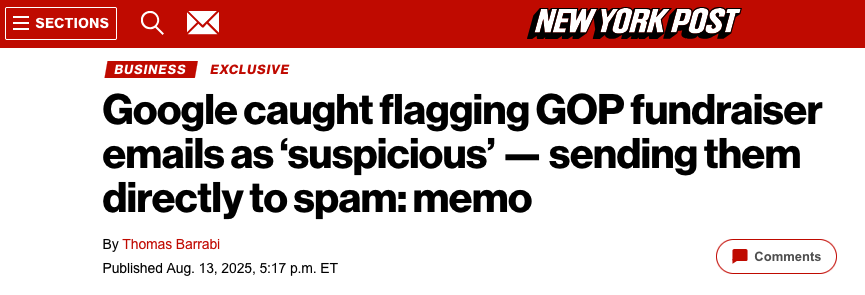
Image: nypost.com
On Aug. 13, The New York Post ran an “exclusive” story titled, “Google caught flagging GOP fundraiser emails as ‘suspicious’ — sending them directly to spam.” The story cited a memo from Targeted Victory – whose clients include the National Republican Senatorial Committee (NRSC), Rep. Steve Scalise and Sen. Marsha Blackburn – which said it observed that the “serious and troubling” trend was still going on as recently as June and July of this year.
“If Gmail is allowed to quietly suppress WinRed links while giving ActBlue a free pass, it will continue to tilt the playing field in ways that voters never see, but campaigns will feel every single day,” the memo reportedly said.
In an August 28 letter to Google CEO Sundar Pichai, FTC Chairman Andrew Ferguson cited the New York Post story and warned that Gmail’s parent Alphabet may be engaging in unfair or deceptive practices.
“Alphabet’s alleged partisan treatment of comparable messages or messengers in Gmail to achieve political objectives may violate both of these prohibitions under the FTC Act,” Ferguson wrote. “And the partisan treatment may cause harm to consumers.”
However, the situation looks very different when you ask spam experts what’s going on with WinRed’s recent messaging campaigns. Atro Tossavainen and Pekka Jalonen are co-founders at Koli-Lõks OÜ, an email intelligence company in Estonia. Koli-Lõks taps into real-time intelligence about daily spam volumes by monitoring large numbers of “spamtraps” — email addresses that are intentionally set up to catch unsolicited emails.
Spamtraps are generally not used for communication or account creation, but instead are created to identify senders exhibiting spammy behavior, such as scraping the Internet for email addresses or buying unmanaged distribution lists. As an email sender, blasting these spamtraps over and over with unsolicited email is the fastest way to ruin your domain’s reputation online. Such activity also virtually ensures that more of your messages are going to start getting listed on spam blocklists that are broadly shared within the global anti-abuse community.
Tossavainen told KrebsOnSecurity that WinRed’s emails hit its spamtraps in the .com, .net, and .org space far more frequently than do fundraising emails sent by ActBlue. Koli-Lõks published a graph of the stark disparity in spamtrap activity for WinRed versus ActBlue, showing a nearly fourfold increase in spamtrap hits from WinRed emails in the final week of July 2025.
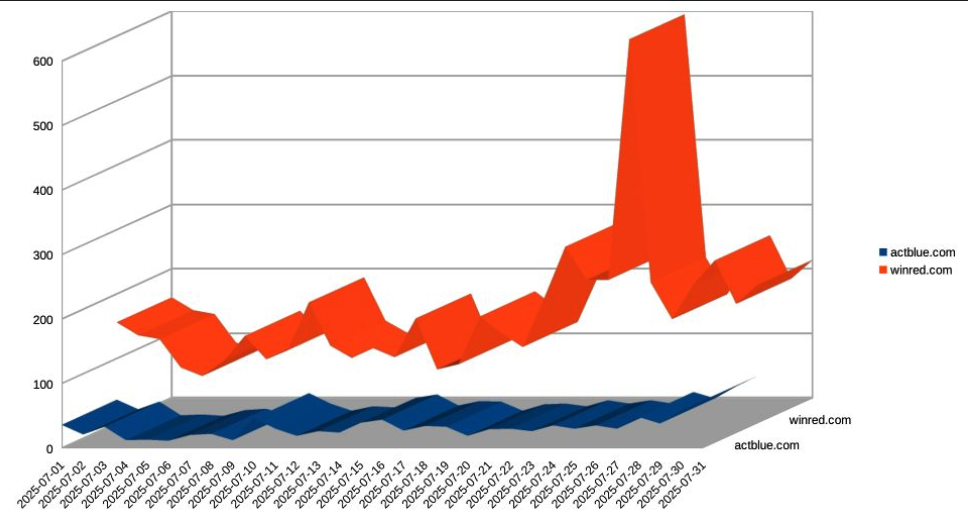
Image: Koliloks.eu
“Many of our spamtraps are in repurposed legacy-TLD domains (.com, .org, .net) and therefore could be understood to have been involved with a U.S. entity in their pre-zombie life,” Tossavainen explained in the LinkedIn post.
Raymond Dijkxhoorn is the CEO and a founding member of SURBL, a widely-used blocklist that flags domains and IP addresses known to be used in unsolicited messages, phishing and malware distribution. Dijkxhoorn said their spamtrap data mirrors that of Koli-Lõks, and shows that WinRed has consistently been far more aggressive in sending email than ActBlue.
Dijkxhoorn said the fact that WinRed’s emails so often end up dinging the organization’s sender reputation is not a content issue but rather a technical one.
“On our end we don’t really care if the content is political or trying to sell viagra or penis enlargements,” Dijkxhoorn said. “It’s the mechanics, they should not end up in spamtraps. And that’s the reason the domain reputation is tempered. Not ‘because domain reputation firms have a political agenda.’ We really don’t care about the political situation anywhere. The same as we don’t mind people buying penis enlargements. But when either of those land in spamtraps it will impact sending experience.”
The FTC letter to Google’s CEO also referenced a debunked 2022 study (PDF) by political consultants who found Google caught more Republican emails in spam filters. Techdirt editor Mike Masnick notes that while the 2022 study also found that other email providers caught more Democratic emails as spam, “Republicans laser-focused on Gmail because it fit their victimization narrative better.”
Masnick said GOP lawmakers then filed both lawsuits and complaints with the Federal Election Commission (both of which failed easily), claiming this was somehow an “in-kind contribution” to Democrats.
“This is political posturing designed to keep the White House happy by appearing to ‘do something’ about conservative claims of ‘censorship,'” Masnick wrote of the FTC letter. “The FTC has never policed ‘political bias’ in private companies’ editorial decisions, and for good reason—the First Amendment prohibits exactly this kind of government interference.”
WinRed did not respond to a request for comment.
The WinRed website says it is an online fundraising platform supported by a united front of the Trump campaign, the Republican National Committee (RNC), the NRSC, and the National Republican Congressional Committee (NRCC).
WinRed has recently come under fire for aggressive fundraising via text message as well. In June, 404 Media reported on a lawsuit filed by a family in Utah against the RNC for allegedly bombarding their mobile phones with text messages seeking donations after they’d tried to unsubscribe from the missives dozens of times.
One of the family members said they received 27 such messages from 25 numbers, even after sending 20 stop requests. The plaintiffs in that case allege the texts from WinRed and the RNC “knowingly disregard stop requests and purposefully use different phone numbers to make it impossible to block new messages.”
Dijkxhoorn said WinRed did inquire recently about why some of its assets had been marked as a risk by SURBL, but he said they appeared to have zero interest in investigating the likely causes he offered in reply.
“They only replied with, ‘You are interfering with U.S. elections,'” Dijkxhoorn said, noting that many of SURBL’s spamtrap domains are only publicly listed in the registration records for random domain names.
“They’re at best harvested by themselves but more likely [they] just went and bought lists,” he said. “It’s not like ‘Oh Google is filtering this and not the other,’ the reason isn’t the provider. The reason is the fundraising spammers and the lists they send to.”

At 49, Branden Spikes isn’t just one of the oldest technologists who has been involved in Elon Musk’s Department of Government Efficiency (DOGE). As the current director of information technology at X/Twitter and an early hire at PayPal, Zip2, Tesla and SpaceX, Spikes is also among Musk’s most loyal employees. Here’s a closer look at this trusted Musk lieutenant, whose Russian ex-wife was once married to Elon’s cousin.
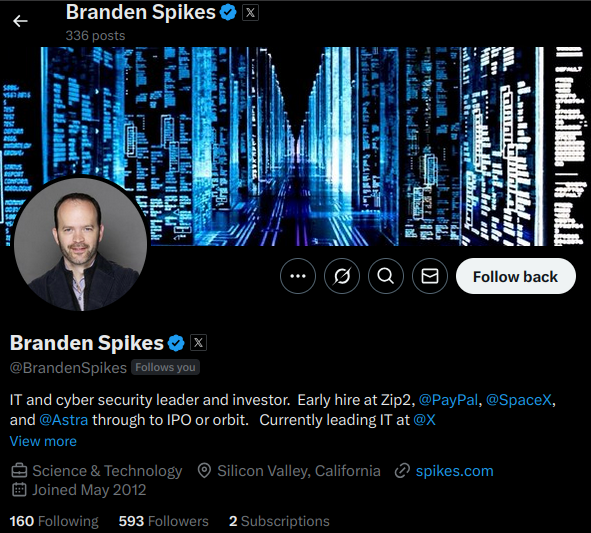
The profile of Branden Spikes on X.
When President Trump took office again in January, he put the world’s richest man — Elon Musk — in charge of the U.S. Digital Service, and renamed the organization as DOGE. The group is reportedly staffed by at least 50 technologists, many of whom have ties to Musk’s companies.
DOGE has been enabling the president’s ongoing mass layoffs and firings of federal workers, largely by seizing control over computer systems and government data for a multitude of federal agencies, including the Social Security Administration, the Department of Homeland Security, the Office of Personnel Management, and the Treasury Department.
It is difficult to find another person connected to DOGE who has stronger ties to Musk than Branden Spikes. A native of California, Spikes initially teamed up with Musk in 1997 as a lead systems engineer for the software company Zip2, the first major venture for Musk. In 1999, Spikes was hired as director of IT at PayPal, and in 2002 he became just the fourth person hired at SpaceX.
In 2012, Spikes launched Spikes Security, a software product that sought to create a compartmentalized or “sandboxed” web browser that could insulate the user from malware attacks. A review of spikes.com in the Wayback Machine shows that as far back as 1998, Musk could be seen joining Spikes for team matches in the online games Quake and Quake II. In 2016, Spikes Security was merged with another security suite called Aurionpro, with the combined company renamed Cyberinc.
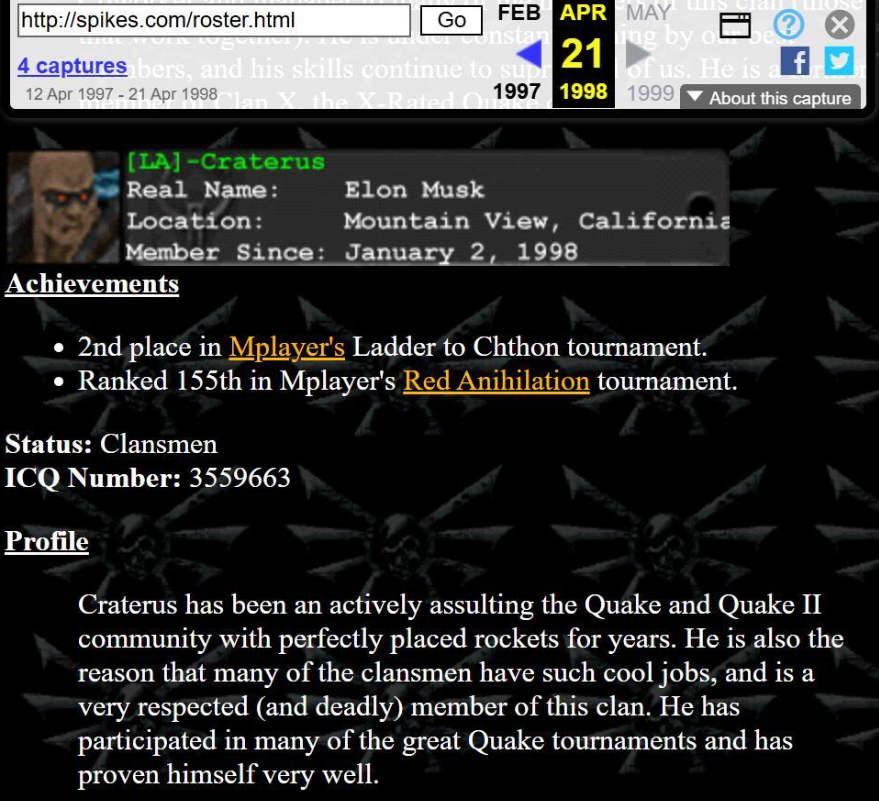
A snapshot of spikes.com from 1998 shows Elon Musk’s profile in Spike’s clan for the games Quake and Quake II.
Spikes’s LinkedIn profile says he was appointed head of IT at X in February 2025. And although his name shows up on none of the lists of DOGE employees circulated by various media outlets, multiple sources told KrebsOnSecurity that Spikes was working with DOGE and operates within Musk’s inner circle of trust.
In a conversation with KrebsOnSecurity, Spikes said he is dedicated to his country and to saving it from what he sees as certain ruin.
“Myself, I was raised by a southern conservative family in California and I strongly believe in America and her future,” Spikes said. “This is why I volunteered for two months in DC recently to help DOGE save us from certain bankruptcy.”
Spikes told KrebsOnSecurity that he recently decided to head back home and focus on his job as director of IT at X.
“I loved it, but ultimately I did not want to leave my hometown and family back in California,” Spikes said of his tenure at DOGE. “After a couple of months it became clear that to continue helping I would need to move to DC and commit a lot more time, so I politely bowed out.”
Prior to founding Spikes Security, Branden Spikes was married to a native Russian woman named Natalia whom he’d met at a destination wedding in South America in 2003.
Branden and Natalia’s names are both on the registration records for the domain name orangetearoom[.]com. This domain, which DomainTools.com says was originally registered by Branden in 2009, is the home of a tax-exempt charity in Los Angeles called the California Russian Association.
Here is a photo from a 2011 event organized by the California Russian Association, showing Branden and Natalia at one of its “White Nights” charity fundraisers:

Branden and Natalia Spikes, on left, in 2011. The man on the far right is Ivan Y. Podvalov, a board member of the Kremlin-aligned Congress of Russian Americans (CRA). The man in the center is Feodor Yakimoff, director of operations at the Transib Global Sourcing Group, and chairman of the Russian Imperial Charity Balls, which works in concert with the Russian Heritage Foundation.
In 2011, the Spikes couple got divorced, and Natalia changed her last name to Haldeman. That is not her maiden name, which appears to be “Libina.” Rather, Natalia acquired the surname Haldeman in 1998, when she married Elon Musk’s cousin.
Reeve Haldeman is the son of Scott Haldeman, who is the brother of Elon Musk’s mother, Maye Musk. Divorce records show Reeve and Natalia officially terminated their marriage in 2007. Reeve Haldeman did not respond to a request for comment.
A review of other domain names connected to Natalia Haldeman’s email address show she has registered more than a dozen domains over the years that are tied to the California Russian Association, and an apparently related entity called the Russian Heritage Foundation, Inc.:
russianamericans.org
russianamericanstoday.com
russianamericanstoday.org
russiancalifornia.org
russianheritagefoundation.com
russianheritagefoundation.org
russianwhitenights.com
russianwhitenights.org
theforafoundation.org
thegoldentearoom.com
therussianheritagefoundation.org
tsarinahome.com
Ms. Haldeman did not respond to requests for comment. Her name and contact information appears in the registration records for these domains dating back to 2010, and a document published by ProPublica show that by 2016 Natalia Haldeman was appointed CEO of the California Russian Foundation.
The domain name that bears both Branden’s and Natalia’s names — orangetearoom.com — features photos of Ms. Haldeman at fundraising events for the Russian foundation through 2014. Additional photos of her and many of the same people can be seen through 2023 at another domain she registered in 2010 — russianheritagefoundation.com.

A photo from Natalia Haldeman’s Facebook page shows her mother (left) pictured with Maye Musk, Elon Musk’s mother, in 2022.
The photo of Branden and Natalia above is from one such event in 2011 (tied to russianwhitenights.org, another Haldeman domain). The person on the right in that image — Ivan Y. Podvalov — appears in many fundraising event photos published by the foundation over the past decade. Podvalov is a board member of the Congress of Russian Americans (CRA), a nonprofit group that is known for vehemently opposing U.S. financial and legal sanctions against Russia.
Writing for The Insider in 2022, journalist Diana Fishman described how the CRA has engaged in outright political lobbying, noting that the organization in June 2014 sent a letter to President Obama and the secretary of the United Nations, calling for an end to the “large-scale US intervention in Ukraine and the campaign to isolate Russia.”
“The US military contingents must be withdrawn immediately from the Eastern European region, and NATO’s enlargement efforts and provocative actions against Russia must cease,” the message read.
The Insider said the CRA director sent another two letters, this time to President Donald Trump, in 2017 and 2018.
“One was a request not to sign a law expanding sanctions against Russia,” Fishman wrote. “The other regretted the expulsion of 60 Russian diplomats from the United States and urged not to jump to conclusions on Moscow’s involvement in the poisoning of Sergei Skripal.”
The nonprofit tracking website CauseIQ.com reports that The Russian Heritage Foundation, Inc. is now known as Constellation of Humanity.
The Russian Heritage Foundation and the California Russian Association both promote the interests of the Russian Orthodox Church. This page indexed by Archive.org from russiancalifornia.org shows The California Russian Foundation organized a community effort to establish an Orthodox church in Orange County, Calif.
A press release from the Russian Orthodox Church Outside of Russia (ROCOR) shows that in 2021 the Russian Heritage Foundation donated money to organize a conference for the Russian Orthodox Church in Serbia.
A review of the “Partners” listed on the Spikes’ jointly registered domain — orangetearoom.com — shows the organization worked with a marketing company called Russian American Media. Reporting by KrebsOnSecurity last year showed that Russian American Media also partners with the problematic people-search service Radaris, which was formed by two native Russian brothers in Massachusetts who have built a fleet of consumer data brokers and Russian affiliate programs.
When asked about his ex-wife’s history, Spikes said she has a good heart and bears no ill-will toward anyone.
“I attended several of Natalia’s social events over the years we were together and can assure you that she’s got the best intentions with those,” Spikes told KrebsOnSecurity. “There’s no funny business going on. It is just a way for those friendly immigrants to find resources amongst each other to help get settled in and chase the American dream. I mean, they’re not unlike the immigrants from other countries who come to America and try to find each other and help each other find others who speak the language and share in the building of their businesses here in America.”
Spikes said his own family roots go back deeply into American history, sharing that his 6th great grandfather was Alexander Hamilton on his mom’s side, and Jessie James on his dad’s side.
“My family roots are about as American as you can get,” he said. “I’ve also been entrusted with building and safeguarding Elon’s companies since 1999 and have a keen eye (as you do) for bad actors, so have enough perspective to tell you that Natalia has no bad blood and that she loves America.”
Of course, this perspective comes from someone who has the utmost regard for the interests of the “special government employee” Mr. Musk, who has been bragging about tossing entire federal agencies into the “wood chipper,” and who recently wielded an actual chainsaw on stage while referring to it as the “chainsaw for bureaucracy.”
“Elon’s intentions are good and you can trust him,” Spikes assured.
A special note of thanks for research assistance goes to Jacqueline Sweet, an independent investigative journalist whose work has been published in The Guardian, Rolling Stone, POLITICO and The Intercept.


sc-daa-1200


 FreshRSS