 Login
Login


The cybercriminals in control of Kimwolf — a disruptive botnet that has infected more than 2 million devices — recently shared a screenshot indicating they’d compromised the control panel for Badbox 2.0, a vast China-based botnet powered by malicious software that comes pre-installed on many Android TV streaming boxes. Both the FBI and Google say they are hunting for the people behind Badbox 2.0, and thanks to bragging by the Kimwolf botmasters we may now have a much clearer idea about that.
Our first story of 2026, The Kimwolf Botnet is Stalking Your Local Network, detailed the unique and highly invasive methods Kimwolf uses to spread. The story warned that the vast majority of Kimwolf infected systems were unofficial Android TV boxes that are typically marketed as a way to watch unlimited (pirated) movie and TV streaming services for a one-time fee.
Our January 8 story, Who Benefitted from the Aisuru and Kimwolf Botnets?, cited multiple sources saying the current administrators of Kimwolf went by the nicknames “Dort” and “Snow.” Earlier this month, a close former associate of Dort and Snow shared what they said was a screenshot the Kimwolf botmasters had taken while logged in to the Badbox 2.0 botnet control panel.
That screenshot, a portion of which is shown below, shows seven authorized users of the control panel, including one that doesn’t quite match the others: According to my source, the account “ABCD” (the one that is logged in and listed in the top right of the screenshot) belongs to Dort, who somehow figured out how to add their email address as a valid user of the Badbox 2.0 botnet.
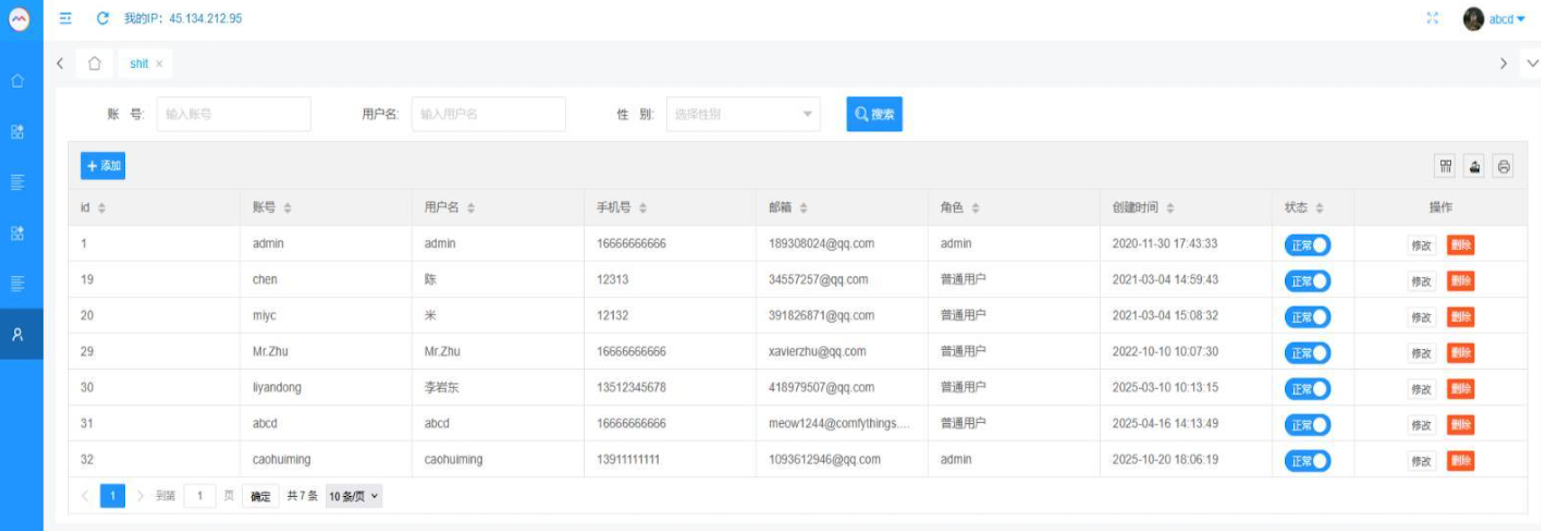
The control panel for the Badbox 2.0 botnet lists seven authorized users and their email addresses. Click to enlarge.
Badbox has a storied history that well predates Kimwolf’s rise in October 2025. In July 2025, Google filed a “John Doe” lawsuit (PDF) against 25 unidentified defendants accused of operating Badbox 2.0, which Google described as a botnet of over ten million unsanctioned Android streaming devices engaged in advertising fraud. Google said Badbox 2.0, in addition to compromising multiple types of devices prior to purchase, also can infect devices by requiring the download of malicious apps from unofficial marketplaces.
Google’s lawsuit came on the heels of a June 2025 advisory from the Federal Bureau of Investigation (FBI), which warned that cyber criminals were gaining unauthorized access to home networks by either configuring the products with malware prior to the user’s purchase, or infecting the device as it downloads required applications that contain backdoors — usually during the set-up process.
The FBI said Badbox 2.0 was discovered after the original Badbox campaign was disrupted in 2024. The original Badbox was identified in 2023, and primarily consisted of Android operating system devices (TV boxes) that were compromised with backdoor malware prior to purchase.
KrebsOnSecurity was initially skeptical of the claim that the Kimwolf botmasters had hacked the Badbox 2.0 botnet. That is, until we began digging into the history of the qq.com email addresses in the screenshot above.
An online search for the address 34557257@qq.com (pictured in the screenshot above as the user “Chen“) shows it is listed as a point of contact for a number of China-based technology companies, including:
–Beijing Hong Dake Wang Science & Technology Co Ltd.
–Beijing Hengchuang Vision Mobile Media Technology Co. Ltd.
–Moxin Beijing Science and Technology Co. Ltd.
The website for Beijing Hong Dake Wang Science is asmeisvip[.]net, a domain that was flagged in a March 2025 report by HUMAN Security as one of several dozen sites tied to the distribution and management of the Badbox 2.0 botnet. Ditto for moyix[.]com, a domain associated with Beijing Hengchuang Vision Mobile.
A search at the breach tracking service Constella Intelligence finds 34557257@qq.com at one point used the password “cdh76111.” Pivoting on that password in Constella shows it is known to have been used by just two other email accounts: daihaic@gmail.com and cathead@gmail.com.
Constella found cathead@gmail.com registered an account at jd.com (China’s largest online retailer) in 2021 under the name “陈代海,” which translates to “Chen Daihai.” According to DomainTools.com, the name Chen Daihai is present in the original registration records (2008) for moyix[.]com, along with the email address cathead@astrolink[.]cn.
Incidentally, astrolink[.]cn also is among the Badbox 2.0 domains identified in HUMAN Security’s 2025 report. DomainTools finds cathead@astrolink[.]cn was used to register more than a dozen domains, including vmud[.]net, yet another Badbox 2.0 domain tagged by HUMAN Security.
A cached copy of astrolink[.]cn preserved at archive.org shows the website belongs to a mobile app development company whose full name is Beijing Astrolink Wireless Digital Technology Co. Ltd. The archived website reveals a “Contact Us” page that lists a Chen Daihai as part of the company’s technology department. The other person featured on that contact page is Zhu Zhiyu, and their email address is listed as xavier@astrolink[.]cn.

A Google-translated version of Astrolink’s website, circa 2009. Image: archive.org.
Astute readers will notice that the user Mr.Zhu in the Badbox 2.0 panel used the email address xavierzhu@qq.com. Searching this address in Constella reveals a jd.com account registered in the name of Zhu Zhiyu. A rather unique password used by this account matches the password used by the address xavierzhu@gmail.com, which DomainTools finds was the original registrant of astrolink[.]cn.
The very first account listed in the Badbox 2.0 panel — “admin,” registered in November 2020 — used the email address 189308024@qq.com. DomainTools shows this email is found in the 2022 registration records for the domain guilincloud[.]cn, which includes the registrant name “Huang Guilin.”
Constella finds 189308024@qq.com is associated with the China phone number 18681627767. The open-source intelligence platform osint.industries reveals this phone number is connected to a Microsoft profile created in 2014 under the name Guilin Huang (桂林 黄). The cyber intelligence platform Spycloud says that phone number was used in 2017 to create an account at the Chinese social media platform Weibo under the username “h_guilin.”
The public information attached to Guilin Huang’s Microsoft account, according to the breach tracking service osintindustries.com.
The remaining three users and corresponding qq.com email addresses were all connected to individuals in China. However, none of them (nor Mr. Huang) had any apparent connection to the entities created and operated by Chen Daihai and Zhu Zhiyu — or to any corporate entities for that matter. Also, none of these individuals responded to requests for comment.
The mind map below includes search pivots on the email addresses, company names and phone numbers that suggest a connection between Chen Daihai, Zhu Zhiyu, and Badbox 2.0.
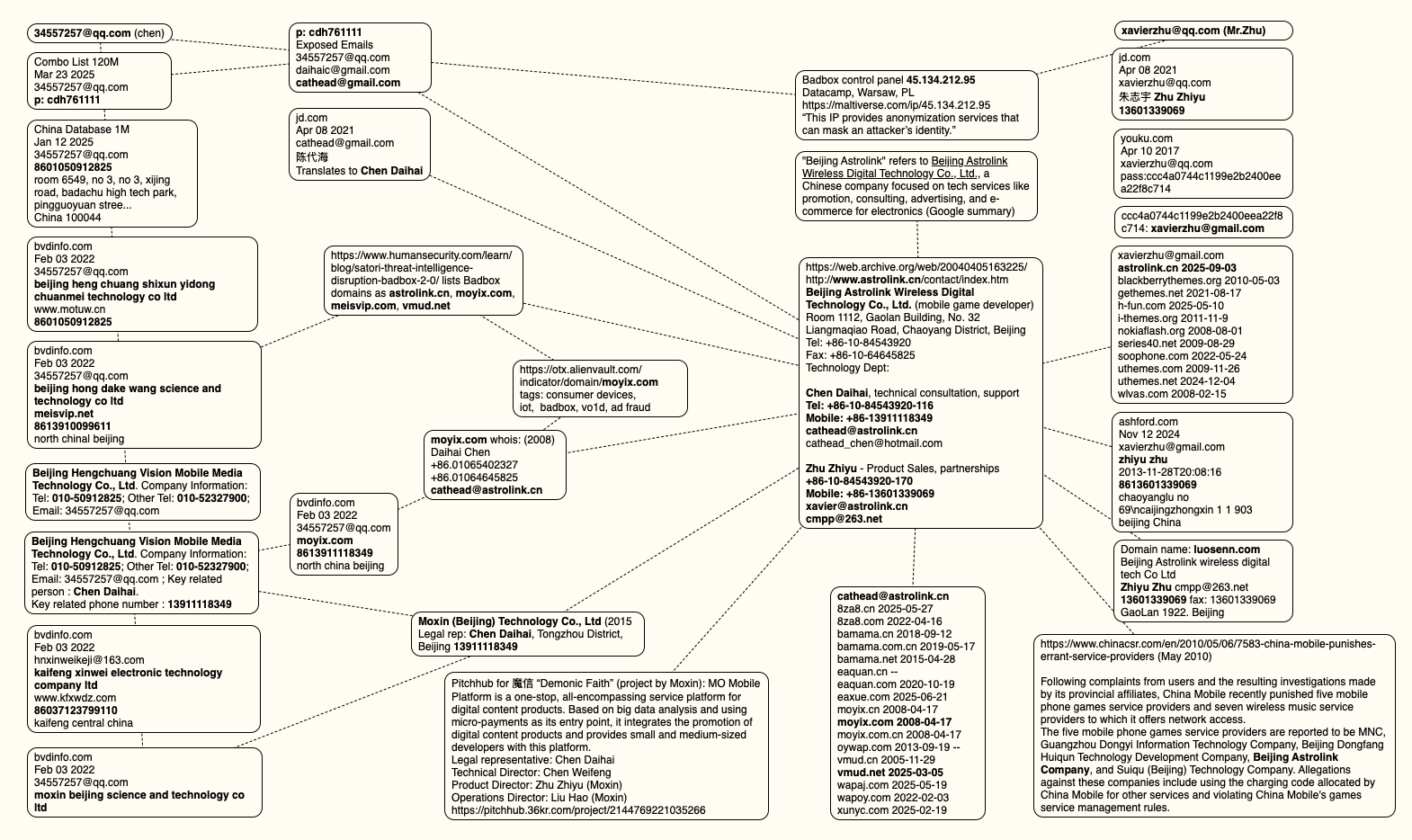
This mind map includes search pivots on the email addresses, company names and phone numbers that appear to connect Chen Daihai and Zhu Zhiyu to Badbox 2.0. Click to enlarge.
The idea that the Kimwolf botmasters could have direct access to the Badbox 2.0 botnet is a big deal, but explaining exactly why that is requires some background on how Kimwolf spreads to new devices. The botmasters figured out they could trick residential proxy services into relaying malicious commands to vulnerable devices behind the firewall on the unsuspecting user’s local network.
The vulnerable systems sought out by Kimwolf are primarily Internet of Things (IoT) devices like unsanctioned Android TV boxes and digital photo frames that have no discernible security or authentication built-in. Put simply, if you can communicate with these devices, you can compromise them with a single command.
Our January 2 story featured research from the proxy-tracking firm Synthient, which alerted 11 different residential proxy providers that their proxy endpoints were vulnerable to being abused for this kind of local network probing and exploitation.
Most of those vulnerable proxy providers have since taken steps to prevent customers from going upstream into the local networks of residential proxy endpoints, and it appeared that Kimwolf would no longer be able to quickly spread to millions of devices simply by exploiting some residential proxy provider.
However, the source of that Badbox 2.0 screenshot said the Kimwolf botmasters had an ace up their sleeve the whole time: Secret access to the Badbox 2.0 botnet control panel.
“Dort has gotten unauthorized access,” the source said. “So, what happened is normal proxy providers patched this. But Badbox doesn’t sell proxies by itself, so it’s not patched. And as long as Dort has access to Badbox, they would be able to load” the Kimwolf malware directly onto TV boxes associated with Badbox 2.0.
The source said it isn’t clear how Dort gained access to the Badbox botnet panel. But it’s unlikely that Dort’s existing account will persist for much longer: All of our notifications to the qq.com email addresses listed in the control panel screenshot received a copy of that image, as well as questions about the apparently rogue ABCD account.
 Article tags
Most accomplished cybercriminals go out of their way to separate their real names from their hacker handles. But among certain old-school Russian hackers it is not uncommon to find major players who have done little to prevent people from figuring out who they are in real life. A case study in this phenomenon is “x999xx,” the nickname chosen by a venerated Russian hacker who specializes in providing the initial network access to various ransomware groups.
x999xx is a well-known “access broker” who frequently sells access to hacked corporate networks — usually in the form of remote access credentials — as well as compromised databases containing large amounts of personal and financial data.
In an analysis published in February 2019, cyber intelligence firm Flashpoint called x999xx one of the most senior and prolific members of the top-tier Russian-language cybercrime forum Exploit, where x999xx could be seen frequently advertising the sale of stolen databases and network credentials.
In August 2023, x999xx sold access to a company that develops software for the real estate industry. In July 2023, x999xx advertised the sale of Social Security numbers, names, and birthdays for the citizenry of an entire U.S. state (unnamed in the auction).
A month earlier, x999xx posted a sales thread for 80 databases taken from Australia’s largest retail company. “You may use this data to demand a ransom or do something different with it,” x999xx wrote on Exploit. “Unfortunately, the flaw was patched fast. [+] no one has used the data yet [+] the data hasn’t been used to send spam [+] the data is waiting for its time.”
In October 2022, x999xx sold administrative access to a U.S. healthcare provider.
The oldest account by the name x999xx appeared in 2009 on the Russian language cybercrime forum Verified, under the email address maxnm@ozersk.com. Ozersk is a city in the Chelyabinsk region of west-central Russia.
According to the breach tracking service Constella Intelligence, the address maxnm@ozersk.com was used more than a decade ago to create an account at Vktontakte (the Russian answer to Facebook) under the name Maxim Kirtsov from Ozersk. Mr. Kirtsov’s profile — “maxnm” — says his birthday is September 5, 1991.
Personal photos Maxnm shared on Vktontakte in 2016. The caption has been machine translated from Russian.
The user x999xx registered on the Russian language cybercrime community Zloy in 2014 using the email address maxnmalias-1@yahoo.com. Constella says this email address was used in 2022 at the Russian shipping service cdek.ru by a Maksim Georgievich Kirtsov from Ozersk.
Additional searches on these contact details reveal that prior to 2009, x999xx favored the handle Maxnm on Russian cybercrime forums. Cyber intelligence company Intel 471 finds the user Maxnm registered on Zloy in 2006 from an Internet address in Chelyabinsk, using the email address kirtsov@telecom.ozersk.ru.
That same email address was used to create Maxnm accounts on several other crime forums, including Spamdot and Exploit in 2005 (also from Chelyabinsk), and Damagelab in 2006.
A search in Constella for the Russian version of Kirtsov’s full name — Кирцов Максим Георгиевич — brings up multiple accounts registered to maksya@icloud.com.
A review of the digital footprint for maksya@icloud.com at osint.industries reveals this address was used a decade ago to register a still-active account at imageshack.com under the name x999xx. That account features numerous screenshots of financial statements from various banks, chat logs with other hackers, and even hacked websites.
x999xx’s Imageshack account includes screenshots of bank account balances from dozens of financial institutions, as well as chat logs with other hackers and pictures of homegrown weed.
Some of the photos in that Imageshack account also appear on Kirtsov’s Vkontakte page, including images of vehicles he owns, as well as pictures of potted marijuana plants. Kirtsov’s Vkontakte profile says that in 2012 he was a faculty member of the Ozersk Technological Institute National Research Nuclear University.
The Vkontakte page lists Kirtsov’s occupation as a website called ozersk[.]today, which on the surface appears to be a blog about life in Ozersk. However, in 2019 the security firm Recorded Future published a blog post which found this domain was being used to host a malicious Cobalt Strike server.
Cobalt Strike is a commercial network penetration testing and reconnaissance tool that is sold only to vetted partners. But stolen or ill-gotten Cobalt Strike licenses are frequently abused by cybercriminal gangs to help lay the groundwork for the installation of ransomware on a victim network.
In August 2023, x999xx posted a message on Exploit saying he was interested in buying a licensed version of Cobalt Strike. A month earlier, x999xx filed a complaint on Exploit against another forum member named Cobaltforce, an apparent onetime partner whose sudden and prolonged disappearance from the community left x999xx and others in the lurch. Cobaltforce recruited people experienced in using Cobalt Strike for ransomware operations, and offered to monetize access to hacked networks for a share of the profits.
DomainTools.com finds ozersk[.]today was registered to the email address dashin2008@yahoo.com, which also was used to register roughly two dozen other domains, including x999xx[.]biz. Virtually all of those domains were registered to Maxim Kirtsov from Ozersk. Below is a mind map used to track the identities mentioned in this story.
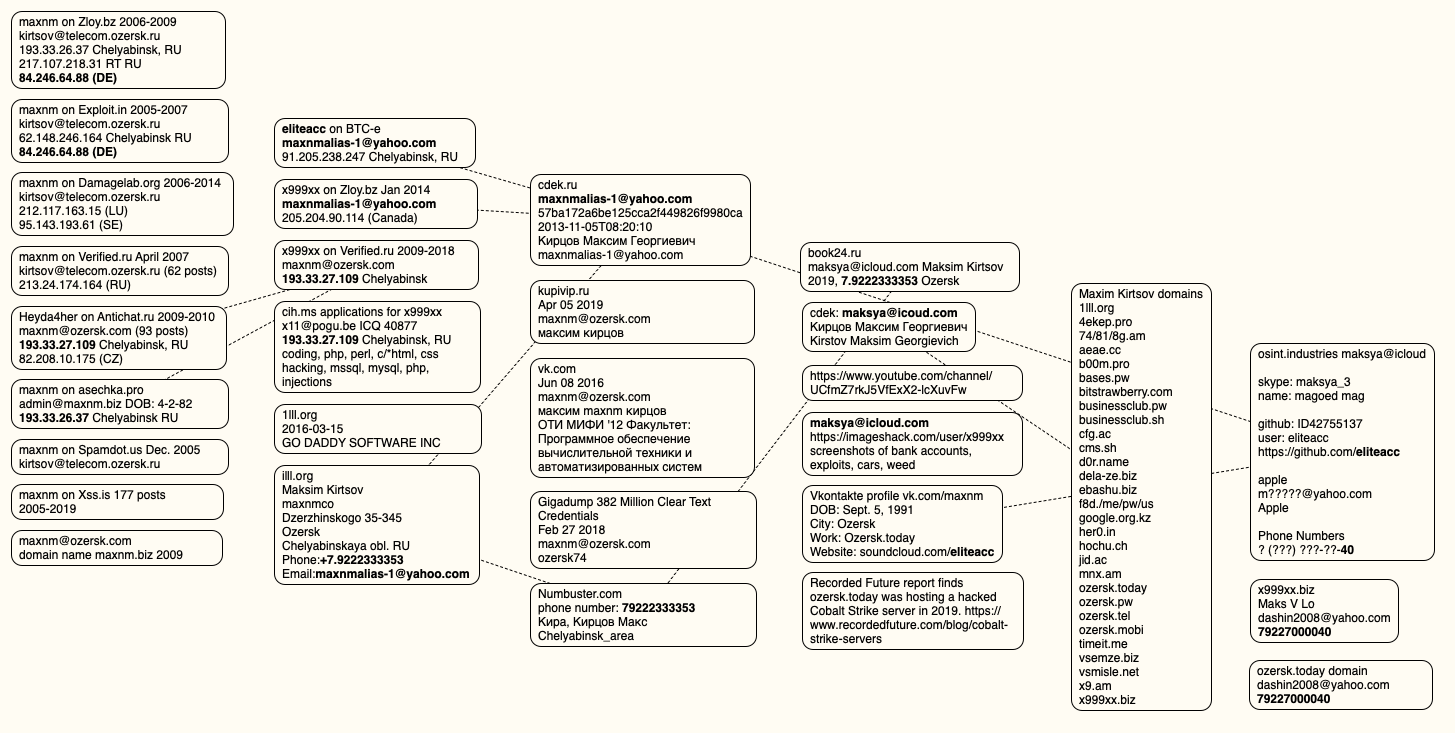
A visual depiction of the data points connecting x999xx to Max Kirtsov.
x999xx is a prolific member of the Russian webmaster forum “Gofuckbiz,” with more than 2,000 posts over nearly a decade, according to Intel 471. In one post from 2016, x999xx asked whether anyone knew where he could buy a heat lamp that simulates sunlight, explaining that one his pet rabbits had recently perished for lack of adequate light and heat. Mr. Kirtsov’s Vkontakte page includes several pictures of caged rabbits from 2015 and earlier.
Reached via email, Mr. Kirtsov acknowledged that he is x999xx. Kirtsov said he and his team are also regular readers of KrebsOnSecurity.
“We’re glad to hear and read you,” Kirtsov replied.
Asked whether he was concerned about the legal and moral implications of his work, Kirtsov downplayed his role in ransomware intrusions, saying he was more focused on harvesting data.
“I consider myself as committed to ethical practices as you are,” Kirtsov wrote. “I have also embarked on research and am currently mentoring students. You may have noticed my activities on a forum, which I assume you know of through information gathered from public sources, possibly using the new tool you reviewed.”
“Regarding my posts about selling access, I must honestly admit, upon reviewing my own actions, I recall such mentions but believe they were never actualized,” he continued. “Many use the forum for self-serving purposes, which explains why listings of targets for sale have dwindled — they simply ceased being viable.”
Kirtsov asserted that he is not interested in harming healthcare institutions, just in stealing their data.
“As for health-related matters, I was once acquainted with affluent webmasters who would pay up to $50 for every 1000 health-themed emails,” Kirtsov said. “Therefore, I had no interest in the more sensitive data from medical institutions like X-rays, insurance numbers, or even names; I focused solely on emails. I am proficient in SQL, hence my ease with handling data like IDs and emails. And i never doing spam or something like this.”
On the Russian crime forums, x999xx said he never targets anything or anyone in Russia, and that he has little to fear from domestic law enforcement agencies provided he remains focused on foreign adversaries.
x999xx’s lackadaisical approach to personal security mirrors that of Wazawaka, another top Russian access broker who sold access to countless organizations and even operated his own ransomware affiliate programs.
“Don’t shit where you live, travel local, and don’t go abroad,” Wazawaka said of his own personal mantra. “Mother Russia will help you. Love your country, and you will always get away with everything.”
In January 2022, KrebsOnSecurity followed clues left behind by Wazawaka to identify him as 32-year-old Mikhail Matveev from Khakassia, Russia. In May 2023, the U.S. Department of Justice indicted Matveev as a key figure in several ransomware groups that collectively extorted hundreds of millions of dollars from victim organizations. The U.S. State Department is offering a $10 million reward for information leading to the capture and/or prosecution of Matveev.
Perhaps in recognition that many top ransomware criminals are largely untouchable so long as they remain in Russia, western law enforcement agencies have begun focusing more on getting inside the heads of those individuals. These so-called “psyops” are aimed at infiltrating ransomware-as-a-service operations, disrupting major cybercrime services, and decreasing trust within cybercriminal communities.
When authorities in the U.S. and U.K. announced in February 2024 that they’d infiltrated and seized the infrastructure used by the infamous LockBit ransomware gang, they borrowed the existing design of LockBit’s victim shaming website to link instead to press releases about the takedown, and included a countdown timer that was eventually replaced with the personal details of LockBit’s alleged leader.
In May 2024, law enforcement agencies in the United States and Europe announced Operation Endgame, a coordinated action against some of the most popular cybercrime platforms for delivering ransomware and data-stealing malware. The Operation Endgame website also included a countdown timer, which served to tease the release of several animated videos that mimic the same sort of flashy, short advertisements that established cybercriminals often produce to promote their services online.
Article tags


 FreshRSS